How to Avoid Roaming Charges Overseas
Learn how to avoid roaming charges overseas with simple setup tips, smarter data choices, and travel-ready options before you land abroad.
When you’re heading abroad, the last thing you want is to come home to a shocking mobile bill. For most travelers, an eSIM is going to be your most cost-effective option, often by a long shot.
The fundamental difference comes down to how you pay. Verizon’s TravelPass locks you into a fixed daily fee of around $10, whereas a travel eSIM lets you buy flexible, prepaid data packages. You simply buy what you need for your trip, which almost always leads to significant savings.
Not long ago, using your phone overseas was a recipe for disaster, usually involving confusing plans and eye-watering roaming charges. Thankfully, things are much simpler now. You have two main choices: stick with your home provider’s roaming plan, like Verizon TravelPass, or switch to a modern travel eSIM for your data needs. The goal is the same: stay connected without breaking the bank.
Verizon TravelPass is built for convenience. It’s a feature you add to your plan that lets you use your normal data, call, and text allowances in over 210 countries for a flat daily rate. The catch? That daily fee kicks in the second your phone connects abroad—even if it’s just an app refreshing in the background.
A travel eSIM, on the other hand, is a digital SIM you download to your phone. This technology lets you buy affordable local data plans from providers like TapSim before you even pack your bags. You might buy a 10 GB plan that’s valid for 14 days in Europe, giving you total control over what you spend. It’s this pay-for-what-you-need approach that makes the Verizon TravelPass vs eSIM cost comparison so one-sided for anyone watching their budget.
To really see the difference, a side-by-side look makes it clear. This table cuts through the noise and shows the core trade-offs you’re making between the “set-it-and-forget-it” daily fee and a more flexible prepaid data plan.
| Feature | Verizon TravelPass | Travel eSIM |
|---|---|---|
| Pricing Model | Fixed daily fee ($10) when used abroad. | One-time, prepaid cost for a data package. |
| Cost Control | Less control; daily fee triggers automatically. | High control; pay only for the data you need. |
| Best For | Very short trips (1–2 days) or convenience-focused users. | Trips longer than 3 days; budget-conscious travelers. |
| Activation | Automatic upon first use in a foreign country. | Manual installation via QR code before your trip. |
| Network Access | Uses Verizon’s designated roaming partners. | Connects to one or more local networks for a strong signal. |
Ultimately, your travel style dictates the best choice. While TravelPass is undeniably simple, an eSIM gives you the savings and flexibility that most modern travelers are looking for, letting you stay connected on your own terms.
Verizon’s TravelPass is built on a simple promise: use your phone abroad just like you do at home. It’s an add-on that lets you tap into your regular talk, text, and data allowance for a flat daily fee. For anyone who dreads fiddling with new SIM cards or confusing roaming packages, this sounds like a dream.
The service works in over 210 countries and regions. Once it’s enabled on your account, it just waits in the background. The moment you land, make a call, send a text, or let an app use data, a 24-hour TravelPass session kicks in, and the daily charge gets added to your bill.
This automatic trigger is a double-edged sword. It’s incredibly convenient, but it’s also easy to activate by accident. A single app refreshing in the background is all it takes to start the clock, so you need to be careful if you’re trying to avoid a charge on a particular day.
The heart of the TravelPass cost is its daily rate. It’s a straightforward fee-based system that can add up faster than you’d think, especially on longer trips. A week-long trip could easily mean seven separate daily charges, turning what seems like a small fee into a noticeable travel expense.
It’s also crucial to remember this is a “per day, per line” cost. If you’re traveling with family and everyone has TravelPass active, each person who uses their phone will trigger their own daily fee. This is where the Verizon TravelPass vs eSIM cost comparison really gets interesting for groups.
For example, a trip to Europe will set you back $10 per line, per day. A seven-day vacation where you use your phone daily could cost around $70 just in roaming fees, before any taxes are added. You can always check the latest rates for your destination on Verizon’s official website.
While TravelPass lets you use your domestic data, it isn’t an unlimited high-speed free-for-all. Verizon gives you a pretty generous daily high-speed data allowance—often 2GB—which is more than enough for most people’s mapping, browsing, and social media needs.
But here’s the catch: once you burn through that high-speed data, your connection slows to a crawl. You’ll be throttled down to much slower 3G speeds for the rest of that 24-hour session, which can make things like video calls or streaming a real test of patience.
This throttling is a key detail to be aware of. You won’t be cut off from the internet entirely, but the drop in speed can be a major headache if you’re relying on your phone for work or navigation. It’s a common tactic carriers use to manage costs, which you can learn more about by reading our guide on what roaming charges are and how to avoid them.
Traveler’s Tip: Watch out for automatic app updates and background data. They can trigger a TravelPass session and eat into your high-speed data allowance before you’ve even actively used your phone.
While Verizon’s TravelPass is a straightforward option, it often comes with a hefty price tag. For the savvy traveler, eSIMs offer a much more modern and flexible way to stay connected abroad, opening the door to serious cost savings and greater control.
At its heart, an eSIM (or embedded SIM) is simply a digital SIM card that’s already built into your phone. This clever bit of tech means you can add a new mobile data plan from a provider like TapSim without having to hunt down a local shop or fiddle with swapping out tiny plastic cards. It’s all done through software.
This completely changes the game for international travel. Instead of being locked into a fixed daily fee that kicks in the moment you use your phone, you get to choose exactly what you need, when you need it.
The real magic of a travel eSIM is the customization. You can browse and buy data plans online before you’ve even packed your bags, ensuring you’re connected the second your plane lands.
This flexibility is where you’ll find the biggest savings when comparing Verizon TravelPass vs. eSIM costs. You can tailor your data plan perfectly to your trip.
With a travel eSIM, you stop being a passive customer who just accepts a daily roaming charge. You’re the one in the driver’s seat, actively choosing the best and most affordable data plan for your journey.
Travel eSIMs work by connecting you directly to local mobile networks, so you get data at prices much closer to what the locals pay. This completely bypasses the expensive international roaming agreements that services like TravelPass rely on.
Compared to Verizon TravelPass, eSIM data plans are almost always a more flexible and significantly cheaper choice for travelers. For a trip to Europe, you can find data-only eSIM plans from as low as $5 for 1GB of data. This can slash your costs; a daily TravelPass rate of $10 could easily be cut in half, even for light use.
This direct-to-local model is precisely why a week-long holiday can end up costing a fraction of the price of daily roaming. You make a single, upfront purchase for a data bundle that lasts your whole trip, instead of racking up daily fees. To get a better sense of how this technology works, you can learn more about what an eSIM is and how it functions. With TapSim, you can browse plans for over 150 destinations, activate your data instantly, and travel with confidence, knowing you’re getting a fair, transparent price.
The real difference between Verizon TravelPass and a travel eSIM becomes glaringly obvious when you look at your bank statement post-trip. To properly compare the Verizon TravelPass vs eSIM cost, let’s run the numbers on a few typical trips and see how things stack up for different travel styles.
For these examples, we’ll use the standard $10 per day for TravelPass and some representative package costs from an eSIM provider like TapSim. Just remember, eSIM prices will shift a bit depending on your destination and how much data you need.
Picture a four-day trip to Rome. You’ll want data for Google Maps, uploading photos, booking tickets to the Colosseum, and hunting down the best cacio e pepe. You’re a light-to-moderate data user.
Right away, the savings are clear. You could pocket an extra $28-$32 just by choosing an eSIM—that’s a lot of extra gelato money.
Now, let’s imagine a 14-day, multi-country tour of Thailand and Vietnam. Here, you’ll lean on your data a lot more for ride-sharing apps, translations, video calls home, and researching your next stop. This is a classic moderate data user scenario.
The longer your trip, the more dramatic the savings become. For a two-week holiday, choosing an eSIM over TravelPass could easily save you over $115. That’s enough for a serious hotel upgrade or a few unforgettable excursions.
This is where the core benefits of an eSIM really shine: affordability, flexibility, and instant connectivity.
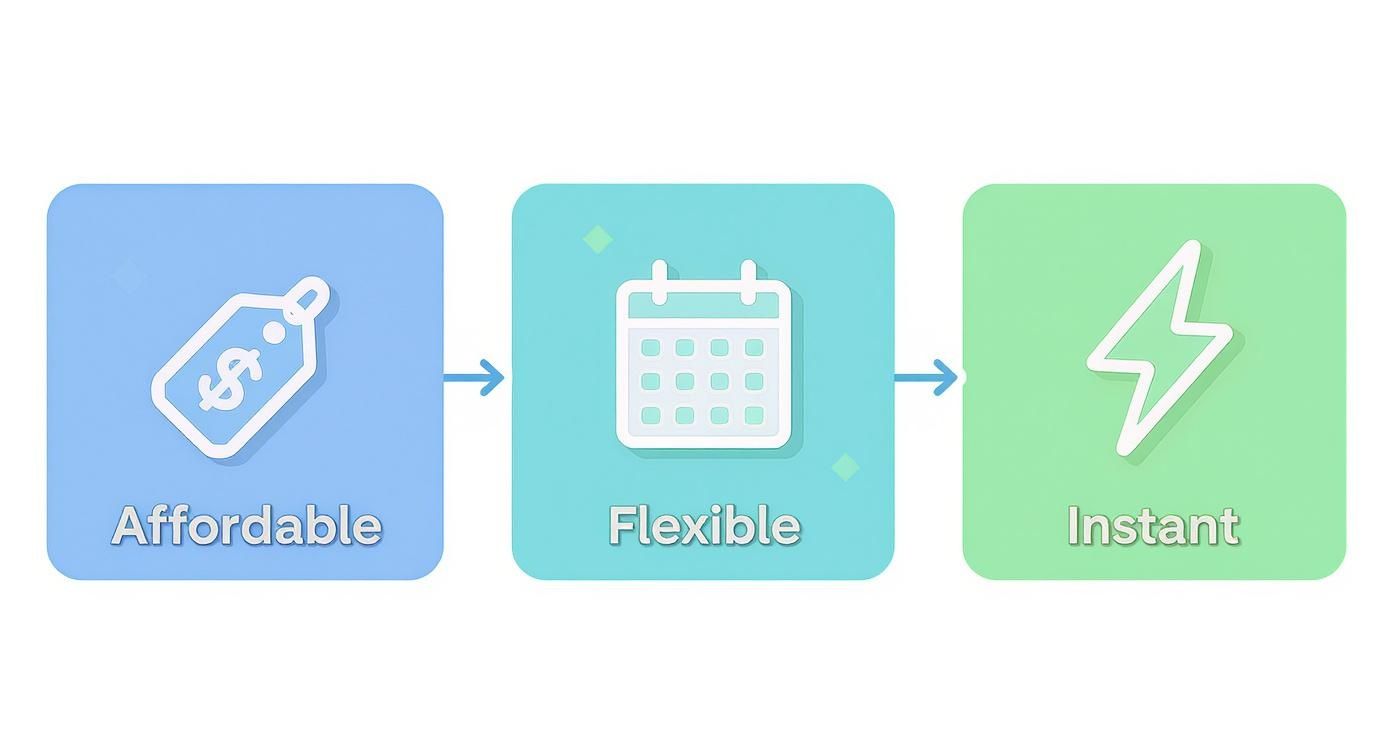
By picking a plan that matches your trip’s exact length and data needs, you stop paying for days or data you simply don’t use.
Finally, think about a 30-day “workation” in South America. As a digital nomad or remote worker, you need a solid, high-volume data connection for video meetings, large file transfers, and staying constantly online. You are a heavy data user.
For any trip lasting more than a week, an eSIM isn’t just a cheaper option—it’s the only one that makes financial sense. The potential savings here are huge, easily exceeding $240.
This table puts it all into perspective, showing just how quickly TravelPass’s fixed daily fee gets left in the dust by the flexible, one-time cost of a travel eSIM.
| Trip Scenario | Estimated Verizon TravelPass Cost | Estimated Travel eSIM Cost | Potential Savings With eSIM |
|---|---|---|---|
| 4-Day City Break (Europe) | $40 | $8 – $12 | ~$30 |
| 14-Day Tour (Asia) | $140 | $20 – $25 | ~$115 |
| 30-Day Remote Work (S. America) | $300 | $35 – $55 | ~$250 |
Ultimately, the math doesn’t lie. The longer you travel and the more control you want over your budget, the more an eSIM becomes the obvious choice.
While travel eSIMs are usually the clear winner on price, there are a few specific situations where Verizon TravelPass is actually the smarter choice. It all comes down to what you value most on your trip: saving money or absolute, effortless convenience.
Let’s be real, this isn’t about which one is “better” overall. It’s about what’s right for your specific trip. A clear-eyed look at the Verizon TravelPass vs eSIM cost comparison shows that the most expensive option isn’t always the wrong one.
Hopping over to Europe for a single 24-hour business meeting? In that case, the simplicity of TravelPass is tough to argue with. A one-day charge of $10 is hardly going to break the bank.
Sure, setting up an eSIM is easy, but it still takes a few minutes. For a trip that’s literally a day or two, the “set it and forget it” promise of TravelPass—where your phone just works the second you step off the plane—is undeniably practical.
For some people, especially business travelers, being able to make and receive calls on their main US number is a must-have. While an eSIM handles your data, you have to be a bit more hands-on in your phone settings to manage calls and texts on your home number.
TravelPass removes that friction entirely. You use your phone exactly like you do at home, with no tweaks needed for calls or texts. If your work relies on that seamless voice connection, the daily fee can be a justifiable business expense.
Let’s face it: some people just don’t want the hassle. They don’t want to download an app, scan a QR code, or fiddle with settings. They’re happy to pay a premium for a service that works automatically, with zero effort on their part.
This is precisely who TravelPass is for. It’s built for the traveler who values their time and mental energy more than finding the best deal. If you just want to land, turn on your phone, and have everything work instantly, TravelPass delivers that experience perfectly.
So, the choice really boils down to your travel style:
Understanding these specific use cases helps you make an informed decision that truly fits what matters most for your journey.
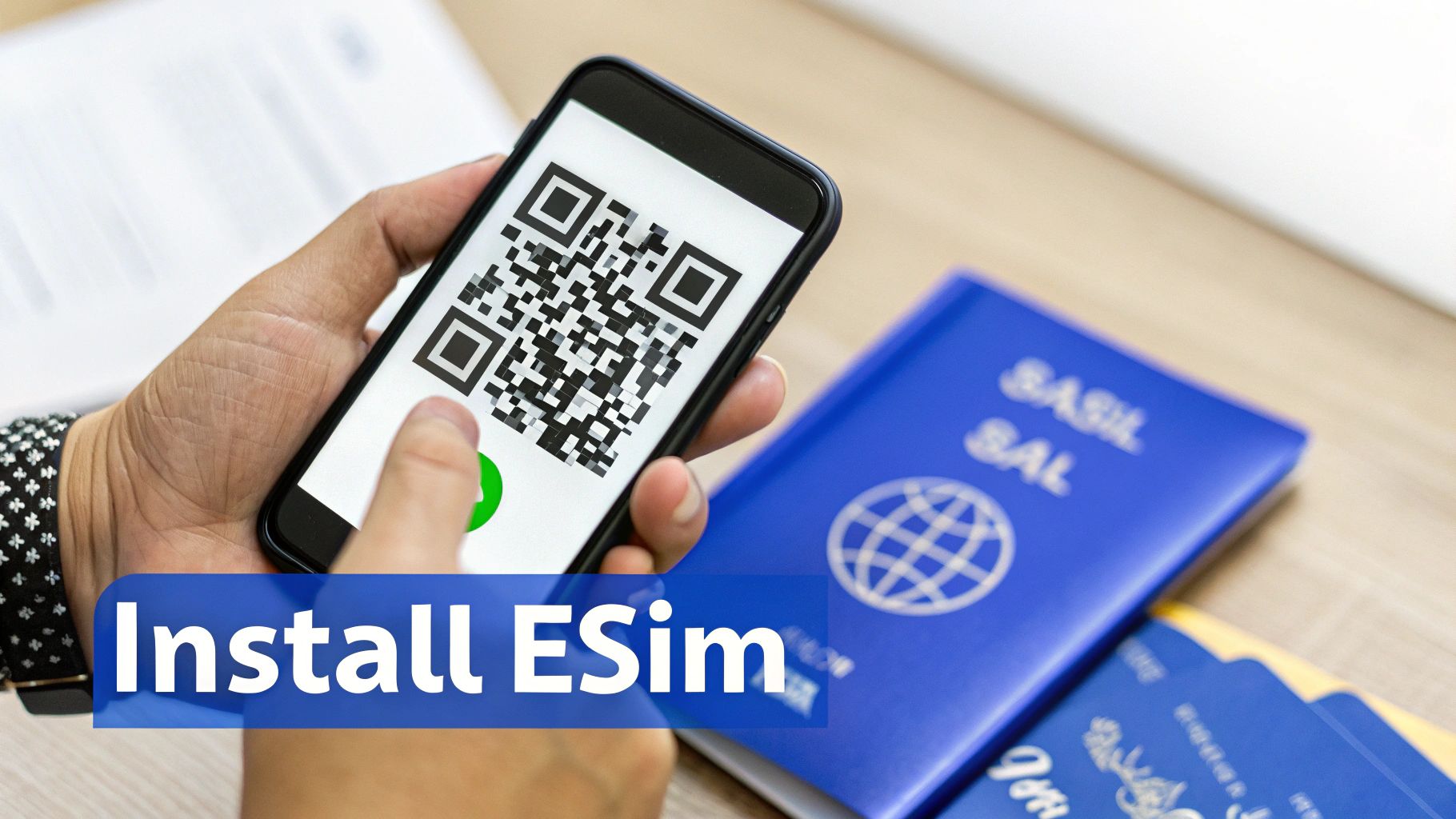
Ready to ditch those daily roaming fees for good? Getting set up with a travel eSIM is refreshingly simple and puts you firmly in control of what you spend on data abroad. It might sound technical, but it’s really just a three-step dance: check, buy, and activate.
Before you jump in, there are two crucial checks you need to make. Get these sorted, and the rest is easy.
First, confirm your smartphone is eSIM-compatible. Most newer phones from Apple, Samsung, and Google already have the technology built-in, but it never hurts to double-check your specific model.
Second, your phone must be unlocked by your carrier. A locked device won’t accept an eSIM from a different provider, so if you’re not sure, a quick call to your network provider will clear things up.
Once you’ve confirmed your phone is good to go, arranging your travel data can be done from your sofa in a few minutes. It’s one less thing to stress about before you fly.
With a travel eSIM, you’re connected the moment you need it—without ever accidentally triggering an expensive daily charge from your home provider. You’re in charge of when your plan starts and what you spend.
This straightforward setup is a massive reason why the Verizon TravelPass vs eSIM cost comparison almost always favors an eSIM for savvy travelers. It’s all about choice and transparency. If you’d like a more detailed guide, you can learn more about how to activate an eSIM on your iPhone and be fully prepared for your next trip.
Choosing how to stay connected abroad can feel a bit daunting. Let’s clear up some of the most common questions people have when comparing the costs of Verizon’s TravelPass against a travel eSIM.
Yes, absolutely. This is one of the standout perks of using an eSIM. Most phones sold in the last few years are Dual SIM capable, meaning you can have both your Verizon line and your travel eSIM running at the same time.
It’s the perfect setup, really. You get to use the cheap, fast data from your travel eSIM for things like Google Maps, browsing, and WhatsApp. Meanwhile, your Verizon number stays active for any calls or texts you can’t afford to miss. You get all the savings on data without going completely off-grid.
Running out of data on an eSIM is no big deal. Unlike a daily roaming pass that might throttle you to painfully slow speeds, a travel eSIM puts you back in the driver’s seat.
If you see your data getting low, you can just top it up through the provider’s app or website. With a service like TapSim, for example, you can buy another data pack for your destination in a couple of clicks, and it activates right away. This flexibility means you’re never stranded without a connection and only pay for more data if you actually need it.
Travel eSIMs are every bit as secure as the physical SIM card you use at home. The technology behind them relies on the same encrypted connections to local mobile networks, keeping your personal information safe.
Think of it this way: your data travels over trusted, private mobile networks, not sketchy public Wi-Fi. That means you can check your bank balance or send sensitive messages with the same peace of mind you’d have in your living room.
An eSIM is just a more modern, convenient way to tap into these secure networks, giving you a reliable and protected connection wherever you go.
Ready to ditch expensive daily roaming fees for good? Get affordable, instant data for your next adventure with TapSim.