How to Activate eSIM on Arrival
Learn how to activate eSIM on arrival without delays. Set up before takeoff, avoid roaming fees, and get mobile data working fast abroad.

When you’re looking for an affordable eSIM for your travels, it really boils down to three things: the real cost per gigabyte, the quality of the local network coverage, and whether essential features like hotspot tethering are included. Experienced travelers know that the most well-known brands often come with a premium price tag, but there are plenty of excellent, budget-friendly options that deliver the same reliable connection for a lot less.
International travel is about the experience, not about getting stung with high fees for mobile data. While the most popular eSIM providers are household names, the market is full of alternatives offering fantastic connectivity without the hefty price. This guide is all about helping you look past the marketing and find a genuinely better deal.
We’ll dig into the details that actually matter—like the true cost you’re paying per gigabyte, the strength of the network in your destination, and whether you can share your connection with other devices. This simple breakdown shows the core elements you should always compare.
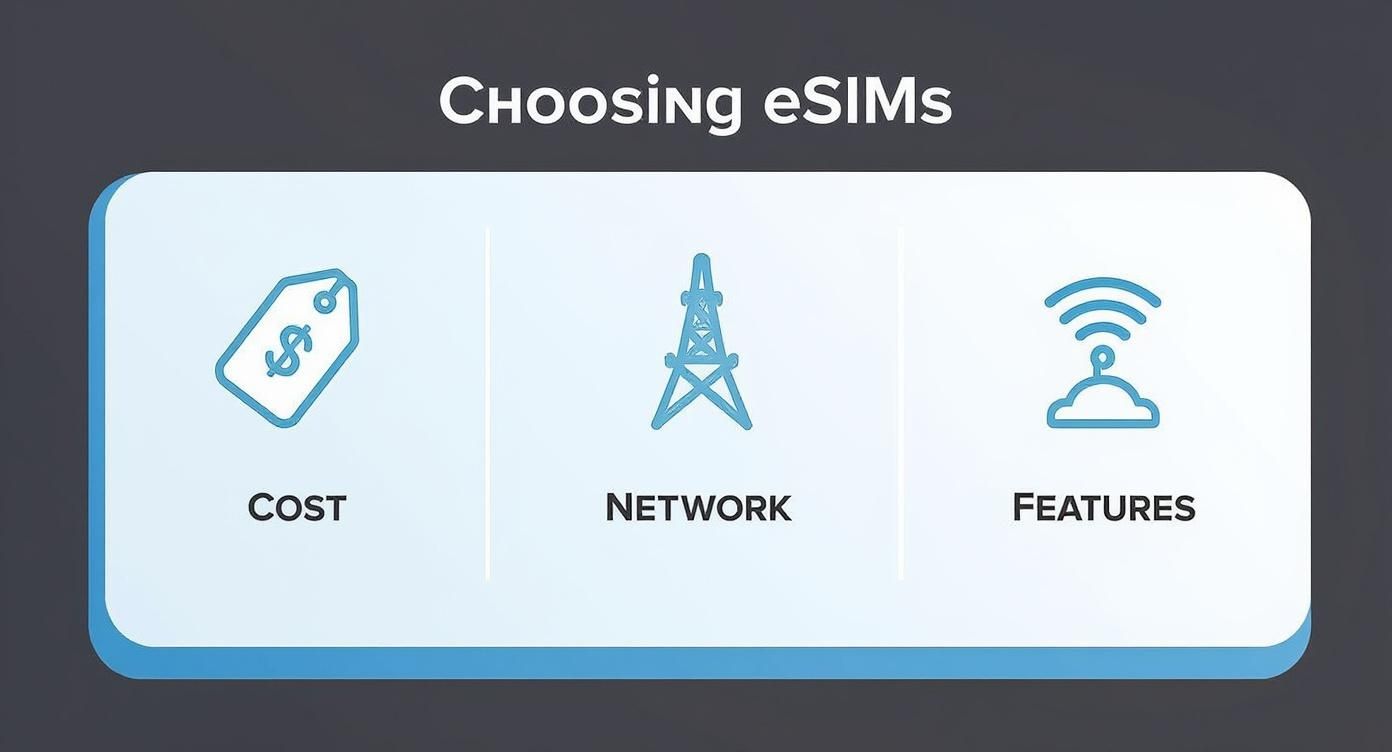
The trick is to find the right balance between cost, network performance, and the features you actually need. Forget the hype; we’re focusing on the practical stuff that guarantees a fast, dependable connection that fits your budget. This advice holds true whether you’re a digital nomad, a frequent business traveller, or just on a family holiday in Europe or Asia. Of course, getting to grips with the basics helps, and you can learn more about how a virtual SIM card works to make a really solid choice.
To find a deal that’s genuinely better, you need to look beyond the advertised price on the tin. The best value comes from digging a little deeper into what you’re actually getting for your money.
Evaluate these key areas to find an eSIM that offers better value than mainstream options.
| Comparison Factor | What to Look For | Why It’s a Game-Changer |
|---|---|---|
| True Cost | The price per gigabyte (GB), not just the plan price. Also, check the validity period. | A low upfront cost can easily mask a high price per GB, making it a surprisingly poor deal in the long run. |
| Network Quality | Partnerships with top-tier local carriers in your destination. | Strong local networks mean fast, reliable 4G/5G speeds, even when you venture off the beaten path. |
| Essential Features | Hotspot tethering support, instant activation, and clear refund policies. | These features give you real flexibility and peace of mind, making sure your eSIM works for all your devices and plans. |
Focusing on these three pillars—cost, network, and features—will always lead you to a smarter, more affordable choice for your travels.
The price you see advertised on an eSIM app rarely tells you the full story. If you want to find a genuinely good-value option that gives you better connectivity without the high price tag, you need to dig a little deeper than the headline number. The single most important metric to focus on is the cost per gigabyte (GB).
Think about it this way: a £10 plan with 5GB of data is £2/GB. A plan that looks cheaper at £7 but only gives you 2GB is actually £3.50/GB. Just doing that quick bit of maths instantly shows you which one is the better deal. It’s the first thing you should do when comparing any eSIM provider.
The validity period is the next piece of the puzzle. A 30-day plan almost always works out better value for a longer trip than buying a weekly plan over and over again. If you’re spending a few weeks travelling around Europe or Asia, grabbing one larger data package will be far cheaper than renewing a 7-day plan three or four times.
For instance, someone might buy a 5GB, 7-day plan for a week in Spain, then grab another for their week in Italy. A much smarter move is to get a regional Europe eSIM with 10GB valid for 30 days. Not only is the cost per GB usually lower, but you also skip the hassle of activating multiple plans.
Pro Tip: Always divide the total plan cost by the number of gigabytes. It’s the simplest way to cut through the marketing fluff and see the real value you’re getting for your money.
One of the biggest traps with so-called “unlimited” data plans is the Fair Usage Policy (FUP) lurking in the small print. These policies give providers the right to dramatically slow down, or “throttle,” your connection once you hit a certain data cap. You might think you’ve bought endless high-speed data, but after a few hours of streaming, you could be stuck with speeds that are barely usable.
A trustworthy provider will be upfront about its high-speed data limits. With TapSim, every plan clearly shows you exactly how much full-speed data you get, so you know what you’re paying for without any nasty surprises.
This kind of honesty is crucial. It helps you avoid the hidden catches that can make a “cheap” plan a lot more expensive and frustrating in the end. By keeping your eye on the cost per GB, the validity period, and transparent terms, you can confidently find a better, more affordable deal for your next trip.
An affordable eSIM is completely useless if you can’t get a signal when you need one. The quality of your connection boils down to one simple thing: the eSIM provider’s partnerships with local mobile networks in your destination country. Better partners mean better connectivity on your travels.
When an eSIM provider teams up with top-tier local carriers, you get faster speeds and more reliable coverage. This holds true whether you’re navigating a busy city centre or trying to upload a photo from a remote beach. It’s why checking which local networks an eSIM uses before you buy is such a crucial step.
Here’s a little secret: many of the more budget-friendly eSIMs actually piggyback on the exact same high-quality networks as the premium brands. This means you can get identical performance for a fraction of the price, but only if you know what to look for.
Before you commit to a plan, do what savvy travellers do: dig into the provider’s website to see who their network partners are for your specific destination. A trustworthy provider will have this information clearly displayed on the product page, not buried in the small print.
You’re looking for partnerships with the dominant mobile networks in the region you’re visiting. Take the UK, for example, where a few big names control the market. Carriers like EE, O2, and Vodafone form the backbone for countless eSIM resellers. EE leads the pack with a 22.42% market share, followed by O2 at 17.50%. This proves you don’t need to pay a premium to tap into the UK’s most reliable networks. You can find more detail on UK mobile stats over at Uswitch.com.
Traveller’s Insight: Look for providers that partner with multiple top-tier carriers in a single country. This gives you a much more resilient connection. If one network is congested or has patchy service in an area, your phone can automatically switch to a stronger signal from another partner.
This multi-carrier approach is a huge advantage over eSIMs that lock you into a single, and sometimes weaker, network. By choosing a service with strong and diverse network partnerships, like TapSim, you get the peace of mind that comes from knowing you’ll have a stable connection wherever your adventure takes you.
Finding a cheap eSIM is one thing, but a great travel eSIM is about more than just gigabytes and cost. While price is obviously a huge factor, a few practical features can make or break your trip, turning a good deal into a genuinely reliable travel companion.
One of the most crucial features is the ability to use your phone as a mobile hotspot, often just called tethering. This lets you share your phone’s data with your laptop, tablet, or even your travel partner’s phone.
Think about it: you’re a remote worker who needs to jump on a quick video call, or you’re travelling with family and want to connect a tablet for the kids. In these moments, hotspot support isn’t a luxury; it’s essential.
The catch is that some eSIM providers don’t include it. Some might charge extra for it or bury it in their most expensive plans. When you’re comparing your options, checking for hotspot capability is a simple way to find a plan that offers real value.
Just as important is how easy it is to get started. After a long flight, the last thing you want is a battle with complicated setup instructions or a long wait for your connection to go live.
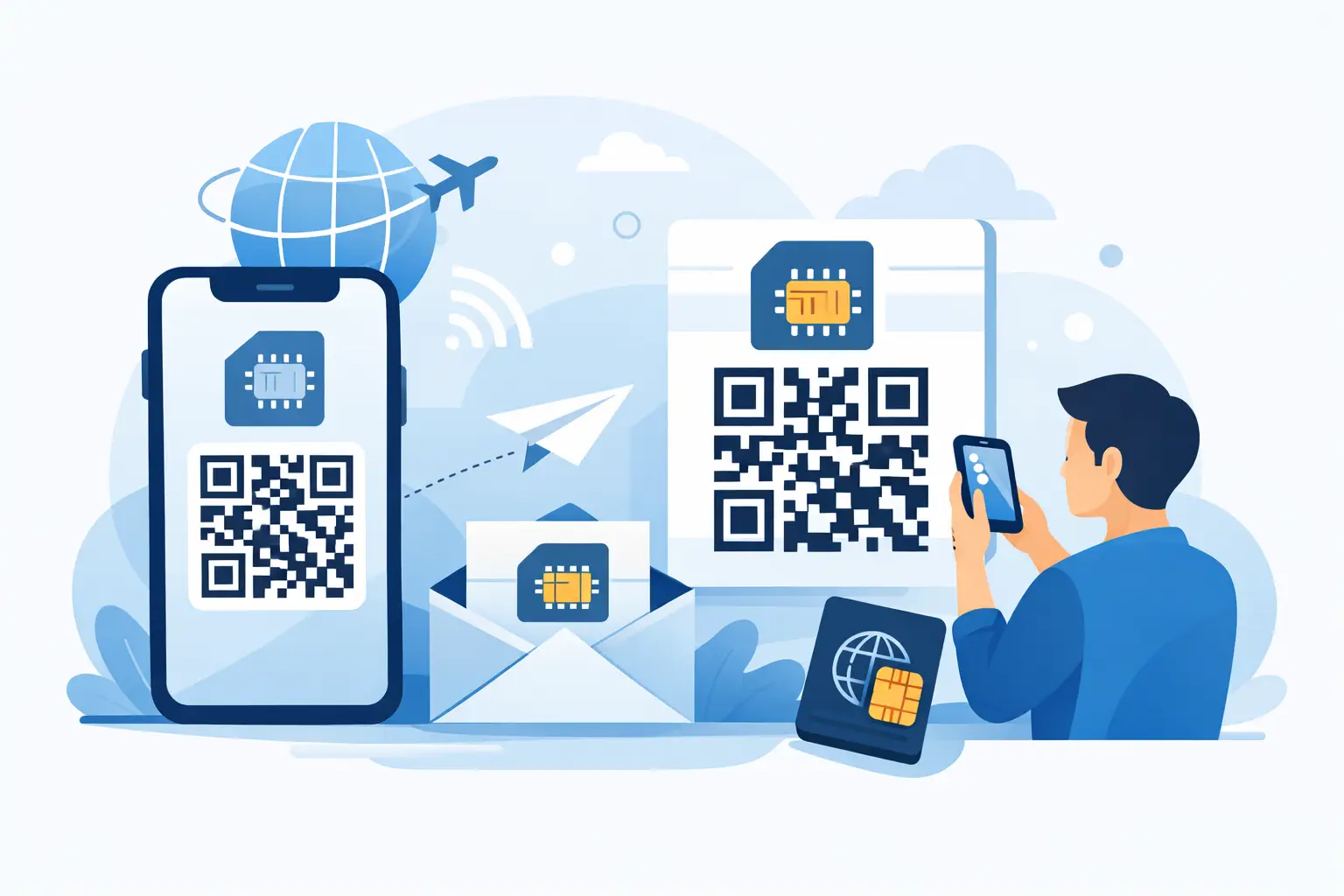
The best eSIMs get you online the moment you land. A simple QR code scan should be all it takes. This means you can book a taxi, pull up your hotel directions, or message family to say you’ve arrived safely, all without having to hunt for a patchy, insecure airport Wi-Fi signal.
Traveller’s Tip: Always install your eSIM before you leave home. This way, all you need to do upon arrival is switch it on in your phone’s settings to get connected immediately.
A dead-simple, instant activation process is a clear sign of a provider that gets what travellers actually need: convenience and reliability.
At TapSim, we build our plans for modern travellers. Every single eSIM we offer comes with full hotspot tethering support, so you can share your connection across all your devices without hidden fees. And our activation is effortless – you can tap, scan, and connect within minutes of touchdown. Head over to TapSim.net to see how simple travel data can be.
Finding an affordable eSIM is a great start, but it’s only half the story. The absolute first thing you need to sort out is whether the eSIM will actually work with your specific phone. While eSIM technology is becoming much more common, this one check can save you a world of frustration.
Hundreds of newer smartphones are now eSIM-ready, but it’s always smart to confirm your particular model is on the list before you hit ‘buy’.
The good news for travellers is that eSIM support has exploded in recent years. As of April 2025, there were a whopping 226 eSIM-compatible smartphone models on the market — that’s a 33% jump from the year before. Big names like Samsung, Apple, and Motorola have all gone in on eSIMs, which has opened the door for savvy budget providers to compete.
This is precisely why a quick compatibility check is so vital. If you’re not entirely sure about your handset, it’s well worth taking a moment to learn whether your phone supports eSIM technology before you go any further.
Just as important as compatibility is what happens when things go wrong. Imagine landing in a new country, and your data just won’t connect. A cheap eSIM suddenly feels very expensive if you’re left stranded with no one to call for help.
When you’re comparing providers, look for ones that offer crystal-clear instructions and a simple way to get in touch with a real person. An eSIM company that invests in transparent support shows they’ve got your back.
Traveller’s Takeaway: Don’t just focus on the price. A provider’s support system is a key part of the value you receive. Fast, reliable help when you’re abroad is priceless.
At TapSim, we’ve built our support for travellers, by travellers. We give you clear, straightforward guidance from the get-go and are always here to help if something doesn’t go to plan, so you’re never left disconnected.
The perfect eSIM is the one that fits your travel style like a glove. Finding an affordable alternative to mainstream providers is only half the battle; the real value comes from matching a data plan to your specific journey. A digital nomad hopping across Asia needs something very different from a tourist on a weekend city break in Europe.
By thinking about your travel habits and data needs upfront, you can avoid two common pitfalls: paying for data you’ll never use or, worse, running out of internet right when you need it most. Let’s break down a few common traveller profiles to help you find the right fit.
Heading off for a short trip, like a three-day getaway to Rome or a long weekend in Paris? Your priority should be simplicity and affordability. There’s really no need to buy a large, expensive regional plan for just a couple of days.
A small, country-specific plan is your best bet here. Look for plans with 1GB to 3GB of data valid for 7 days. That’s more than enough for maps, messaging, and a bit of social media without overspending. With TapSim, you can grab a small local package that gets you connected instantly for just a few pounds.
For the business traveller, reliability is everything. You might only be in Frankfurt for a two-day conference, but you need a flawless connection for emails, video calls, and pulling documents from the cloud. Hotspot tethering is absolutely non-negotiable.
Your ideal plan is one that guarantees a strong connection on a premium local network. A plan with 5GB to 10GB of data is a safe choice, giving you plenty of bandwidth for work tasks without worrying about hitting a limit. The ability to easily top up is also a huge plus if a meeting runs over or your trip gets extended.
Actionable Takeaway: Before you go, check your phone’s settings to see your typical daily data usage at home. This gives you a realistic baseline for how much you’ll need abroad, helping you pick a plan that’s just right.
If you’re spending a month or more backpacking through Southeast Asia or exploring South America, your needs change completely. Buying a new eSIM in every single country is a hassle and gets expensive fast.
This is where regional eSIMs really shine. A large, regional bundle that covers multiple countries with a 30-day or 90-day validity is by far the most cost-effective option. Look for plans with 20GB or more to cover everything from booking hostels to staying in touch with family back home. For a deeper dive into finding the right plan for longer trips, check out our complete guide on the best eSIM for travel.
Travelling with family means juggling multiple devices. The kids need their tablets for entertainment, while you need your phone for navigation and booking tickets on the fly. A single, robust eSIM with a generous data allowance and full hotspot support is essential.
A large data plan of 10GB to 20GB for your destination will allow you to share the connection with everyone, saving you the headache and cost of buying multiple plans. With TapSim, our flexible plans ensure there’s a cost-effective option for every kind of journey, whether it’s a short break or a multi-country adventure.
Choosing a travel eSIM for the first time can throw up a few questions. Let’s tackle some of the most common ones travellers have when they’re trying to find a balance between price and performance.
Looking past the headline price is key. The most effective way to judge value is to work out the cost per gigabyte (GB). Just divide the total price of the plan by the data you get.
This simple bit of maths often shows that a plan with a higher upfront cost but more data is actually the better deal in the long run. Don’t forget to check the validity period, either. For a longer trip, a 30-day plan almost always offers better value than renewing a 7-day plan multiple times.
Definitely. An eSIM company doesn’t own the mobile masts; its quality comes down to the deals it strikes with local network operators. Many affordable providers, TapSim included, partner with the very same major carriers as the pricier brands.
What does that mean for you? You can often get the exact same fast 4G/5G speeds and reliable coverage, just without the premium price tag. Before you buy, it’s always smart to see which local networks an eSIM provider uses at your destination.
It’s a fair question for any traveller relying on connectivity. Any good eSIM provider will have a clear support system and a fair refund policy. Before committing, have a quick look at their website for customer support options and read through the terms.
A provider that stands behind its product will make its support team easy to contact and will have a no-fuss refund process for genuine technical faults. That’s a huge sign of a trustworthy company.
At TapSim, we believe in honest support. If you run into a snag our team can’t fix, we’ll make it right. It’s all part of our promise to offer a reliable and fair service for every single traveller.
Ready to travel with affordable, hassle-free data? Check out TapSim‘s transparently priced eSIMs for your next destination.