eSIM for Business Travel: What to Know
Learn how esim for business travel cuts roaming costs, speeds arrival setup, and keeps teams connected with clear data limits and fewer surprises.
That text message from your mobile provider warning you’ve landed in a new roaming zone? It’s a familiar sight for anyone crossing the border into Switzerland and a sure-fire way to spoil the holiday mood. The quickest way to dodge those hefty roaming charges is to simply turn off data roaming on your home SIM and switch to a travel eSIM for affordable, reliable mobile data. It’s the simplest trick in the book for staying connected without racking up a shocking bill.

It’s a mistake anyone could make. You’re travelling through Europe, and your phone just works. The EU’s “Roam Like at Home” policy has made hopping between France, Germany, and Italy completely seamless for mobile users. But that bubble of convenience bursts the second you set foot in Switzerland.
The reason is all down to political geography. Switzerland isn’t a member of the European Union (EU) or the European Economic Area (EEA), so it’s not bound by the rules that ended roaming fees for member countries.
This means your home mobile provider is free to charge you out-of-bundle rates for data, calls, and texts as soon as your phone connects to a Swiss network like Swisscom or Salt Mobile. And they often do.
To put it in perspective, here’s a quick summary of the difference.
| Feature | In the EU/EEA | In Switzerland |
|---|---|---|
| “Roam Like at Home” | Yes, applies to all member countries. | No, this EU regulation does not apply. |
| Data Usage | Taken from your domestic plan’s allowance. | Charged at expensive, out-of-bundle international rates. |
| Calls & Texts | Standard domestic rates apply. | Priced at premium international rates for both making and receiving calls. |
| Provider’s Obligation | To provide roaming at no extra cost. | To inform you of high charges; they are not obligated to offer free roaming. |
This table really highlights why you can’t treat Switzerland like just another European stopover.
Mobile operators have agreements with networks across the globe to keep their customers connected. Inside the EU/EEA, these agreements are regulated to keep prices fair for everyone. But outside that zone, operators negotiate their own terms, and any extra costs are often passed straight onto your bill.
The situation has also changed for UK travellers. Since the UK left the EU, its residents no longer benefit from “Roam Like at Home” rules when visiting Switzerland. Many UK providers have brought back daily roaming fees, with some charging anywhere from £2 to a staggering £24 per day. This makes a bit of pre-trip planning essential if you’re coming from the UK.
Without a special travel pass, pay-as-you-go data rates can be eye-watering—we’re talking several pounds per megabyte. A few background apps refreshing or a quick map check can burn through your budget before you’ve even had your first Swiss hot chocolate.
Key Takeaway: Think of Switzerland as a connectivity island in the middle of Europe. Your EU roaming benefits stop at the border, and you need a plan to avoid getting stung by high charges.
This unique status means that whether you’re heading to Zurich, Geneva, or the Alps, sorting out your mobile data beforehand is a must. Modern options like travel eSIMs offer a simple and affordable way to get online. For example, you can browse available data plans for Switzerland and have everything set up the moment you arrive.
Before you pack for your Swiss adventure, spending a few minutes on your phone can save you a world of hassle and a surprising amount of money. Think of it as a pre-flight check for your digital life. Getting this sorted now means you’ll land connected, without any nasty surprises waiting on your next mobile bill.
The very first thing to do is get the facts straight from your current mobile provider. Don’t just assume your plan covers Switzerland; you need to dig into the specifics.
Jump onto your provider’s app or website and search for their roaming policy, making sure you find the page specifically for Switzerland. This is where many travellers get caught out by confusing small print.
You’re looking for clear answers to a few key questions:
Knowing these details upfront gives you a clear picture of what you’re up against. It’s your baseline for deciding whether sticking with your home provider is worth it or if you should look for a better deal elsewhere.
This next step is absolutely critical, especially if you’re thinking about a more affordable alternative like a travel eSIM. An unlocked phone is simply one that isn’t tied to a single mobile network. It means you have the freedom to install an eSIM or use a SIM from any company you choose.
Traveler’s Tip: The quickest way to check is usually in your phone’s settings. On an iPhone, for instance, go to Settings > General > About. If you scroll down and see “No SIM restrictions” next to Network Provider Lock, you’re all set.
If your phone is locked, your next call should be to your home provider to ask them to unlock it. This isn’t always instant and can sometimes take a few days, so don’t leave it until the last minute.
Having an unlocked phone is your ticket to freedom. It means you can choose the best data solution for your trip—like instantly activating an eSIM from TapSim—instead of being stuck with your home network’s high fees.
Now that you know your standard EU roaming plan won’t cover you in Switzerland, what’s the best way to stay connected? The good news is you have a few solid choices, and the right one really depends on your travel style.
You’ve got three main routes to consider: a modern travel eSIM, a traditional local Swiss SIM card, or just relying on public Wi‑Fi. Are you hopping over to Zurich for a quick weekend city break, or are you planning a two-week hike through the Alps where you’ll need reliable data? Let’s break down what each option looks like in practice.
The simplest and most modern solution is a travel eSIM. This is a digital SIM you download and install on your phone, and the best part is you can get it all sorted from your sofa before you even pack your bags.
With TapSim, you can buy a data plan online and activate it the second your plane touches down in Geneva. There’s no hunting for a mobile shop, no fumbling with tiny plastic cards, and no trying to explain what you need in another language. You get to keep your regular phone number for important calls and texts, while all your mobile data runs through the much cheaper, prepaid eSIM. It’s a perfect fit for anyone who values convenience and wants to be online from minute one.
Your other choice is to buy a local Swiss SIM card when you arrive. You’ll find them at the airport or in stores for providers like Swisscom or Salt. This can sometimes be a bit cheaper, especially if you’re staying for a very long time, but it definitely comes with a few practical headaches.
First, you’ll probably have to queue at the airport kiosk, which is the last thing you want to do after a flight. You’ll also need to hand over your passport for registration, as it’s a legal requirement in Switzerland. For a short trip, the time you spend finding a store and getting through the paperwork can really eat into your holiday.
Traveler’s Reality: For trips under a few weeks, the sheer convenience of landing with a pre-installed eSIM and having instant data almost always outweighs the few euros you might save by getting a physical SIM.
For the true budget-conscious traveller, sticking to public Wi‑Fi is an option, but it has some serious drawbacks. You can find free Wi‑Fi in airports, your hotel, and some city-centre cafes, but the moment you step outside to find your way around Bern or look up a bus stop, you’re completely offline.
This makes simple on-the-go tasks like using Google Maps, ordering an Uber, or checking train times pretty much impossible. On top of that, public networks are often unsecured, which is a real security risk if you need to log into your bank or email. It’s okay as a backup, but you can’t rely on it as your main way to stay connected.
To help you decide, here’s a quick comparison of your main choices.
| Option | Best For | Pros | Cons |
|---|---|---|---|
| Travel eSIM | Short to medium trips, convenience-focused travellers, and instant connectivity upon arrival. | – Buy and install before you travel – Instant internet on landing – Keep your home number active |
– Requires a modern, eSIM-compatible phone – Might be slightly more expensive for very long stays |
| Local SIM | Long-term stays (a month or more) or very heavy data users. | – Can be cost-effective for long trips – Plans from local providers |
– Hassle of finding a store and queuing – Requires passport registration – No connectivity until you buy it |
| Public Wi-Fi | Absolute budget travel, as a backup to another option. | – Free to use | – Patchy availability and unreliable – Security risks on unsecured networks – Useless for navigation on the go |
Ultimately, a pre-planned solution like an eSIM often provides the best balance of cost, convenience, and security for most trips to Switzerland.
This simple flowchart can help you visualise the very first, most important check you need to make.
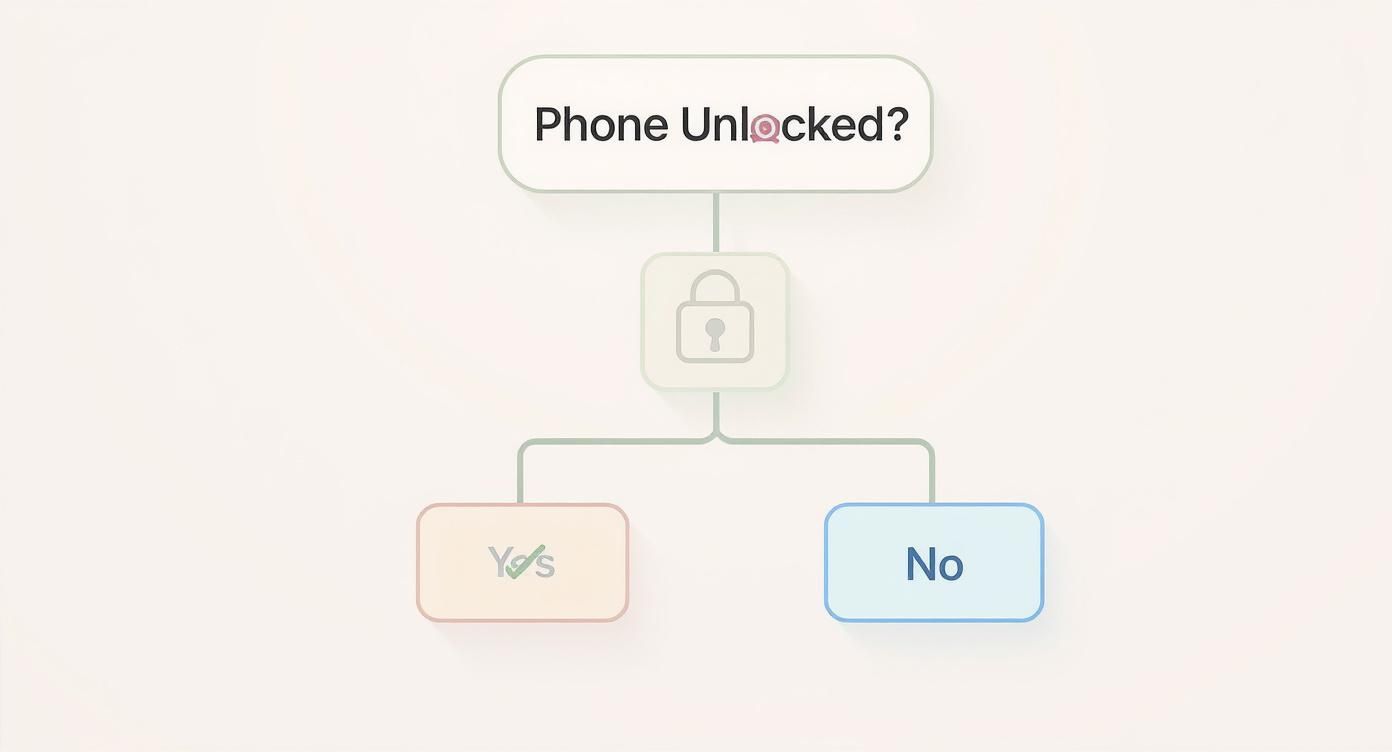
As the chart shows, having an unlocked phone is the crucial first step. It’s what opens the door to using affordable alternatives like a travel eSIM or a local Swiss SIM.
For UK travellers, the stakes are particularly high. Some UK providers charge as much as £1.50 per megabyte on a pay-as-you-go basis. Travellers have reported hitting their daily spending cap of £15 in just a few minutes, which leads to their data being cut off without warning, leaving them stranded. You can explore user experiences with Swiss roaming charges to see just how fast these costs can spiral. This is exactly why getting a solution sorted before you go is so essential.
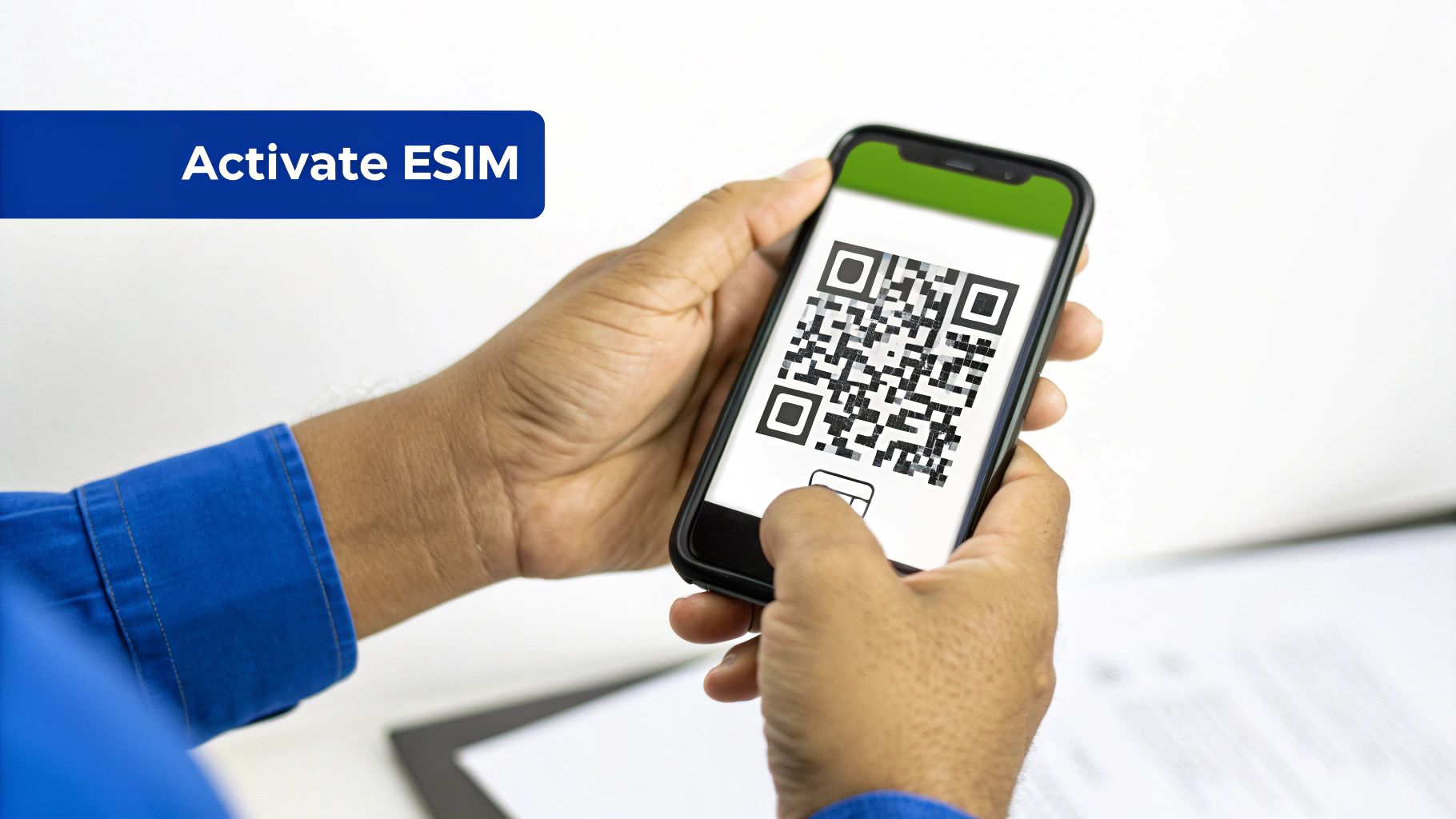
The idea of a digital SIM might sound a bit technical, but setting up a travel eSIM is surprisingly easy. It’s designed to get you online the moment you land, letting you skip the hassle of finding a shop and fiddling with tiny plastic cards. Let’s walk through how to get it right.
First up, you need to pick a data plan. Think honestly about your travel style. Are you a light user who just needs Google Maps and WhatsApp? Or are you planning to be the designated navigator, hotspot provider, and social media updater for your group? Travel eSIMs come in all shapes and sizes, from a 1GB plan perfect for a weekend in Zurich to much larger bundles for that two-week trek through the Alps.
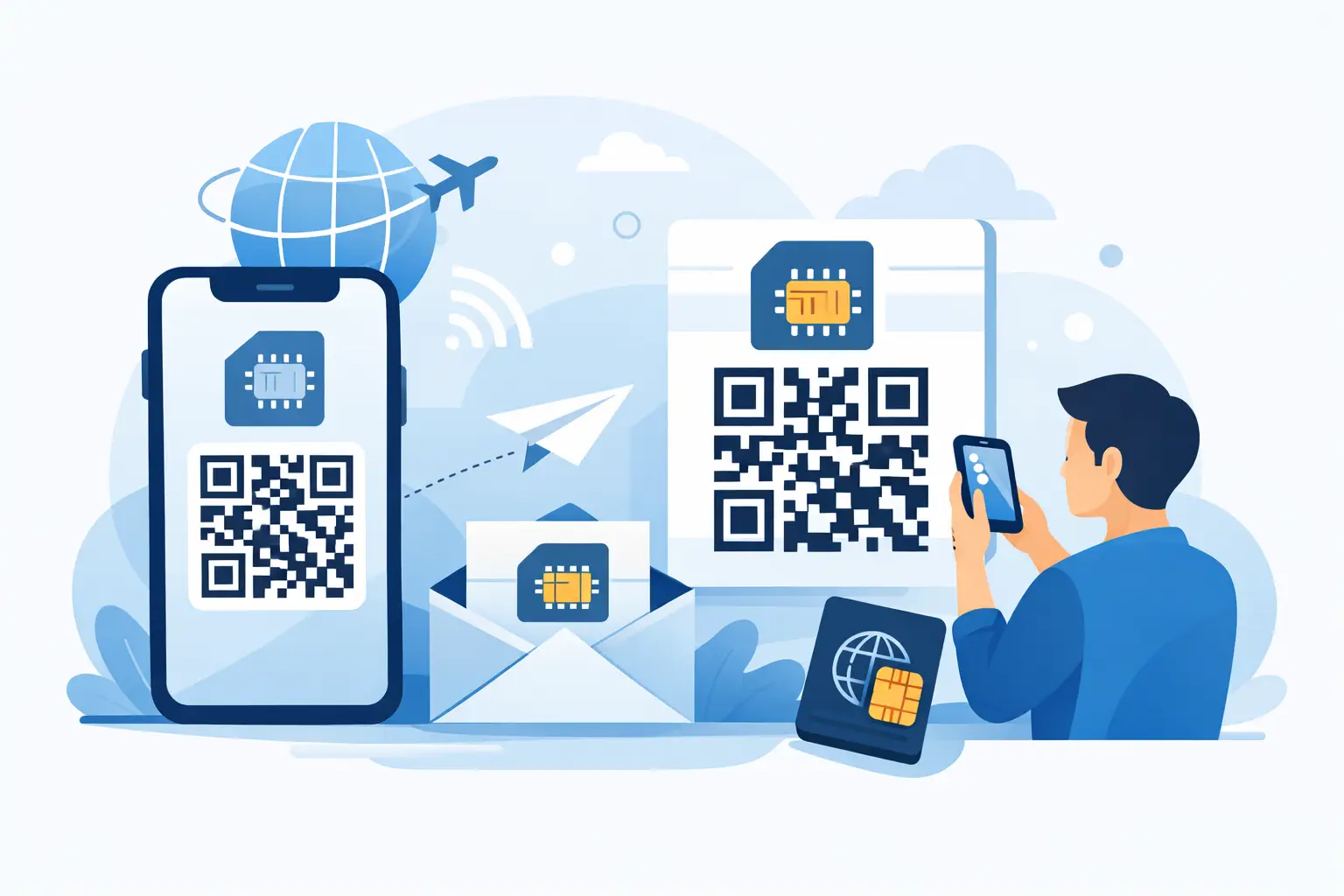
Once you’ve bought your plan, you’ll typically receive a QR code via email. This is your key. The best bit of advice is to install the eSIM while you’re still at home, connected to your reliable Wi-Fi. It saves a world of hassle trying to find a connection at the airport.
Getting it onto your phone is usually straightforward:
From there, your device walks you through the last couple of steps. It’s a good idea to label the eSIM as you go. Something clear like ‘Swiss Travel’ or ‘Holiday Data’ will make it easy to find in your settings later. If you’re an iPhone user and want a screen-by-screen guide, this resource on how to activate an eSIM on your iPhone is incredibly helpful.
Traveler’s Tip: Just install the eSIM at home, don’t activate the plan itself. The clock on your data package usually starts ticking the moment you activate it. Wait until your plane has landed in Switzerland to switch it on, and you’ll get every single day you paid for.
So you’ve arrived, cleared customs, and you’re ready to explore. Now’s the time to dive back into your phone’s cellular settings and turn on your newly installed eSIM.
The final, and most important, step is to make sure you set your travel eSIM as the line for mobile data. This is the crucial move that prevents your home network from connecting and racking up those painful roaming charges.
One of the best things about modern phones is their dual-SIM capability. You can tell your phone to use the new eSIM for all its internet needs while keeping your home SIM active just for receiving calls and texts. It’s the best of both worlds—you get affordable local data without the fear of missing an important call or message on your regular number. It puts you in complete control, so you can enjoy your fondue without worrying about a nasty bill waiting for you back home.
Getting a travel eSIM is one thing; making that data allowance stretch for your whole Swiss adventure is another challenge entirely. Mobile data can vanish in the blink of an eye, particularly when you’re out and about exploring. A few small changes to your phone’s settings and your daily habits can make all the difference, keeping you connected without the hassle of constantly topping up.
The usual culprits for draining data are the apps working silently in the background. Social media, email, and weather apps are always pulling new information, a process that eats up your precious megabytes when you’re not even looking.
First things first: tackle background app refresh. Switching this off is probably the single most effective way to stop apps from using data when they’re not open on your screen. You’ll still get your important messages, but you’ll put a stop to that sneaky, silent data drain.
Automatic updates are another major data hog. Your phone’s app store is likely set up to download updates over any connection it can find, including your mobile data. Before you pack your bags, jump into your store settings and change this to Wi-Fi only. The last thing you want is a massive game update gobbling up your data while you’re trying to find your hotel in Geneva.
Traveler’s Tip: Your phone almost certainly has a built-in ‘Data Saver’ or ‘Low Data Mode’. Toggling this on is a fantastic catch-all solution. It automatically clamps down on background data and pauses things like cloud photo syncs until you’re connected to Wi-Fi again.
A little forward planning before you leave can save you a surprising amount of data once you’re on the ground. Instead of streaming music and podcasts on the go, download your playlists and favourite episodes while you’re still on your home Wi-Fi. The same logic applies to any films or shows you want to watch on that scenic train journey from Zurich to Lucerne.
Offline maps are an absolute game-changer. Both Google Maps and other navigation apps let you download maps of entire cities or regions. This means you can get full turn-by-turn directions without using a single byte of your data plan. To get a better sense of how these apps work, our guide on how Google Maps uses data has some great insights.
Finally, get into the habit of treating your mobile data like a valuable resource. Use free Wi-Fi whenever and wherever you find it. Your hotel, local cafés, and even train stations are the perfect places to get your data-heavy tasks done.
Use these Wi-Fi hotspots to:
By consciously shifting the heavy lifting to Wi-Fi, you save your travel eSIM data for what it’s really for—navigating, messaging, and staying connected while you’re taking in those stunning Swiss landscapes. This smart approach means even a smaller data plan can easily last your entire trip, giving you peace of mind and connectivity when it matters most.
Even the most seasoned travellers have last-minute questions. When it comes to mobile data in Switzerland, things can feel a bit murky, especially for those of us used to seamless EU roaming. Let’s clear up some of the most common queries.
The short answer is no. Because Switzerland sits outside the EU and the EEA, the “Roam Like at Home” rules don’t apply there. This means your mobile provider back home has no obligation to give you free roaming and will almost certainly apply international rates for data, calls, and texts. The only exception is if you have purchased a specific Switzerland travel add-on from them.
Nobody wants that surprise bill when they get home. To make absolutely sure your phone doesn’t start sneakily using expensive data the moment you cross the border, there are two simple things to do.
Doing this creates a digital safety net, preventing your home SIM from connecting to a Swiss network and burning through data without you even realising it.
Absolutely, and this is where using a travel eSIM really shines. Most modern phones with dual-SIM capability let you keep your home SIM active just for calls and texts, while you channel all your internet usage through the much more affordable travel eSIM.
A Real-World Tip: This dual-SIM setup is a game-changer. You stay available for that important call from home and can still receive crucial things like two-factor authentication codes from your bank, all while sidestepping those eye-watering data roaming fees.
For the vast majority of trips—anything from a long weekend to a few weeks—an eSIM is hands-down the more convenient option. You just can’t beat the simplicity: buy it online from your sofa, install it before you leave, and you’ve got data the second your plane’s wheels touch the tarmac.
A local Swiss SIM card might work out a tiny bit cheaper if you’re staying for a month or longer. But that saving comes with the hassle of finding a shop, queuing up, and dealing with the required passport registration. For sheer ease and getting connected instantly, an eSIM is the clear winner for dodging roaming charges in Switzerland.
Ready to explore Switzerland without the dread of a massive phone bill? TapSim provides instant, affordable data plans to keep you connected.