eSIM for Business Travel: What to Know
Learn how esim for business travel cuts roaming costs, speeds arrival setup, and keeps teams connected with clear data limits and fewer surprises.
On the surface, the AT&T International Day Pass sounds like a simple solution for staying connected abroad. But as many travelers have discovered, the reality can be quite different, and the final bill often holds some unwelcome surprises.
The biggest catch? A full daily fee—often $12—is triggered by the slightest interaction with the network. Think sending a single text, making a one-minute call, or even just an app fetching new data in the background. This “pay-per-day” model kicks in automatically, turning a handy feature into a potential money pit.
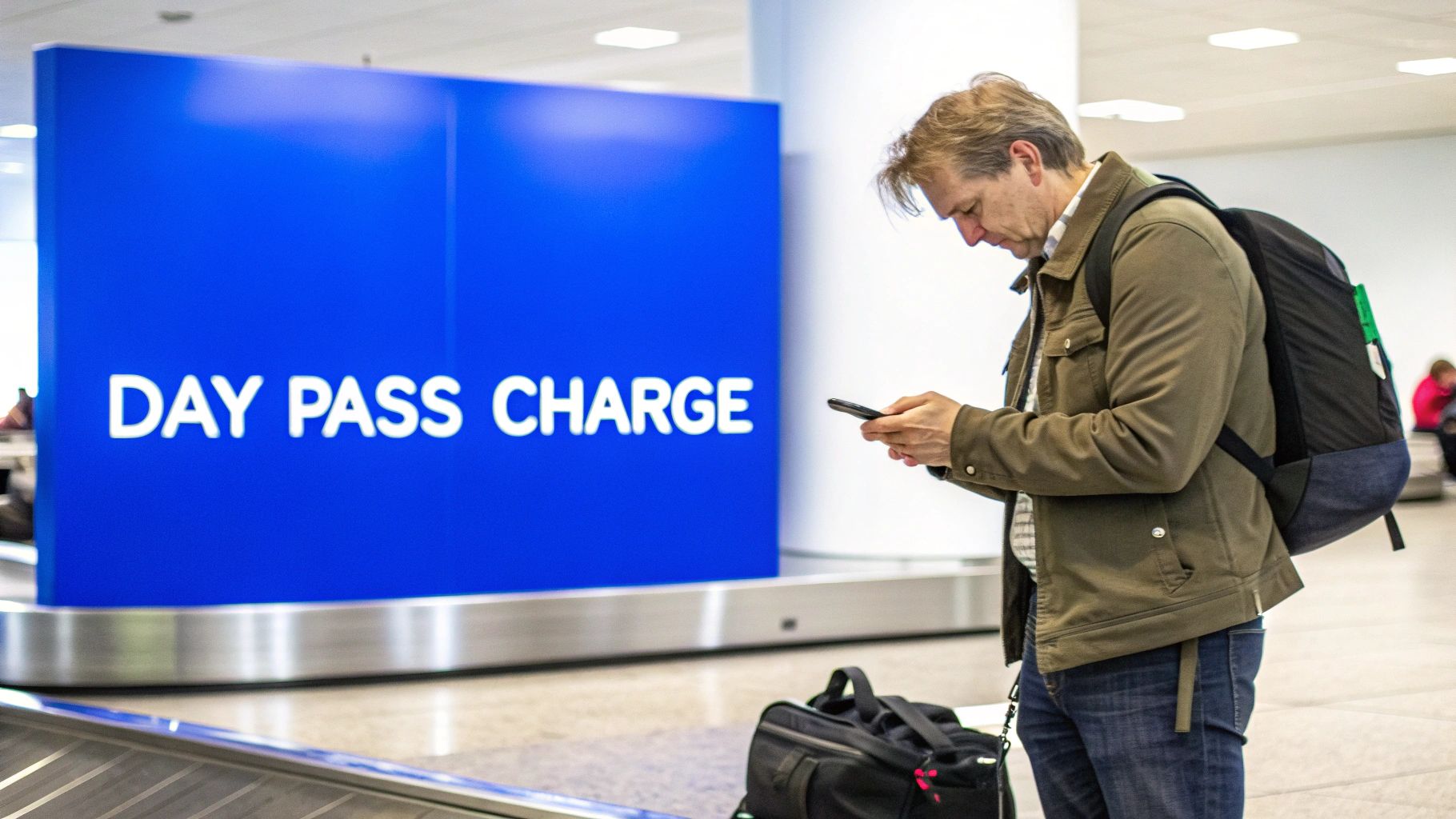
Picture this: you’ve just landed after a long flight. You switch your phone off airplane mode to send a quick “I’ve arrived safely!” text to your family. That one tiny action is all it takes to activate the International Day Pass and add a full daily charge to your account. For countless travelers, this is exactly where the trouble starts.
The service is sold on convenience, but it feels a lot like a hotel minibar—temptingly easy to use, but the bill at checkout can leave you reeling. You aren’t paying for what you use; you’re paying a flat daily fee the moment you use anything at all.
The heart of the problem is the automatic trigger. The Day Pass doesn’t ask for your permission each day. It just activates the moment your phone calls, texts, or uses mobile data abroad. This includes all those sneaky background processes you don’t even think about, like an email app syncing or a weather widget refreshing.
Let’s say you land in London and turn on your phone. You send that quick text, and—boom—you’ve just been billed $12 for the next 24 hours, even if you put your phone away immediately after. According to AT&T’s own terms, the pass activates with the first use of data, text, or a call in an included destination. You can dig into the fine print yourself on AT&T’s international plans page.
This table breaks down the difference between the advertised promise and the costly reality.
| Advertised Feature | Potential Hidden Cost |
|---|---|
| Simple Daily Fee | Triggered by any usage, even a single text or background data. |
| Convenient Activation | Activates automatically without daily consent, making it hard to control. |
| Use Your Home Plan | Only applies to your first two lines; extra lines cost $6 each per day. |
| Coverage in 210+ Destinations | Accidental roaming near non-covered borders can trigger expensive pay-per-use rates. |
Essentially, what’s positioned as a simple, convenient service is designed to bill you automatically, putting the responsibility squarely on your shoulders to avoid unwanted charges.
This pay-per-day structure can escalate costs with frightening speed, turning a supposedly straightforward roaming solution into a major travel expense. A family of four could easily find themselves paying close to $30 for a single day of what they thought was minimal phone use.
The real shock isn’t the daily fee itself, but how incredibly easy it is to trigger. It’s a system that prioritizes automatic billing over user control—the exact opposite of what most modern travelers need.
This forces you to be hyper-vigilant about managing your device just to avoid accidental charges. A much more transparent approach, like using a prepaid travel eSIM, lets you buy a set amount of data for a fixed price. With an eSIM, the risk of surprise daily fees is completely eliminated. For a clear, upfront data plan, travelers can use a provider like TapSim.
One of the most frustrating things about the AT&T International Day Pass isn’t just the price tag; it’s how ridiculously easy it is to trigger. You don’t need to be scrolling social media or streaming videos to get hit with the bill. A tiny, invisible digital handshake between your phone and a foreign network is all it takes to activate the full daily charge.
This happens because our smartphones are never truly idle. Even tucked away in your pocket with the screen off, your apps are constantly working in the background—pulling in new emails, refreshing the weather forecast, or downloading the latest podcast episode. To the Day Pass, this background activity looks exactly the same as you actively using your phone, and just like that, the $12 daily clock starts ticking.
A common source of bill shock comes from misunderstanding how AT&T defines a “day.” While the main pass runs for a full 24 hours from the moment you first use it, your travel plans rarely fit into such a neat box.
Picture this: you land in Rome at 10 PM. You send a quick text to let family know you’ve arrived, which triggers your first $12 charge. That covers you until 10 PM the next day. Simple, right? But if you’re on a multi-line plan, the $6 fee for the second line is often charged per calendar day. This mismatch can create a baffling bill where different lines on the same account get charged differently for the exact same trip.
This timing snag is especially painful during short layovers or when you’re crossing borders. Arriving late one evening and leaving early the next morning can easily land you with two separate daily charges for what feels like less than 24 hours of travel.
For families or any group traveling on the same plan, the “per line” fee structure can make your costs snowball. The daily charge applies to every single line that uses data, makes a call, or sends a text.
Let’s walk through a real-world scenario:
Over a 10-day holiday, that single, seemingly harmless action could inflate your bill by $300. This is a long way from a simple flat daily rate and a perfect example of the hidden costs that catch so many people out. To get a better handle on these fees, you can explore our detailed guide on what roaming charges are.
While the Day Pass covers calls back to the U.S. and to other included countries, phoning a local number in a country that isn’t on the list can land you with hefty pay-per-use rates. A quick call to book a local restaurant or tour operator in a non-included destination could add unexpected fees on top of your daily charge.
Tethering—using your phone as a personal hotspot for your laptop—is another common pitfall. It’s incredibly handy, but it burns through your domestic data allowance far quicker than you might realize. Laptops are data-hungry devices, and a few hours of work can easily push you towards AT&T’s data limits, leaving you with throttled (painfully slow) speeds for the rest of your trip.
At its heart, the problem is a total lack of control. The Day Pass effectively operates on an “opt-out” system, where almost any interaction with a network—whether you meant to do it or not—results in a charge. You’re billed by default unless you take very specific, proactive steps to stop it.
There’s a much simpler way to handle this: a prepaid travel eSIM. With a provider like TapSim, you buy a set amount of data for a fixed, upfront price. There are no automatic daily triggers or surprise per-line fees. You’re put firmly back in control of your spending, and you can relax knowing there won’t be an eye-watering bill waiting for you when you get home.
Picture this: you’re sailing through the Caribbean or cruising along the European coast, assuming your AT&T International Day Pass has you covered just like it would on land. It’s a common assumption, but unfortunately, it’s a very expensive mistake to make. One of the biggest and most shocking hidden costs with the Day Pass is the massive surcharge that kicks in the moment your ship leaves port.
Once you’re out at sea, your phone is no longer connecting to the usual cell towers on land. It cleverly switches over to the ship’s own satellite network to keep you connected. It’s this seamless, almost invisible switch that triggers a much, much higher daily rate, often without a single notification to warn you.
Think of it like this: on land, you’re paying city prices for your data. The second you’re at sea, you’re paying isolated, five-star resort prices for that same service. The experience feels identical, but the bill tells a very different story.
The real trap springs when your trip mixes days at sea with days in port. You might use your phone on the ship in the morning and then again while exploring a city in the afternoon. Logically, you’d expect two different rates, right? Instead, you get slapped with a single, inflated charge for the entire day. The higher sea rate always wins.
Let’s say you’re cruising near the UK and pop into a port for the day. You might think the standard pass applies, but there’s a hidden $20 per day charge if your usage spans both land and sea. That’s nearly double the standard rate. AT&T’s international travel policies are clear on this: for days with mixed use, you pay the higher cruise fee. This covers over 400 ships, and travelers on cruises everywhere from the Americas to Asia can get caught by surprise.
This visual shows just how easily a daily charge can be triggered, whether you’re on land or at sea.
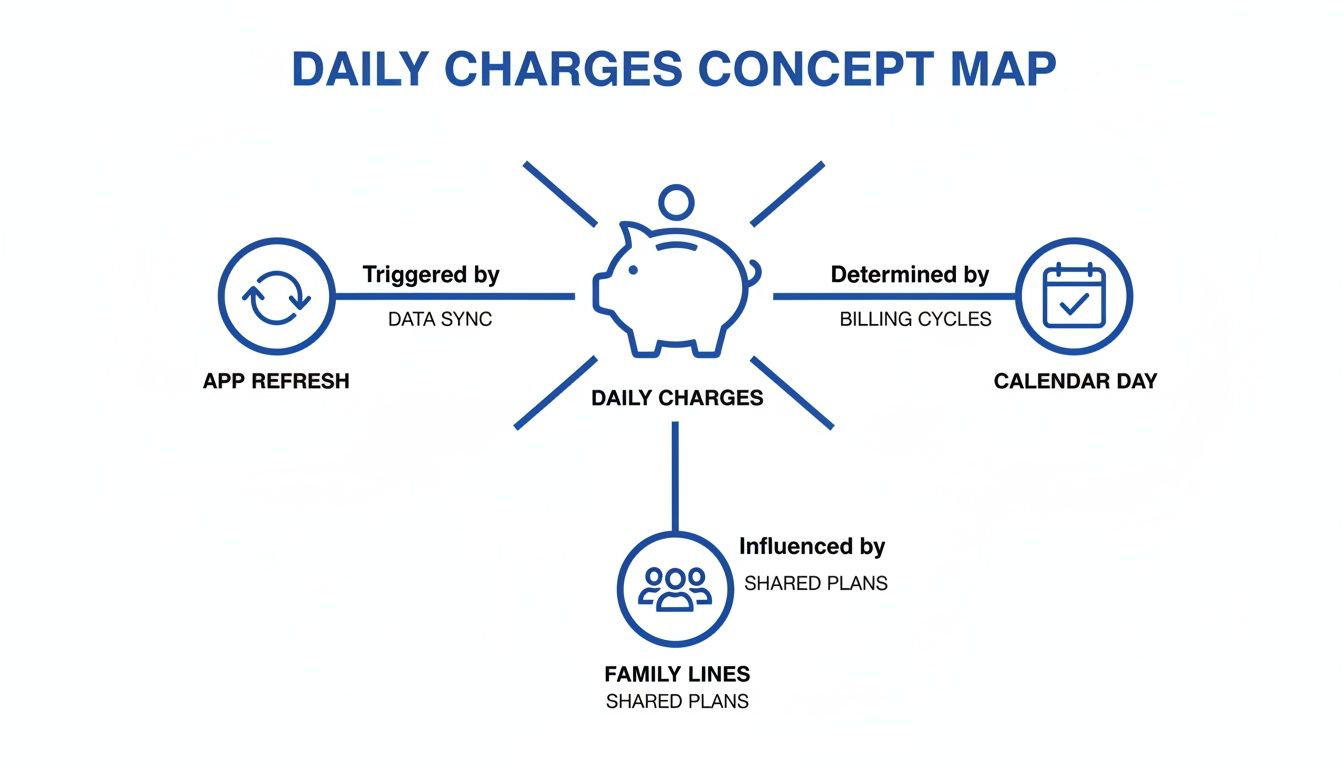
The crucial takeaway is that these charges are automatic. They can be triggered by anything from a background app refresh to someone else on your family plan sending a single text.
Let’s see how this plays out for a family of four on a seven-day Caribbean cruise.
It’s easy to see how these charges can spiral, potentially adding hundreds of dollars to your final bill and putting a serious damper on your holiday. Understanding the difference between land and sea connectivity is absolutely vital before you set sail.
Your best defense against the cruise ship surcharge is to treat the ship’s network like it doesn’t exist. Put your phone in airplane mode while you’re at sea. Only turn it back on when you’re safely docked in port and connected to a local land network.
For a more predictable and stress-free solution, a travel eSIM is the way to go. With a provider like TapSim, you buy a data plan for your specific destinations before you even leave home. You pay a single fixed price upfront, which completely eliminates the risk of surprise satellite network fees and puts you back in control of your spending.
On paper, AT&T’s International Day Pass seems to have a built-in safety net for longer trips: a cap that stops the daily charges after 10 days in a single billing cycle. For one person, that sounds like a predictable $120 maximum. But here’s the catch, and it’s a big one—it all hinges on when your monthly bill is generated.
This single detail, which is so easy to overlook when you’re busy packing, can completely blow that 10-day cap out of the water. It’s all about the phrase “per billing cycle.” If your holiday happens to cross the date your billing period resets, that 10-day counter goes right back to zero.
Let’s make this real. Imagine your billing cycle always ends on the 20th of the month. You’ve booked a fantastic 14-day trip to Europe, leaving on the 15th of June.
Here’s how AT&T’s system will see it:
Suddenly, your 14-day holiday has triggered 14 separate daily charges. The 10-day cap offered no protection at all because your trip was split across two of AT&T’s billing windows.
The 10-day cap isn’t a limit for your trip’s duration; it’s a limit on charges within a single, arbitrary 30-day billing window. This subtle distinction can easily double what you expected to pay.
This table shows exactly how a trip that crosses a billing date can lead to charges well beyond what you budgeted for.
Cost Scenario: Long Trip Straddling Billing Cycles
Let’s say your 14-day trip is split perfectly, with seven days falling into each billing cycle.
| Billing Cycle 1 | Billing Cycle 2 | Total Charged Days |
|---|---|---|
| 7 Days of Use | 7 Days of Use | 14 Days |
$12/day x 7 = $84 |
$12/day x 7 = $84 |
$168 |
As you can see, instead of being capped at $120, the final bill for roaming comes to $168, and that’s before taxes and other fees. For a family of four, this simple timing mistake could add hundreds to your bill.
On top of the daily fees, you’ll find another layer of cost in the small print: taxes and administrative surcharges. These are never advertised in the headline price but can add a hefty percentage to your final total.
Let’s say you’re on a 12-day business trip abroad. You’re banking on the 10-day cap, expecting a maximum bill of $120 per line. But the billing cycle misalignment could trigger charges across two months, and you might also see local taxes tacked on without much warning. While AT&T’s documents confirm the cap, countless user reports show people being overbilled simply due to this date confusion. You can read more about how these charges catch travellers off guard.
This lack of clarity makes it almost impossible to budget accurately. The price you see isn’t the price you pay. It’s a completely different experience with a prepaid travel eSIM. With providers like TapSim, what you see is what you get—no surprise taxes, no admin fees, and no billing cycle traps. You simply buy the data you need for a fixed price, giving you total control and, more importantly, peace of mind.
Knowing the traps of the AT&T International Day Pass is one thing, but actively taking control is how you actually save yourself from a shocking bill. The trick is to shift from reacting to charges to preventing them in the first place, and that all comes down to a simple pre-travel checklist. These are small, easy actions you can take right now to make sure your phone doesn’t start spending your holiday money without your permission.
Think of it as creating a digital bubble around your device before you even step on the plane. By tweaking a few key settings, you can stop your phone from automatically latching onto a foreign network and triggering that initial, costly daily fee.
Before your flight even takes off, it’s worth spending a few minutes running through these crucial steps. It might seem small, but this can prevent days of unwanted charges. You’re essentially putting your phone into a low-cost travel mode.
These three steps build a strong defense against the most common automatic triggers. But you also need to manage your usage consciously while you’re actually on your trip.
The goal is to make Wi-Fi your primary connection and treat mobile data as a tool you use deliberately, not one that runs automatically. This simple mindset shift puts you back in the driver’s seat.
Even with your settings adjusted, you need to stay vigilant. The Day Pass can still be triggered by calls or texts, so adopting Wi-Fi-first habits is absolutely essential.
While these defensive tactics work, they demand constant attention. A much simpler and more reliable approach is to opt out of the daily-charge model altogether. This is where a travel eSIM becomes the smart choice.
With a provider like TapSim, the whole financial model is flipped on its head. Instead of an open tab that charges you $12 every 24 hours for any usage, you buy a specific amount of data for a fixed, upfront price. You know exactly what you’re spending before your trip even begins.
This model completely gets rid of the risk of hidden costs. There are no daily charges, no sneaky background usage fees, and absolutely no surprise bills waiting for you back home. You’re in complete control, free to use your data as you see fit without worrying about triggering a new fee. Check out the available eSIMs on TapSim.net to find a plan that fits your travel style.
Once you’ve seen all the ways hidden costs can creep into your bill, it’s clear that plans like the AT&T International Day Pass are built around automatic billing, not traveler control. The constant worry about background data triggering a new charge or getting caught by a billing cycle trap adds a layer of stress nobody needs on their trip. This is exactly where a modern alternative changes the game.
A travel eSIM works on a totally different principle. Instead of an open-ended tab that hits you with a $12 charge every time your phone connects, you buy exactly what you need upfront for one fixed price. It’s a simple but powerful shift from a reactive, “pay-when-it-triggers” model to a proactive, prepaid one.
The real beauty of an eSIM is its straightforwardness. You pick a data package that suits your trip, whether that’s a long weekend in Paris or a month-long trek through Asia. There are no automatic daily fees to watch out for because the system simply isn’t designed to catch you out.
With a travel eSIM, the very idea of a “hidden cost” vanishes. You pay for a specific amount of data, and that’s the end of it. You are in the driver’s seat from the moment you buy your plan.
This approach gets rid of the anxiety that comes with accidental usage. You can leave your phone on without panicking that a background app refresh will cost you a day’s worth of roaming fees. It gives you the freedom to relax and actually enjoy your travels, not spend them policing your device settings. To learn more about this approach, have a look at our guide on using an eSIM for international travel.
Another huge plus is just how easy it is. With a provider like TapSim, you can buy and set up your eSIM from your sofa before you’ve even packed your bags. Activation is immediate, so you can land at your destination, switch on your phone, and be online within minutes.
At the end of the day, a travel eSIM is about having genuine peace of mind. It’s a smarter, more affordable, and much less stressful way to stay connected, turning your phone from a potential budget-buster back into the helpful travel companion it’s meant to be.
Here are some quick, no-nonsense answers to the questions we hear most often from travelers trying to figure out the best way to stay connected on their trips.
Yes, but you have to act fast. Once the AT&T International Day Pass kicks in, a 24-hour timer starts ticking. To stop the meter running and avoid being charged for another day, you need to cut off all data usage before that window closes. Your best bet is to switch your phone to airplane mode and double-check that all background data is turned off.
The most surefire method is to dive into your phone’s settings and switch off data roaming before your plane even touches down. This acts as a physical block, stopping your phone from connecting to a foreign mobile network for data. If you want to be completely certain, just keep your phone in airplane mode and stick to Wi-Fi.
It can be, but you’re often trading cost for hassle. Think about it: you have to track down a local shop, deal with a potential language barrier, and physically swap out your SIM card. While you’re doing all that, you could be missing important calls and texts coming to your regular number. A travel eSIM is a far simpler and more modern approach.
The real problem with daily roaming passes isn’t just the headline price—it’s the complete lack of control. A prepaid eSIM flips that script entirely, putting you firmly in charge of what you spend right from the get-go.
An eSIM is all about transparency. You pay a single, fixed price upfront for a specific amount of data, which completely sidesteps the risk of AT&T International Day Pass hidden costs. There are no automatic daily charges, no billing cycle headaches, and definitely no surprise fees waiting for you back home. With an eSIM from a provider like TapSim, you can get it all set up in minutes and land at your destination with data ready to go.
Ready for a smarter, stress-free way to travel? TapSim offers transparent, affordable eSIM data plans for over 150 destinations, so you can connect the moment you arrive without any hidden fees. Check available eSIMs on TapSim.net and travel with confidence.