eSIM for Business Travel: What to Know
Learn how esim for business travel cuts roaming costs, speeds arrival setup, and keeps teams connected with clear data limits and fewer surprises.
Not long ago, staying connected abroad meant navigating a minefield of eye-watering roaming charges or scrambling to find a local SIM card the moment you landed. Thankfully, things have moved on. Today, your main choice is between the classic physical SIM card you pop into your phone and the newer digital eSIM that’s built right in. Understanding the difference is your first step toward affordable, easy internet access, no matter where your travels take you.
Think of a SIM card as your phone’s passport. It’s the tiny chip—the Subscriber Identity Module—that identifies you to a mobile network, giving you the green light to make calls, send texts, and browse the web. Without one, your smartphone is just a very smart, pocket-sized computer that’s stuck on Wi-Fi.
For a traveler, this little piece of tech is a lifeline. It’s how you’ll book a ride-share from the airport in Bangkok, look up the best gelato in Rome, or video call home from a beach in Bali. The type of SIM you choose will genuinely shape your entire connectivity experience on the road.
Every SIM option out there, from the one in your pocket now to the one you’ll use for your next trip, belongs to one of two main families. Knowing the difference is crucial before you even start packing.
Before you get excited about new SIM options, there’s a vital first step: you must check if your phone is unlocked. A locked phone is tied to a specific network, but an unlocked one gives you the freedom to use any SIM, physical or digital, from almost any provider worldwide.
Both types do the same fundamental job: they get you connected. But how they do it, especially when you’re miles from home, couldn’t be more different.
This guide will walk you through it all, from the chunky plastic cards of the past to the instant digital connections that are changing travel for good. With options like TapSim, travelers can activate data the second they land, making for a truly seamless start to any trip. By the time we’re done, you’ll know exactly which SIM solution is the right one for your next adventure.
Before digital eSIMs made travel connectivity as easy as tapping a screen, staying online abroad meant fumbling with a physical SIM card. It’s a tiny piece of plastic that, believe it or not, started out the size of a credit card. Understanding its journey from a bulky slab to a minuscule chip helps explain not just why your new phone has such a tiny slot (or none at all), but also why the whole system was ready for a digital upgrade.
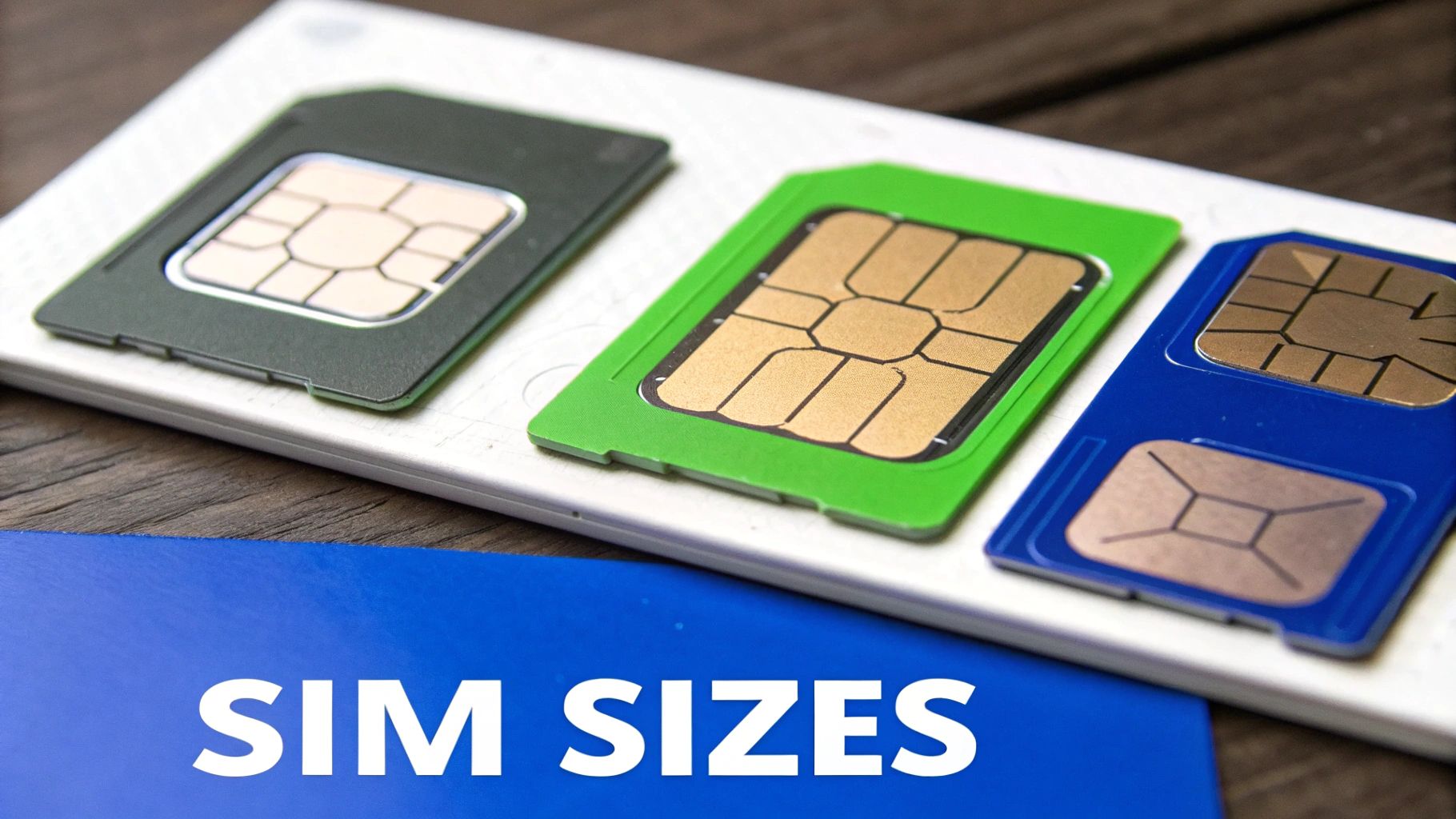
This incredible shrinking act wasn’t just about saving space. It was a direct response to our demand for sleeker phones with more room for bigger batteries and better cameras. But for travelers, it created a confusing mess of different SIM sizes and a constant worry about compatibility.
Let’s go back to the beginning. The very first SIM card, the Full-Size SIM (1FF), landed in 1991. It was enormous – literally the size of a credit card – and was designed for the hefty car phones of that era. Today, it’s a museum piece, completely impractical for the pocket-sized devices that were just around the corner.
This led to the Mini-SIM (2FF) in the late 1990s. This is the one most of us probably remember as the “standard” SIM card. It powered countless classic Nokia and Motorola phones and was the go-to format for over a decade, making international phone rentals a common sight at airports for frequent flyers.
Then smartphones arrived, and the race was on to make them thinner, faster, and more powerful. Every single millimeter of internal space became precious, which led directly to the next two major size reductions.
This constant shrinking solved one problem for phone manufacturers but created a brand-new one for globetrotters. There’s nothing quite like the frustration of landing in a new country, only to find the local SIM card you just bought doesn’t fit your phone. It’s a classic travel snag that has left countless people disconnected at the worst possible time.
The physical SIM’s journey from a bulky card to a tiny chip mirrors the evolution of mobile phones themselves. Each size reduction enabled slimmer, more powerful devices, but it also introduced compatibility headaches for travelers who just wanted to get online.
The table below gives you a quick visual guide to how these cards stack up, which can be handy if you’re trying to figure out what an older device might use.
| SIM Type | Size (mm) | Introduced | Commonly Found In |
|---|---|---|---|
| Full-Size (1FF) | 85.6 × 53.98 | 1991 | Early car phones and mobile equipment (now obsolete) |
| Mini-SIM (2FF) | 25 × 15 | 1996 | Feature phones and early smartphones (e.g., iPhone 3GS) |
| Micro-SIM (3FF) | 15 × 12 | 2003 | Mid-era smartphones (e.g., iPhone 4, Samsung Galaxy S3) |
| Nano-SIM (4FF) | 12.3 × 8.8 | 2012 | Most modern smartphones from 2012 onwards |
As you can see, the difference between a Micro and a Nano-SIM is just a few millimeters, but it makes all the difference when you’re trying to get connected.
Even with the Nano-SIM becoming the standard, sticking with physical cards still throws up some all-too-familiar problems for anyone on the move.
These real-world hassles are exactly what paved the way for a smarter technology. The limitations and sheer inconvenience of swapping little plastic chips created a clear need for a digital solution – one that could give you instant connectivity across multiple destinations without any tiny, losable parts. And that’s where the modern eSIM comes in, completely changing the game for travelers everywhere.
After years of fiddling with ever-shrinking bits of plastic, it’s time to meet the technology that gets rid of them altogether: the eSIM, or embedded SIM. This isn’t another physical card you have to keep track of; it’s a tiny chip that’s already built right into your phone, waiting to be brought to life digitally.
The best way to think of it is as a “digital key” for your mobile. Instead of needing a physical key (a plastic SIM card) to unlock a phone network, you simply download the right digital one for the country you’re in. This completely changes the game for travelers, turning a classic airport headache into a simple task you can do before you even leave home.
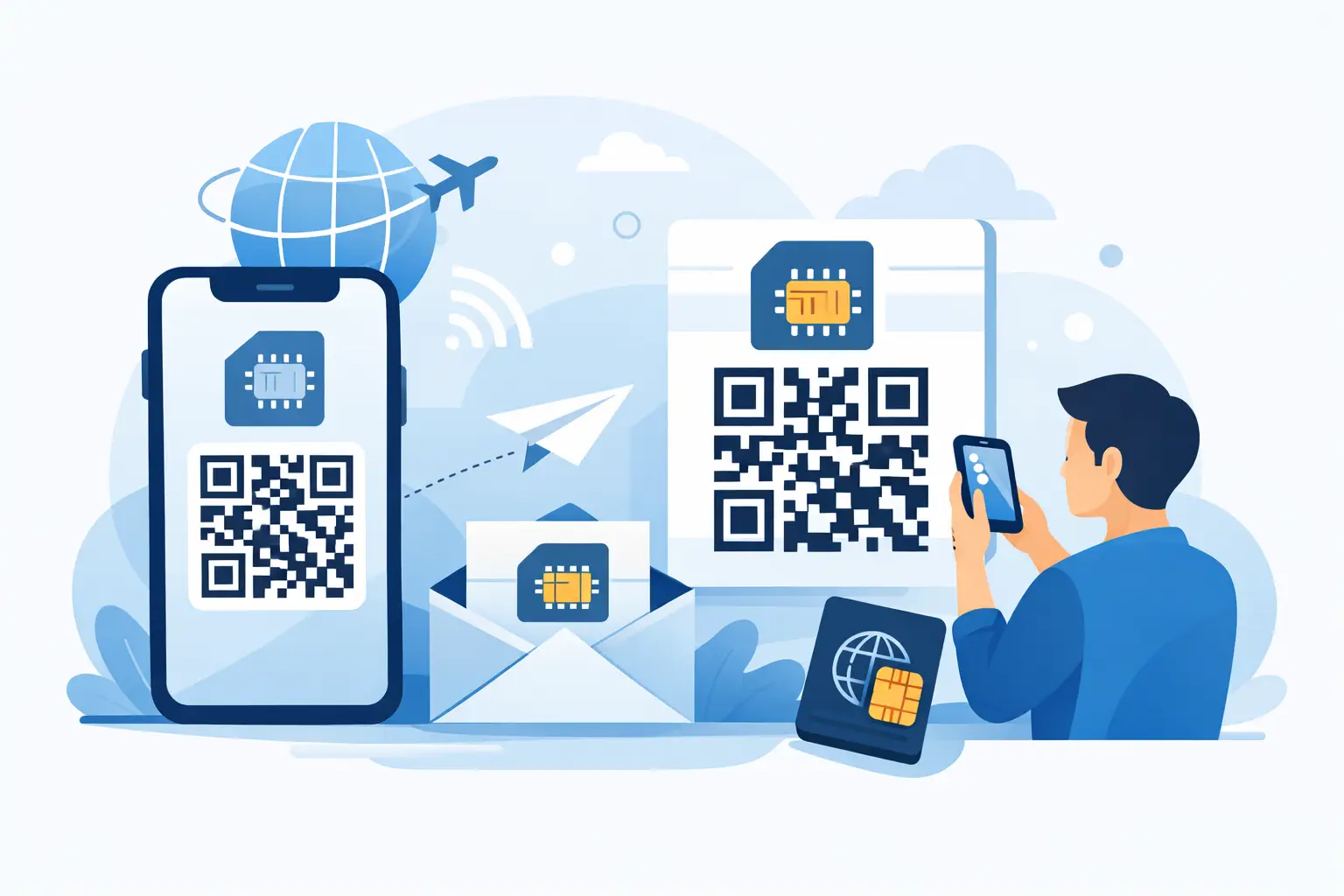
If you’ve ever found yourself hunting for a SIM card shop in a new city or fumbling with that tiny pin-like tool, the appeal is instant. The process couldn’t be simpler: you buy a data plan online, get a QR code in your email, scan it with your phone, and you’re sorted. Your travel data plan is installed and ready to go the moment you land.
The real magic of an eSIM isn’t just the tech itself, but what it does for your trip. It’s all about removing the hassle and getting you connected faster, so you can focus on your travels instead of staring at your phone’s signal bars.
From a traveler’s point of view, here’s where it really shines:
This move to digital connectivity is more than just a passing trend. The market for eSIMs is growing rapidly as more travelers discover the benefits. You can read more about the growing eSIM market and see how it’s changing travel.
So, how does this play out in the real world? Imagine you’re planning a two-week trip to Japan. Instead of spending hours researching local phone companies and trying to find a kiosk at the airport, you can just visit an eSIM provider like TapSim from the comfort of your sofa.
You pick a data package that fits your trip—let’s say, 10 GB for 14 days. After a quick payment, a QR code lands in your inbox. You scan it, and just like that, the Japanese data plan is added to your phone. It sits quietly in the background until you arrive in Tokyo, where you simply switch your cellular data over to the new eSIM. It’s a completely seamless experience built for modern travel.
An eSIM transforms mobile data from a physical product you have to find and buy into a digital service you can instantly access. It’s the difference between queuing for a ticket and having a boarding pass on your phone.
This is exactly why so many globetrotters are making the switch. With an eSIM, you’re back in control of your connectivity. It gives you a reliable and fair way to get online in over 150 destinations without the dreaded fear of surprise roaming charges. For a deeper dive into the mechanics, have a look at our guide on what an eSIM is and how it works. It’s a powerful, practical solution to one of travel’s oldest problems.
When you’re gearing up for a trip, choosing between different SIM card types really comes down to one simple question: what’s going to be the easiest, cheapest, and most reliable way to stay connected thousands of miles from home?
For years, the physical SIM was the only game in town. Now, the modern eSIM has arrived, offering a powerful new way to get online abroad. Let’s put them head-to-head on the things that really matter to a traveler.
The biggest difference you’ll notice straight away is how you actually get connected. With a physical SIM, your first task after a long-haul flight is often hunting down a local mobile phone shop. This can mean fumbling with a new language, trying to make sense of confusing plans, and dealing with local registration paperwork—all when you’re tired and just want to find your hotel.
An eSIM completely flips that script. You can sort out your entire data plan from your sofa before you even leave for the airport. With an eSIM from TapSim, for instance, you just get a QR code in your email, give it a quick scan, and your plan is good to go. The moment the plane touches down, you just switch to your travel eSIM in your phone’s settings, and boom—you’re online. No queues, no fiddling with tiny bits of plastic, and absolutely no stress.
If you’re visiting more than one country, flexibility is everything. Think about backpacking across Europe or hopping between cities on a business trip through Asia. Using physical SIMs means you have to go through the whole buying-and-installing process in every single country. It’s not just a hassle; the costs can really start to add up.
This is where an eSIM really shines. Many providers offer regional or even global plans that cover dozens of countries in one simple package. You can install one eSIM for your entire European adventure, and it will automatically connect to the best local network as you cross each border. It just works.
A globetrotter can think of an eSIM as a universal travel adapter for mobile data. Instead of needing a different physical plug for each country, you have one digital solution that works seamlessly wherever you go.
Even better, if your phone has dual SIM capabilities, you can keep your home SIM active for calls and texts while using your travel eSIM for data. When comparing physical SIMs and eSIMs, it’s a great idea to check out the best dual SIM phones for travelers, as they give you the ultimate freedom to use both.
Losing your phone is a traveler’s worst nightmare. The type of SIM you use can make a big difference in how secure your information is if the worst happens. A physical SIM card can be popped out and put into another phone in seconds, potentially giving a thief access to your number for calls and two-factor authentication codes.
An eSIM, on the other hand, is built right into your phone’s hardware. It can’t be physically removed, which makes it much harder for someone to hijack your line. You can also deactivate your eSIM profile remotely, adding another valuable layer of security for your digital life when you’re far from home.
To break it down even further, let’s look at a direct comparison of the features that travelers care about most.
| Feature | Physical SIM Card | eSIM (like TapSim) |
|---|---|---|
| Activation | Requires finding a store, purchasing, and physically inserting the card. | Instant digital activation via QR code, often before you even travel. |
| Flexibility | Usually locked to one country or network; requires a new SIM for each destination. | Easily switch between plans; regional and global plans cover multiple countries. |
| Device Compatibility | Works with nearly any unlocked phone, old or new. | Requires a modern, eSIM-compatible smartphone. |
| Security | Can be removed and used by a thief if the phone is stolen. | Embedded in the device, cannot be physically removed, and can be remotely deactivated. |
| Convenience | Risk of losing or damaging the tiny card when swapping. | No physical parts to lose; manage plans directly from your phone’s settings. |
| Availability | Available in airports and mobile shops worldwide. | Purchased online from anywhere with an internet connection. |
Ultimately, while both get you online, the experience is worlds apart. The eSIM is designed for the modern traveler who values speed and simplicity.
This simple decision tree can help you figure out which path is right for your device.
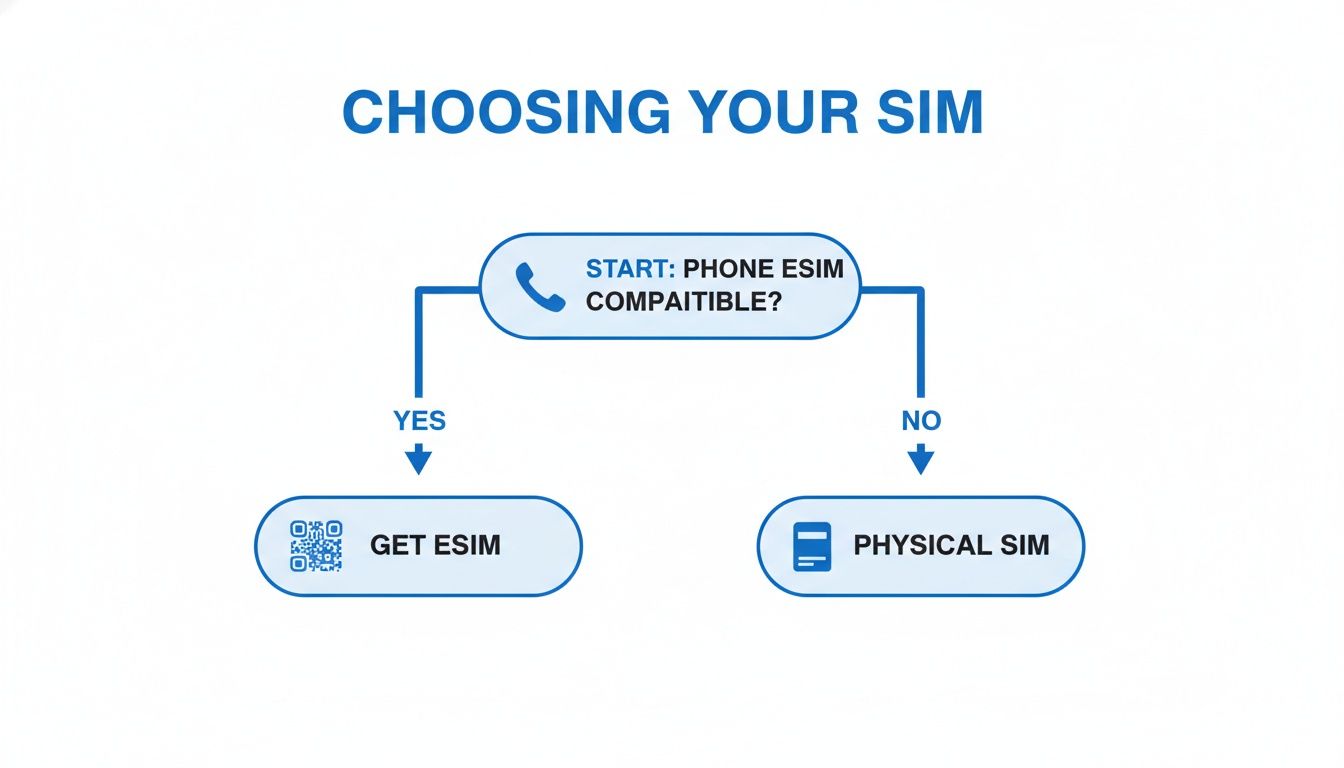
As the flowchart shows, the first and most important step is simply checking if your phone supports eSIM technology.
Look, a local physical SIM might occasionally offer slightly cheaper data if you’re staying put in one country for several weeks. But for most international trips, the sheer convenience, security, and flexibility of an eSIM are pretty hard to argue with. The ability to land, switch on your phone, and be connected instantly removes one of the biggest headaches of arriving in a new place.
For today’s travelers—whether you’re on a weekend city break or working as a digital nomad—an eSIM is the most straightforward and effective solution. To see just how much it can simplify your next trip, learn more about using an international SIM card without roaming fees.
Before you can dive into the world of digital SIMs for your travels, you need to answer one crucial question: is your phone actually compatible with eSIM technology? It’s a simple check, but an essential one. Knowing this unlocks a much easier and often cheaper way to get data on your next trip. Most newer phones from big names like Apple, Samsung, and Google have included this tech for years, but it always pays to be certain.
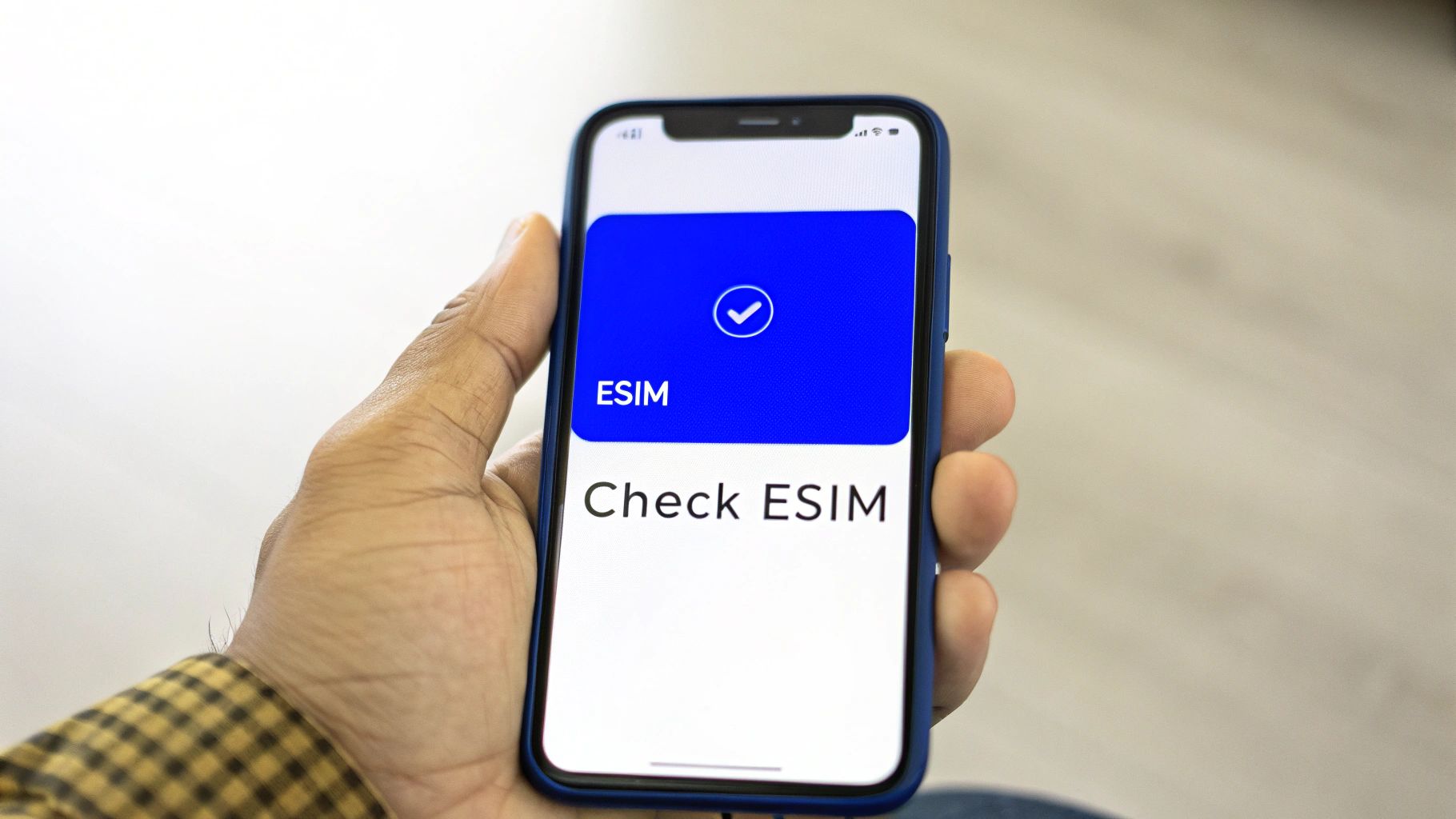
This isn’t just about browsing the web. An eSIM for data means your main number stays active for things like bank verification texts, allowing you to use your digital wallet abroad without a hitch.
Thankfully, you don’t need a degree in tech support to figure this out. There are a couple of straightforward ways to check, whether you’re on an iPhone or an Android.
For iPhone Users:
For Android Users (Samsung, Google Pixel, etc.):
That EID number is the key. It’s the unique identifier for the embedded chip inside your phone. Seeing it in your settings is the clearest possible sign that you can start shopping for travel eSIM plans.
While digging through your phone’s settings is a solid way to check, there’s an even faster route. We’ve put together a simple, up-to-date compatibility checker that takes all the guesswork out of the equation.
You can visit our list right here: Does My Phone Support eSIM?. In just a few seconds, you’ll know for sure if your device is ready.
Checking this before you travel is a smart move. It means you can browse and buy an affordable data plan for your destination with complete confidence, knowing you’ll be able to get connected the moment your plane touches down.
Figuring out mobile connectivity abroad can feel like a bit of a minefield, especially when you’re busy planning a trip. Getting straight, honest answers is the key to a stress-free journey. So, let’s tackle some of the most common questions travelers have about SIM cards and eSIMs, giving you the practical advice you actually need.
Yes, you absolutely can. Most modern phones that support eSIMs also come with a traditional physical SIM tray. This combination is known as Dual SIM, and for a traveler, it’s a game-changer.
This setup lets you keep your regular number active on the physical SIM, so you don’t miss important calls or bank verification texts from home. At the same time, you can pop a travel eSIM on your phone for cheap, local mobile data at your destination. You get the best of both worlds: affordable, fast internet abroad without ever losing access to your main phone number.
It’s surprisingly easy to manage, too. In your phone’s settings, you just choose which line to use for data and which to use for calls and texts, putting you firmly in control.
Absolutely nothing—and that’s one of the best things about using an eSIM for your travel data. Your WhatsApp account is tied to your phone number, not the SIM card that’s actually providing the internet connection.
As soon as you activate a data-only travel eSIM, your phone gets online, and WhatsApp just keeps working with your existing number. All your chats, groups, and contacts will be right where you left them.
This means you can stay in touch with friends and family back home using the number they already have. There’s no confusion, no need to set up a new account—it’s completely seamless.
This is a massive advantage for anyone who relies on messaging apps to coordinate plans, share holiday photos, or make calls over the internet.
It might seem like the easiest option after a long flight, but buying a SIM card at the airport often has some major downsides. Airport kiosks are famous for charging a premium for plans that offer far less data than what you could find online or in the city centre.
You might also find yourself stuck in a long queue, especially if a big flight has just landed. On top of that, language barriers can make it tricky to understand the different plans, let alone the local registration rules.
A travel eSIM is a much smoother and often more secure alternative. You can buy and install one from a trusted provider like TapSim before you even pack your bags. This way, you’re connected the moment your plane touches down, letting you skip the queues and get your trip started right away.
The world of SIM technology is always evolving, and you might hear about new concepts like iSIM (integrated SIM), which is built directly into a phone’s main processor. However, these newer technologies are still in their very early days and aren’t really a practical option for consumer travel just yet.
For any traveler planning a trip today, the choice really boils down to two main options:
Right now, the eSIM is the most modern, flexible, and convenient technology out there for international travel. It cuts out all the physical hassle and gives you instant connectivity, which is why it’s the main focus for providers dedicated to giving travelers a seamless, fair, and honest experience abroad.
Nope, your main phone number won’t change at all. A data-only travel eSIM, like the ones from TapSim, simply adds a second line to your phone purely for internet access. Your primary number, which is linked to your physical SIM card (or your main eSIM), stays completely untouched.
This is a huge benefit. It means you can still get those important calls and texts (like bank verification codes) on your regular number, all while using the cheap, local data from your travel eSIM. You just tell your phone to use the travel eSIM for mobile data, and everything else stays exactly the same.
This can be a real dealbreaker for digital nomads, remote workers, or families who need to get multiple devices online. The short answer is: yes, most do!
Many travel eSIM providers, including TapSim, offer plans that let you share your data connection with a laptop, tablet, or another phone through a personal hotspot. It’s always a good idea to check the specific details of the plan you’re buying, though. Some “unlimited” plans from other providers can have sneaky fair-use policies that restrict or throttle hotspot data.
A good provider will be completely transparent about this, so you can choose a plan with confidence, knowing you can get your work done or keep the family’s devices online without any nasty surprises.
Ready to travel without the connectivity headaches? With TapSim, you can get online in over 150 destinations in just a few taps. Check available eSIMs on TapSim.net and enjoy fair, fast, and honest mobile data on your next adventure.