Best eSIM for Balkans road trip (Cross-border guide): Reliable data on the go
Share:
If you’re gearing up for a road trip through the Balkans, the best thing you can do for your sanity and your wallet is to get a regional eSIM that covers every country on your route. This is especially true for non-EU nations like Serbia and Albania. A single digital SIM means you get instant, non-stop data as you drive across borders, completely sidestepping the old routine of hunting for local SIMs or getting stung by eye-watering roaming fees.
Your Guide to Staying Connected on a Balkans Road Trip
A proper road trip through the Balkans is an incredible adventure, full of stunning coastlines, ancient cities, and a whole lot of border crossings. But here’s the rub: how do you stay online without racking up huge roaming charges or getting stuck juggling a half-dozen different SIM cards?
This guide is all about the modern, hassle-free answer: a regional eSIM. Think of it as your digital passport to the internet, giving you seamless data whether you’re cruising from Croatia into Montenegro or making your way from Serbia down to North Macedonia.
Why a Regional eSIM Changes Everything
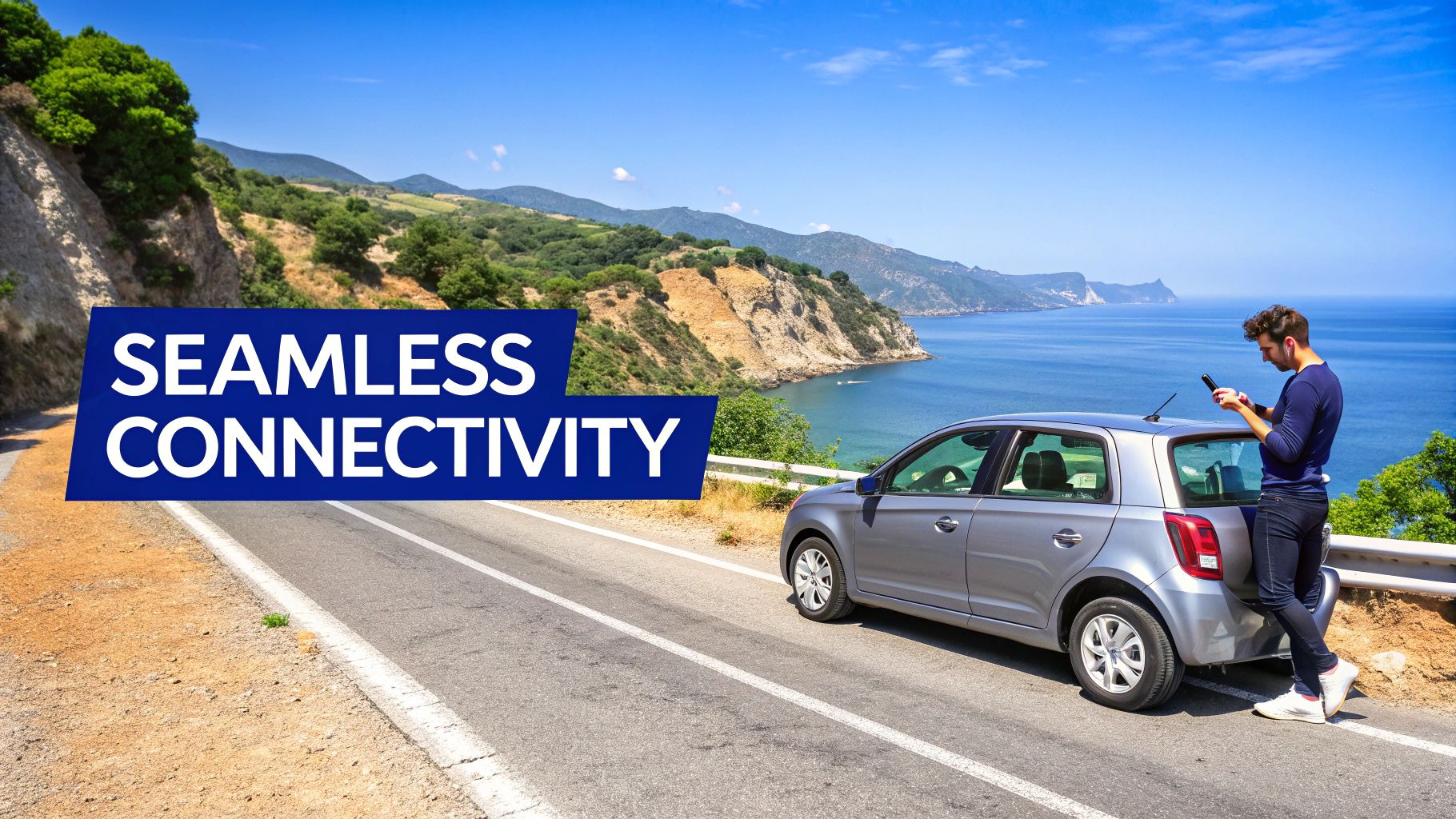
Picture this: you’re driving the magnificent Adriatic highway, the views are epic, and then you cross the border. Your phone signal vanishes. Google Maps goes blank. It’s a classic road trip headache that a multi-country eSIM makes a thing of the past.
Instead of pulling over at the first kiosk you see in a new country, you simply install one digital plan on your phone before you even lock your front door. With TapSim, travelers can activate data instantly before takeoff and be connected the second the plane touches down.
This approach is a massive win for any multi-country journey:
No More Lost Signals: Keep your maps and music streaming without a blip as you cross from one country to the next.
Keep Costs Down: Say goodbye to bill shock. You’ll avoid those notoriously high roaming fees, which can be a real problem in the non-EU Balkan countries.
Total Convenience: No more awkward attempts at buying a SIM card in a language you don’t speak. Just tap and go.
Get Online Instantly: You’re connected in minutes, either right before you land or as soon as you arrive.
A regional eSIM just makes your trip smoother. It saves you money and guarantees you’ve always got access to maps, translation apps, and whatever else you need online. It’s how smart travelers do multi-country trips these days.
Deciding how you’ll stay connected really sets the tone for your whole trip. Getting sorted with a single, elegant solution like a regional eSIM takes the headache out of dealing with the patchwork of mobile networks across the Balkan peninsula. It lets you focus on the amazing views and incredible culture, not where you’ll find the next Wi-Fi hotspot.
To get a better sense of your options, here’s a quick rundown of the most common ways travelers get data in the Balkans.
Balkans Connectivity Options at a Glance
Connectivity Method
Best For
Pros
Cons
Regional eSIM
Multi-country road trips, convenience seekers
Instant activation, covers multiple countries with one plan, no physical SIM needed
Requires a newer, eSIM-compatible phone
Local SIM Cards
Long stays in one country, budget travelers
Often the cheapest per-gigabyte rates, widely available
Inconvenient for multi-country trips, need to buy a new one at each border
Home Provider Roaming
Short trips to EU countries, travelers who prioritise simplicity
Seamless and automatic, uses your existing number
Can be extremely expensive, especially in non-EU nations
Pocket Wi-Fi Device
Groups or families with multiple devices, heavy data users
Connects several devices at once, secure connection
Another device to carry and charge, can have high rental and data costs
Ultimately, a regional eSIM offers the best balance of convenience and cost for a true cross-border adventure. As we dig deeper, you’ll see just how perfectly this tech is suited for the twists and turns of a Balkan road trip. If you’re curious, you can check out some of the worldwide eSIMs from TapSim to see what plans are available.
How a Regional eSIM Makes Border Crossings a Breeze
Picture this: you’re cruising down the breathtaking Adriatic highway, leaving Croatia and heading into Montenegro. With an old-school SIM card, this is usually the moment your connection drops. The next hour is a frustrating cycle of searching for Wi-Fi and then hunting down a local mobile shop to buy a new SIM. A regional eSIM for the Balkans completely sidesteps this entire mess.
Think of it as a master key for mobile networks. Instead of being locked to a single provider in one country, a regional eSIM gives your phone access to multiple networks across the whole area. It’s a single digital profile that lets your phone automatically hop onto a local network the second you cross a new border.
This means Google Maps keeps directing you, your Spotify playlist doesn’t miss a beat, and you stay connected without having to do a single thing. It’s not just a digital SIM; it’s a genuinely smarter way to travel, built to erase those annoying connectivity blackouts.
The Magic Behind Automatic Network Switching
The real secret sauce of a regional eSIM is its ability to roam intelligently. A physical SIM is hardwired to one mobile operator. When you take it abroad, it has to ‘roam’ on a partner network, which is often code for eye-watering fees.
A regional eSIM, however, comes pre-loaded with access passes to a whole range of networks in different countries.
One Profile, Many Networks: Your single eSIM profile holds the digital keys to several mobile operators across the Balkans.
Smart Detection: As your car crosses the border, your phone picks up on the new location and available networks.
Seamless Handover: The eSIM automatically latches onto the strongest partner network in your new country, usually within seconds.
The whole process happens in the background. No restarting your phone, no fiddling with settings, no manual network selection. It’s true set-it-and-forget-it connectivity, which is exactly what you need on a road trip where you might cross several borders in a single day.
Why This Matters for a Balkans Road Trip
The Balkan peninsula is a fascinating mix of EU and non-EU countries, a detail that’s crucial when it comes to mobile data. For EU residents, roaming inside the Union is pretty simple. But the moment you drive into a non-EU country like Albania, Serbia, or Bosnia and Herzegovina, your home provider’s roaming charges can skyrocket.
This is the exact problem a dedicated Balkan regional eSIM is built to solve. It treats the entire region—EU and non-EU alike—as one big coverage zone, giving you a predictable price and a hassle-free data connection wherever your itinerary takes you.
A regional plan is your shield against bill shock. By bundling both EU and non-EU Balkan countries into one package, you get a flat-rate data plan that works everywhere, saving you from having to constantly worry about which side of a border you’re on.
With a TapSim plan, for example, you can drive from Slovenia (EU), through Croatia (EU), and into Bosnia and Herzegovina (non-EU) without giving your data a second thought. The eSIM handles all the complex network gymnastics behind the scenes, leaving you free to focus on the road. This is the kind of effortless connectivity that makes the best eSIM for a Balkans road trip an absolute must-have.
How to Choose the Right Balkans eSIM Plan
Not every eSIM is cut out for the unique patchwork of a Balkans road trip. It’s easy to get drawn in by a cheap headline price, but the real test comes when you’re crossing multiple borders. A plan that works beautifully for a week on the Croatian coast might leave you completely offline the second you drive into Albania.
To find the right eSIM for your adventure, you need to think like a road-tripper. That means matching the plan to your specific itinerary by balancing country coverage, data allowance, and how long the plan lasts. Getting this right is the difference between seamless connectivity and a frustrating search for Wi-Fi.
Check the Country Coverage List First
This is the absolute first thing you should do. The Balkans is a fantastic mix of EU and non-EU countries, and that’s where many generic ‘Europe’ plans fall flat. They often leave out non-EU states like Serbia, Bosnia and Herzegovina, and North Macedonia. Always, always check the fine print and verify the specific country list before you buy.
A proper regional Balkans plan is built for this very challenge. With TapSim, for instance, you can grab a single package that bundles all these diverse countries together, creating one big data zone. It’s the easiest way to avoid that sinking feeling of losing your connection just as you’re navigating away from a border crossing.
If your trip extends beyond the region, our guide on choosing an eSIM for Europe travel has some broader strategies you might find useful.
Calculate Your Data Needs Realistically
How much data do you really get through on the road? It’s probably quite different from your usage at home. Navigation apps like Google Maps or Waze are essential but sip data surprisingly slowly. On the other hand, streaming music or podcasts to pass the time on long drives will chew through your gigabytes much faster.
Here’s a rough guide to help you estimate:
Light User (1-3 GB per week): You’re mainly using maps, sending messages, and doing a bit of light browsing.
Medium User (5-10 GB per week): This covers regular social media use, a good amount of music streaming, and the odd video call back home.
Heavy User (20+ GB per week): Perfect if you’re working remotely, streaming videos, or uploading lots of high-resolution photos and clips.
It’s always better to have a little more data than you think you’ll need. The stress of running out mid-trip is far worse than the cost of an extra gigabyte. Most eSIM providers, including TapSim, make it simple to top up if you start running low.
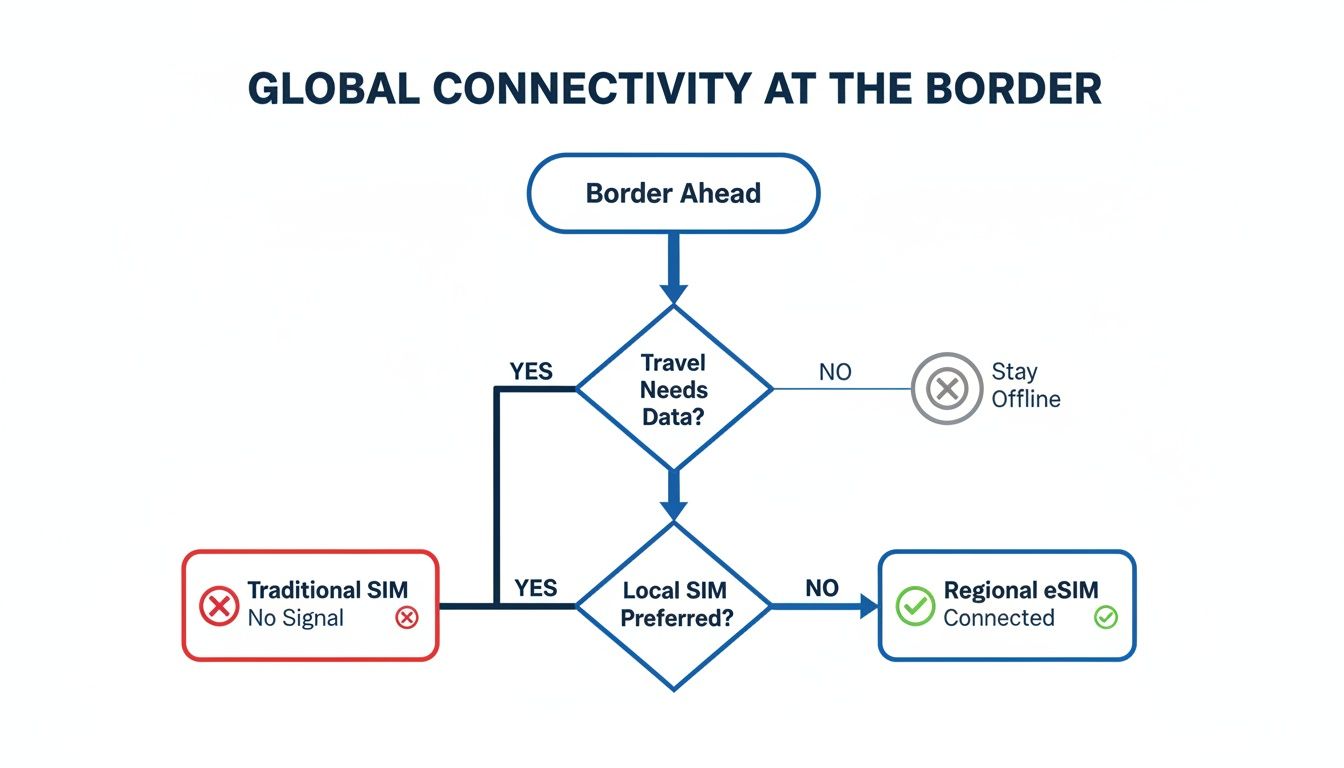
This decision tree clearly shows how a regional eSIM is designed to keep you online when you cross borders, a point where traditional SIMs often fail.
As you can see, the regional eSIM is the only option that really guarantees uninterrupted service as you hop from one country to the next.
Match the Plan’s Validity to Your Trip Length
The validity period is simply how many days your plan stays active. It’s vital to pick one that covers your entire journey from start to finish. If your road trip is 14 days long, a 15-day or 30-day plan is what you need. Buying a 7-day plan twice is just more hassle and usually works out to be more expensive.
The good news is that the market for regional eSIMs is growing, which means better value for travelers. You can now find 30-day eSIM plans offering a massive 100 GB of data for around $55—a fraction of what you’d pay for traditional roaming from most home networks. It just goes to show that staying connected across the Balkans is more affordable than ever.
Getting Your eSIM Set Up Before You Go
One of the best things about using an eSIM is just how easy it is to get sorted before you even pack your bags. You can have everything ready to go from the comfort of your sofa, which means you’ll land at your destination with a working phone. This completely removes the stress of hunting for a local SIM card shop after a long, tiring flight.
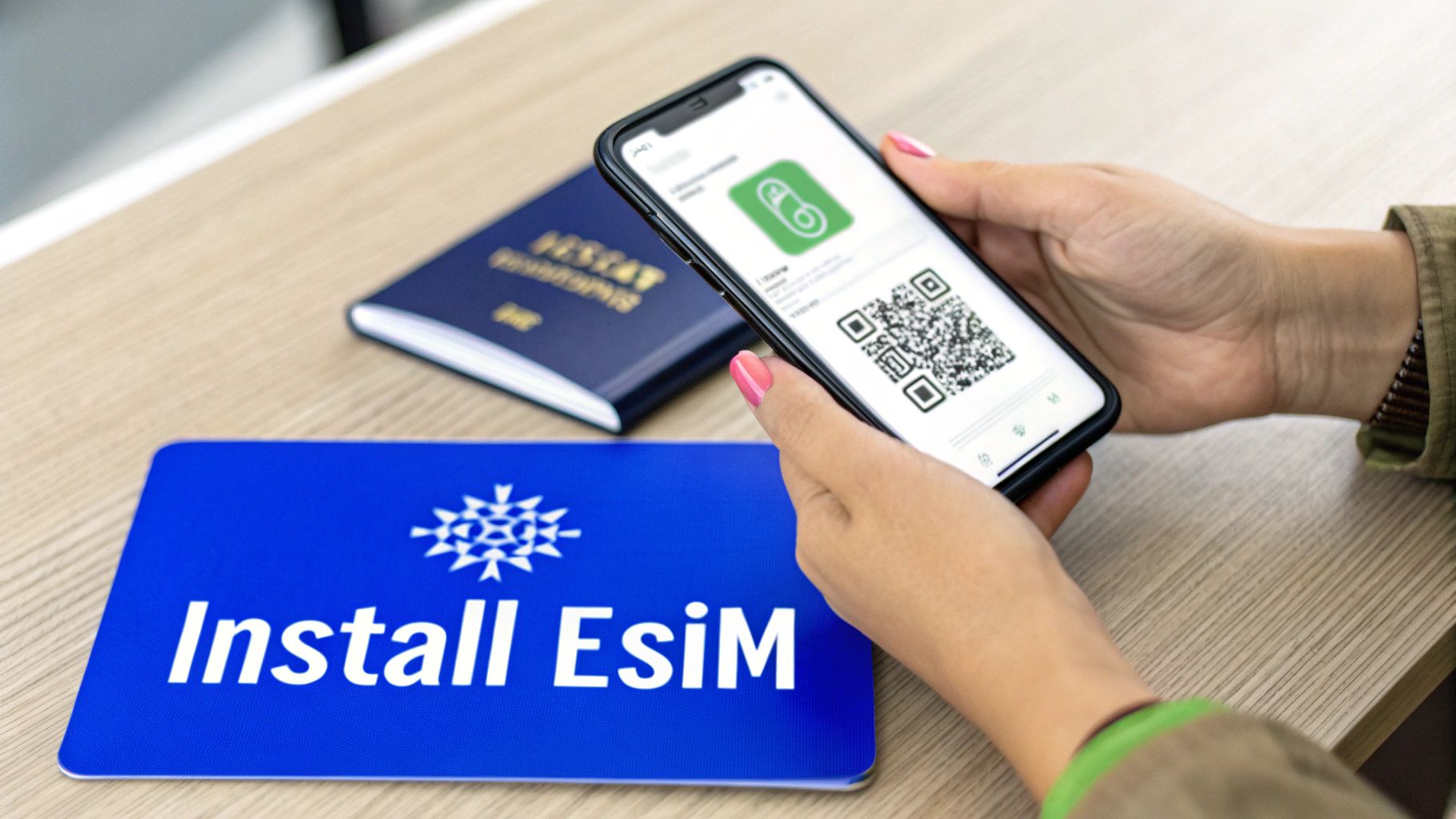
The whole process is digital and only takes a few minutes. You buy your plan online, get a QR code almost instantly, and you’re ready to install. No more fumbling with tiny plastic cards or searching for a paperclip to pop open your phone’s SIM tray.
The Golden Rule: Install at Home, Activate on Arrival
If you remember one thing, make it this: install your eSIM while you’re still at home with a stable internet connection, but wait to activate it until you land in the Balkans.
Why? The installation part involves downloading the eSIM profile to your phone, and that needs a solid Wi-Fi connection. Trying to do this on patchy airport Wi-Fi is a recipe for disaster.
By installing it before you leave, the plan is loaded and waiting quietly on your device. The clock on your data plan won’t start ticking until it connects to a network in the Balkans. This means you can get it all sorted days in advance without wasting a single megabyte of your allowance.
This simple two-step process—install at home, activate on arrival—is the secret to a seamless start. It guarantees your phone is ready for action the moment you land, so you can book a ride or let family know you’ve arrived without any hassle.
Step-by-Step Installation Guide
Getting your eSIM up and running is straightforward, whether you’re on an iPhone or an Android. The menus might look a little different, but the main idea of scanning a QR code is exactly the same.
For iPhone Users:
Buy Your Plan: Head over to TapSim.net and choose the Balkans regional plan that suits your itinerary. Once you check out, an email with your QR code will land in your inbox.
Add Your eSIM: Go to Settings > Mobile Data > Add eSIM.
Scan the QR Code: Use your phone’s camera to scan the code from your email. Your iPhone will handle the rest, downloading and installing the eSIM profile.
Label Your Plan: It’s a good idea to name your new eSIM something obvious, like “Balkans Trip“. This makes it super easy to switch between your home SIM and your travel data. For a more detailed walkthrough, you can follow our guide on how to activate an eSIM on an iPhone.
For Android Users:
Grab Your Plan: Just like with an iPhone, purchase your plan from TapSim.net and have the QR code email ready to go.
Add a Mobile Plan: Go to Settings > Network & Internet > SIMs, then tap the ‘+’ icon to add a new one.
Scan the Code: Choose the option to scan a QR code and point your camera at it. Your phone will download and install the profile.
Name Your Plan: Give it a clear label, like “Balkans Data“, so you can easily manage your connections.
Final Checks for a Smooth Trip
Once the eSIM is installed, there are two crucial settings to double-check, especially for a multi-country road trip. Getting these right will ensure your data works automatically as you hop from one country to the next.
First, go into your phone’s mobile settings and make sure your new travel eSIM is selected as the primary source for mobile data. You can still keep your home number active for calls and texts if you like, but you want all your internet traffic to run through the TapSim eSIM.
Second—and this is the most important part—you absolutely must enable Data Roaming on your travel eSIM. I know, it sounds wrong. You bought an eSIM to avoid roaming charges. But for a regional eSIM to work its magic, it needs to be able to “roam” onto different partner networks across the Balkans. This setting is what allows it to seamlessly switch between providers in Croatia, Montenegro, and Serbia without you having to do a thing.
Understanding Network Coverage Across the Balkans
The Balkans are a stunning, yet complex, patchwork of EU and non-EU countries. For anyone planning a road trip, this single fact has a massive impact on your mobile data. Getting your head around this is the key to staying connected without the stress. This is precisely where a regional eSIM proves its worth—it’s built to handle these network gymnastics for you.
Think of the Balkans not as one big mobile zone, but as a collection of separate territories stitched together. In EU member states like Croatia, Slovenia, and Greece, your regular SIM might roam just fine. But the second you drive across the border into a non-EU country like Albania, Bosnia and Herzegovina, or Serbia, the rules—and the costs—change dramatically.
This is where your home provider’s standard roaming charges can spiral out of control. A regional eSIM designed specifically for the Balkans, however, treats the entire area as one seamless coverage zone. It saves you from the guesswork and the dreaded bill shock that can come with each new border crossing.
What to Expect from Networks on the Ground
It’s smart to have realistic expectations for your journey. While major cities like Belgrade, Sarajevo, and Tirana have fantastic, speedy 4G/5G signals, the experience on the open road can be a different story. The Balkans are famous for their breathtaking mountains, and network performance naturally dips and dives with the terrain.
Urban Hubs: You can count on fast, stable connections, perfect for video calls, streaming, or downloading hefty files.
Coastal Roads: Along the popular Adriatic coast, coverage is generally solid and reliable.
Mountain Passes: In remote spots, like the Albanian Alps or Montenegro’s Durmitor National Park, you might see the signal weaken or drop to 3G. It’s always a good idea to download offline maps for these stretches of your drive.
This variability is exactly why you need to double-check an eSIM provider’s specific country list. A good regional plan will have partnerships with the strongest local networks in each nation, ensuring you get the best possible signal, no matter where your adventure takes you.
The real magic of a dedicated Balkan eSIM is that it automatically switches to the best local network in each country you enter. This means you’re not just covered—you’re getting the strongest signal available, whether you’re in a bustling city centre or a quiet rural valley.
Why Non-EU Coverage Is the Most Important Factor
For any proper Balkan road trip, coverage in the non-EU countries is the deal-breaker. This is where many generic “European” eSIMs fall short, completely leaving out essential destinations. You absolutely must confirm that your chosen plan explicitly includes:
Albania
Bosnia and Herzegovina
Montenegro
North Macedonia
Serbia
These are often the most eye-wateringly expensive places to roam with a standard home SIM, which makes an all-inclusive eSIM the smartest, most budget-friendly choice. A plan like TapSim’s specific Balkans regional eSIM is designed to cover these crucial non-EU countries, making sure your connection doesn’t vanish when you need it most.
The market has really matured, giving travelers plenty of options. In 2025, there are now over 80 providers offering more than 2,400 different prepaid data plans for the region. You can find everything from a basic 1 GB plan starting at around $5.50 to unlimited data packages, though the latter often come with speed limits or a hefty price tag. Some eSIM providers even offer plans that include calls and texts, showing just how much choice travelers now have.
Matching Your eSIM to Your Balkans Itinerary
There’s really no single “best” eSIM for a Balkans road trip. The right choice comes down to your personal travel style—how you’ll be using your phone on the ground. Think about your route, how long you’ll be gone, and what you’ll actually need data for day-to-day.
To get a better feel for this, let’s walk through a couple of classic road trip scenarios. Seeing how a plan fits a specific itinerary will help you picture what you need for your own adventure.
Itinerary 1: The 10-Day Adriatic Coastal Drive
Picture this: a stunning ten-day drive down the Adriatic coast. You start in Croatia, wind your way through Montenegro, and maybe even dip your toes into Albania. It’s a trip defined by sea views, spontaneous beach stops, and evenings exploring ancient towns.
On a trip like this, your data needs are pretty straightforward. You’ll mostly be using it for:
Navigation: Firing up Google Maps or Waze to find that hidden cove everyone’s talking about.
Social Media: Uploading that perfect sunset shot from Dubrovnik’s walls or the view over Kotor Bay.
On-the-fly planning: Looking up ferry times, finding a great restaurant, or booking your next night’s stay.
For this kind of journey, you don’t need a massive data package. A 10 GB plan with a 15-day validity period is a fantastic sweet spot. It gives you plenty of data for all your daily needs with a comfortable buffer, so you’re not stressing about running out while trying to find your guesthouse.
Itinerary 2: The 30-Day Digital Nomad Grand Tour
Now, let’s imagine a different kind of trip: a month-long deep dive into the heart of the Balkans. You’re working remotely, venturing inland to explore Serbia, Bosnia and Herzegovina, and North Macedonia.
In this scenario, data isn’t just a handy tool; it’s essential for your work.
For a digital nomad, having lots of reliable data is non-negotiable. You need to be able to jump on a video call from a café in Belgrade or upload a big file from Skopje without a second thought.
This kind of travel-work blend demands a much heavier data allowance. Your daily usage will look more like this:
Remote Work: Constant video calls, accessing cloud drives, and sending hefty files.
Entertainment: Streaming a film or a few episodes of a series to unwind in the evenings.
Keeping in Touch: Frequent video calls with friends and family back home.
For a trip of this intensity, you’ll want to look at a high-volume plan of 50 GB or even more. This lets you work without constantly checking your data usage or hunting for sketchy, unreliable public Wi-Fi.
Thankfully, the market has really stepped up for global travelers. It’s now easy to find data-only plans that include tethering and cover key non-EU countries like Albania, Bosnia, and Serbia. For example, some eSIM providers offer plans with 20 GB of data for around $55 with 30-day validity—perfect if you use apps like WhatsApp for calls and messages.
By thinking through your own itinerary, you can easily find that perfect balance between data, duration, and price. Have a look at the plans on TapSim.net and see which one fits your adventure.
Your Balkan eSIM Questions, Answered
Planning the final details of your Balkans road trip often throws up a few last-minute questions about staying connected. Let’s get them sorted so you can hit the road with confidence.
Can I Still Use My Regular Number for Calls and Texts?
Yes, you absolutely can, and this is one of the biggest perks of using a travel eSIM. Think of it as having two lines in one phone. Your primary SIM card stays active, so you can still receive important calls and texts (like verification codes from your bank) on your usual number.
Your new travel eSIM handles all the mobile data, saving you from your home provider’s eye-watering roaming fees. Just make sure you dive into your phone’s settings and select the eSIM for ‘Mobile Data’. It’s a simple switch that can save you a fortune.
What if I Burn Through All My Data?
We’ve all been there—one too many video calls or a long session on Google Maps, and suddenly your data is gone. Don’t panic. Topping up is incredibly straightforward.
Most eSIM providers, including TapSim, let you buy more data directly through their app. It’s usually a matter of a few taps, and the new data pack is added to your eSIM almost instantly. You’ll be back online before your coffee gets cold. While it’s smart to keep an eye on your usage, knowing a top-up is quick and easy provides great peace of mind.
How Do I Know if My Phone Even Works with an eSIM?
Good question. Most phones made from 2018 onwards are eSIM-compatible. This covers the iPhone XS and anything newer, the Google Pixel 3 and its successors, and a whole host of modern Samsung Galaxy phones.
But you should always double-check to be sure. The quickest way is to dial *#06# on your phone. If an ‘EID’ number pops up on the screen, your device is good to go. Most eSIM websites also have a handy compatibility checker tool you can use before purchasing.
Ready to get your Balkan adventure connected? TapSim offers reliable, multi-country eSIMs that activate the moment you need them, so you’re online as soon as you arrive.
That text message from your mobile provider warning you’ve landed in a new roaming zone? It’s a familiar sight for anyone crossing the border into Switzerland and a sure-fire way…
On the surface, the AT&T International Day Pass sounds like a simple solution for staying connected abroad. But as many travelers have discovered, the reality can be quite different, and…
Heading to India? An eSIM is the smartest way for a traveler to get online the second they land. Instead of wrestling with local SIM card registration—a process that often…
When planning a trip to Egypt, the right eSIM is one that works the moment you land. You’re looking for instant activation, clear pricing with no hidden fees, and solid…
You’ve just landed, ready to start your adventure, but your phone has other plans. An error message pops up: “Could not activate mobile data network.” Sound familiar? This is likely…
When you’re heading abroad, the last thing you want is to come home to a shocking mobile bill. For most travelers, an eSIM is going to be your most cost-effective…
It’s a common worry for travelers: you land in a new country, activate a travel eSIM for affordable data, and fear you’ll be locked out of WhatsApp, cut off from…
Let’s get straight to the point: for most travelers today, 1GB of data is not enough for a 7-day trip. A few years ago, it might have been plenty. But…