How to Compare Pay As You Go SIMs for Smart Travel
Share:
For any traveler, the best pay-as-you-go (PAYG) option is almost always a modern eSIM. Think about it from a practical standpoint: you get instant activation right from your phone, transparent pricing with no nasty roaming surprises, and you can keep your main number for calls and texts. It completely beats the old routine of hunting down a physical SIM card shop the second you land. With an eSIM, you’re connected the moment the plane’s wheels touch the tarmac.
Your Quick Guide to Choosing a PAYG Travel SIM
Staying connected abroad should be the easy part of your trip. Whether you’re navigating the streets of Rome or posting a photo from a beach in Thailand, reliable mobile data is essential. For years, the go-to move was grabbing a local physical SIM at the airport, but that often meant dealing with confusing plans, long queues, and language barriers.
Thankfully, technology has moved on. The big decision now isn’t just which network to pick, but what type of SIM makes the most sense for your journey. This guide will walk you through the key things to look for when you compare pay as you go SIMs, all from the practical perspective of a globetrotter.
Understanding the Modern Traveller’s Needs
Across the world, travelers want flexible, data-heavy plans without being tied down. Our reliance on mobile data has skyrocketed, and this is especially true when we’re abroad, using maps, translation apps, and booking services on the go.
This is exactly why understanding pay-as-you-go options is so critical for travel.
Key Factors for Your Comparison
Before getting into the details, it’s good to know what you’re actually looking for. A solid PAYG travel option nails the balance between cost, convenience, and coverage. Modern solutions were designed around these very principles, offering prepaid data plans you can activate on the spot. With TapSim, travelers can activate data instantly before takeoff.
Here’s a quick look at the most important criteria to use when comparing PAYG SIMs.
Key PAYG SIM Comparison Factors at a Glance
This table breaks down the essential criteria every traveler should use when evaluating a Pay As You Go SIM or eSIM. It’s your cheat sheet for making a smart choice.
Evaluation Factor
What to Look For
Why It Matters for Travellers
Activation Process
Instant digital activation via QR code or app.
This lets you skip airport queues and language hassles, getting you online the moment you arrive.
Cost Transparency
Clear, upfront pricing with no hidden fees or roaming charges.
You can budget your trip properly without the fear of a shock bill when you get home.
Network Coverage
Strong partnerships with major local carriers in your destination.
This is what guarantees you’ll have a fast, reliable connection for maps, apps, and staying in touch.
Data Flexibility
A good range of data packages and simple, instant top-ups.
It means you only buy what you need and can easily add more if your plans change.
Ultimately, focusing on these four areas will help you cut through the noise and find a PAYG SIM that genuinely works for your travel style, not against it.
PAYG Flexibility vs Monthly Contracts
For any traveller, the choice between a Pay As You Go (PAYG) SIM and a monthly contract isn’t just about money—it’s about freedom. Monthly contracts are built for residents, tying you into a 12 or 24-month commitment, often complete with credit checks and rigid terms. That kind of structure just doesn’t work with the spontaneous nature of travel.
A PAYG plan, on the other hand, is all about flexibility. You buy what you need, when you need it, and that’s it. No strings attached. It’s the perfect setup for a week-long city break in Europe, a month backpacking across Asia, or even for a business traveler who frequently visits different countries. There are no credit checks, no penalties for leaving, and zero long-term obligations.
The Problem with Roaming on Your Home Contract
Many domestic mobile contracts offer “roaming passes” or daily charges for using your plan abroad. While they sound convenient, these can get incredibly expensive, fast. A daily fee of $5 to $10 might seem small at first, but over a two-week holiday, you could be looking at a bill far higher than a simple prepaid data plan would have cost.
For a traveller, a monthly contract is like renting a car for a year when you only need it for a weekend. A PAYG SIM is the equivalent of booking that car just for the days you’ll actually be driving—it’s smarter, more efficient, and perfectly suited to the task.
With a PAYG travel eSIM, you buy a specific amount of data for a fixed price. You know exactly what you’re spending before you even leave home. This completely eliminates the risk of “bill shock”—that dreaded, unexpectedly massive phone bill waiting for you when you get back. It’s a common trap for anyone relying on their home provider’s roaming deals; you can see a real-world breakdown in this Verizon Travel Pass vs eSIM cost comparison.
Why PAYG Still Thrives in a Contract-Dominated World
While monthly contracts are common, the PAYG model remains a go-to option for millions. For example, pay-as-you-go plans still make up 28% of the UK mobile market. Looking globally, the prepaid market is projected to grow from USD 42.5 billion in 2025 to USD 75 billion by 2035, proving its lasting appeal for budget-conscious users and anyone with fluctuating data needs—like travellers. You can discover more insights about how SIM-only plans are shaping the UK market on ccsinsight.com.
This enduring popularity comes down to one simple thing: control. You are in charge of your spending, your usage, and your commitment.
Modern eSIMs: The Ultimate PAYG Solution
The evolution of PAYG has brought us the travel eSIM, which takes this flexibility to a whole new level. Instead of having to hunt down a local shop for a physical SIM card when you arrive, you can sort everything out on your phone before you’ve even packed your bags.
Here’s how a modern travel eSIM improves the classic PAYG model:
Pre-Trip Purchase: Buy and install your data plan from the comfort of your home, so you’re connected the moment you land.
Instant Activation: A quick QR code scan is all it takes. No filling out forms or showing your passport.
Clear, Upfront Costs: You pick a data package (e.g., 5 GB for 15 days) and pay one fixed price. With TapSim, prices are always transparent with no hidden fees.
Easy Top-Ups: If you’re running low on data, you can add more right from an app or website, no need to find a physical store.
This digital-first approach is perfectly matched to the needs of modern travellers. It gives you all the benefits of PAYG—flexibility, cost control, no commitment—while getting rid of the old hassles of buying and managing a physical SIM card abroad. It’s simply the smartest way to compare pay as you go sims for your next adventure.
Seven Essential Criteria for Evaluating PAYG SIMs
When you start to compare pay-as-you-go SIMs, it’s easy to get lost in a sea of options. The best way to make a smart choice is to have a clear framework. Think of it as a traveller’s checklist for connectivity—a set of practical criteria that cuts through the marketing noise and focuses on what truly matters when you’re on the road.
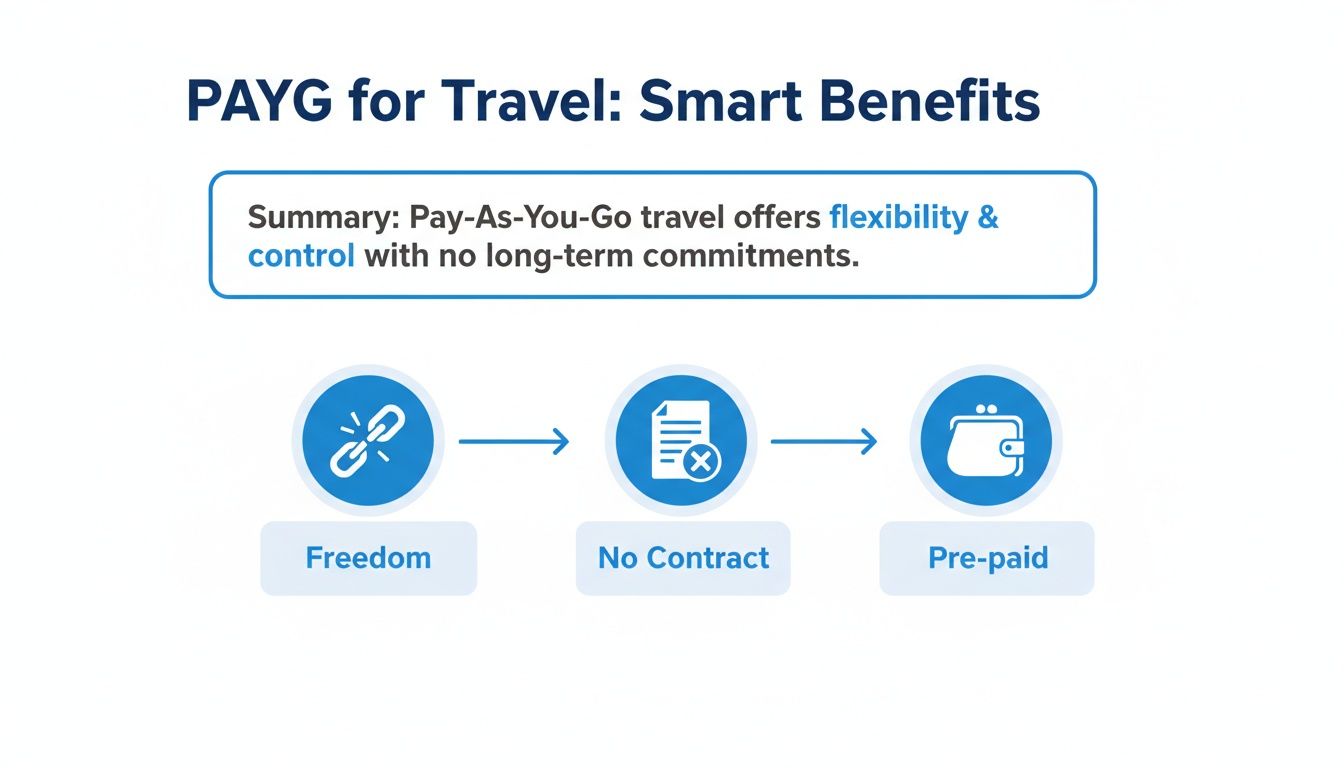
This summary shows the core benefits of a PAYG approach for travel: total freedom from contracts and the simplicity of pre-paid data.
These three pillars—freedom, no contracts, and pre-paid control—are exactly why so many experienced travellers prefer the flexibility of PAYG for their trips abroad.
Let’s break down the seven essential criteria you should use to evaluate any PAYG SIM, whether it’s a physical card you buy at the airport or a modern eSIM you install at home.
1. True Cost Per Gigabyte (GB)
The advertised price of a data plan is often just the beginning. The most important metric to look at is the true cost per gigabyte (GB). A cheap plan with a tiny data allowance can quickly become expensive if you find yourself having to top up multiple times.
To figure this out, just divide the total price by the number of gigabytes included. For instance, a $15 plan with 5 GB of data works out to $3 per GB. This simple bit of maths helps you compare different offers on a level playing field, ensuring you get the best value for your money. If you’re unsure how much data you’ll need, our guide on how long 3 GB of data lasts can be a really helpful starting point.
2. Real-World Network Coverage
A provider might promise “nationwide 5G,” but what does that actually mean for you on the ground? Coverage isn’t just about the network technology; it’s all about the partnerships the provider has with local carriers in your destination. Strong local partnerships are what deliver a stable, fast connection.
Before you buy, check which local networks the PAYG SIM uses. A provider that partners with major players like Vodafone, Orange, or T-Mobile in Europe, for example, is far more likely to offer reliable service than one that piggybacks on smaller, regional networks. This is especially critical if you’re travelling to more remote areas outside of the big cities.
3. Activation Simplicity
The last thing you want after a long flight is to waste time hunting for a mobile shop, navigating language barriers, and filling out paperwork just to get online. The activation process is a huge differentiator between old-school SIMs and modern eSIMs.
Traditional Physical SIMs: Often require finding a specific store, showing your passport, and waiting around for the card to be activated.
Modern Travel eSIMs: Activation is instant. With a provider like TapSim, you get a QR code by email, scan it with your phone, and your data plan is good to go. You can even set it all up from home before you leave.
This digital-first approach means you’re connected the moment you land, ready to order a taxi or check into your hotel without any stress.
A seamless activation process is the difference between a frustrating arrival and a smooth start to your adventure. It really sets the tone for your entire trip.
4. Device Compatibility (Physical SIM vs eSIM)
Your phone’s compatibility is a make-or-break factor. Most modern smartphones support both physical SIMs and eSIMs, but it’s always worth double-checking. An eSIM-compatible phone gives you far more flexibility, as you can store multiple eSIM profiles and switch between them without having to physically mess around with tiny plastic cards.
Before committing, confirm your device is unlocked and supports eSIM technology. Most provider websites have a simple checker tool. This one quick step ensures you can take advantage of the convenience and global reach that modern travel eSIMs offer.
5. Data Top-Up Process
What happens when you burn through your data mid-trip? The process for adding more data—or “topping up”—should be just as simple as the initial purchase. A clunky top-up process can leave you stranded without a connection right when you need it most.
Look for providers that offer easy, in-app or online top-ups. You should be able to purchase another data package with just a few taps, without needing to find a physical voucher or queue up in a store. This ensures you can stay online without interrupting your travels.
6. Hotspot and Tethering Rules
For many travellers, especially digital nomads or those travelling in groups, being able to share your mobile data with other devices is non-negotiable. This feature, known as hotspotting or tethering, turns your phone into a portable Wi-Fi router.
However, not all PAYG plans allow it. Some providers block tethering outright or charge extra for the privilege. Always check the fine print to confirm that hotspotting is included. With TapSim, for instance, most plans come with hotspot functionality enabled, giving you the freedom to connect your laptop, tablet, or a travel companion’s device.
7. Customer Support
When you’re in a different time zone and something goes wrong, accessible and responsive customer support is absolutely essential. Imagine your data not activating upon arrival—you need a team that can help you sort the issue out quickly.
Check what kind of support channels are available. Is it just an email form with a 48-hour response time, or do they offer 24/7 chat or a dedicated support ticket system? Honest, reliable support is a key part of a trustworthy service, ensuring that if you do run into trouble, you won’t be left in the dark. That peace of mind is invaluable when you’re far from home.
Finding the Best PAYG Option for Your Travel Style
Knowing what to look for in a PAYG SIM is half the battle. The other half is figuring out how those features apply to your specific trip. After all, the perfect SIM for a weekend city break is going to be completely wrong for a month-long work trip.
Let’s walk through three common traveller types to see how their needs differ and what they should be looking for. See which one sounds most like you—it’ll help you cut through the noise and find what you actually need.
The Weekend Explorer in Europe
Picture this: you’re heading to Lisbon for a long weekend. You’re not there to work. You just need enough data for the essentials—navigating with Google Maps, uploading a few stories to Instagram, checking restaurant reviews, and messaging friends on WhatsApp. Streaming films or joining video calls is the last thing on your mind.
For a short, sharp trip like this, your priorities are simple:
Instant Activation: Who wants to waste precious holiday time hunting down a phone shop? You need an eSIM you can set up the moment you land, or even before you leave.
Low Cost: You’ll likely only need 1–3 GB of data. It makes no sense to overpay for a massive bundle you won’t even touch.
Zero Fuss: The whole process should be incredibly straightforward. Buy it, scan a QR code, and you’re online. Anything more complicated just isn’t worth the hassle.
For the weekend explorer, the cost per gigabyte isn’t the main concern; it’s all about the overall price and sheer convenience. A simple, low-data bundle from a provider like TapSim is a perfect match here. It gives you exactly what you need to get connected fast and start enjoying your trip.
The Digital Nomad in Southeast Asia
Now, let’s switch gears. Imagine you’re a digital nomad or remote worker setting up shop in Chiang Mai, Thailand, for a month. Your internet connection isn’t just for fun—it’s your lifeline. You’re dealing with video conferences, uploading chunky files, and staying in sync with clients across the globe.
Your priorities look completely different:
Hefty Data Allowances: You’re going to burn through data. We’re talking 20 GB or more for the month, so the cost per gigabyte suddenly becomes a make-or-break factor for your budget.
Rock-Solid Coverage: Your work can’t stop because of a patchy signal. You have to pick a provider that partners with top-tier local networks. No compromises.
Hotspot and Tethering: Sharing your phone’s connection with your laptop is non-negotiable. You need to be able to work from anywhere, be it a cafe or your apartment.
Painless Top-Ups: If you’re about to run out of data mid-workflow, you need a quick and easy way to add more without any drama.
For a digital nomad, a travel SIM isn’t a perk; it’s a fundamental business tool. Reliability, data volume, and tethering are what truly matter.
A pay-as-you-go model still provides the flexibility this kind of traveller needs, but they have to be much more discerning. It’s about carefully comparing the larger data packages and double-checking that hotspotting is fully supported.
The Global Business Traveller on a Multi-Country Trip
Finally, think of a business professional on a whirlwind ten-day trip, with stops in New York, London, and Tokyo. Their schedule is packed, and they’re constantly on the move. Being offline between flights or faffing about with a new SIM in each country is simply not an option.
For them, the requirements are crystal clear:
Seamless Multi-Country Coverage: The only thing that makes sense is a single regional or global plan that works across every destination without needing a single tweak.
Absolute Reliability: Connectivity has to be flawless. They need a premium service that guarantees a strong signal for crucial emails, client calls, and accessing company networks.
Simplicity and Efficiency: Time is their most valuable asset. The setup has to be a one-and-done deal before the trip even starts, working perfectly upon arrival in each new time zone.
This traveller isn’t hunting for a bargain; they’re paying for peak reliability and efficiency. A global or regional eSIM is really the only practical solution. It completely removes the headache of buying separate plans for the USA, Europe, and Japan, offering one streamlined package for the whole itinerary. Providers that specialize in these comprehensive plans are built for exactly this kind of demanding, multi-stop journey.
Once you identify your travel style, you can filter your options with confidence and pick a PAYG SIM that genuinely works for you.
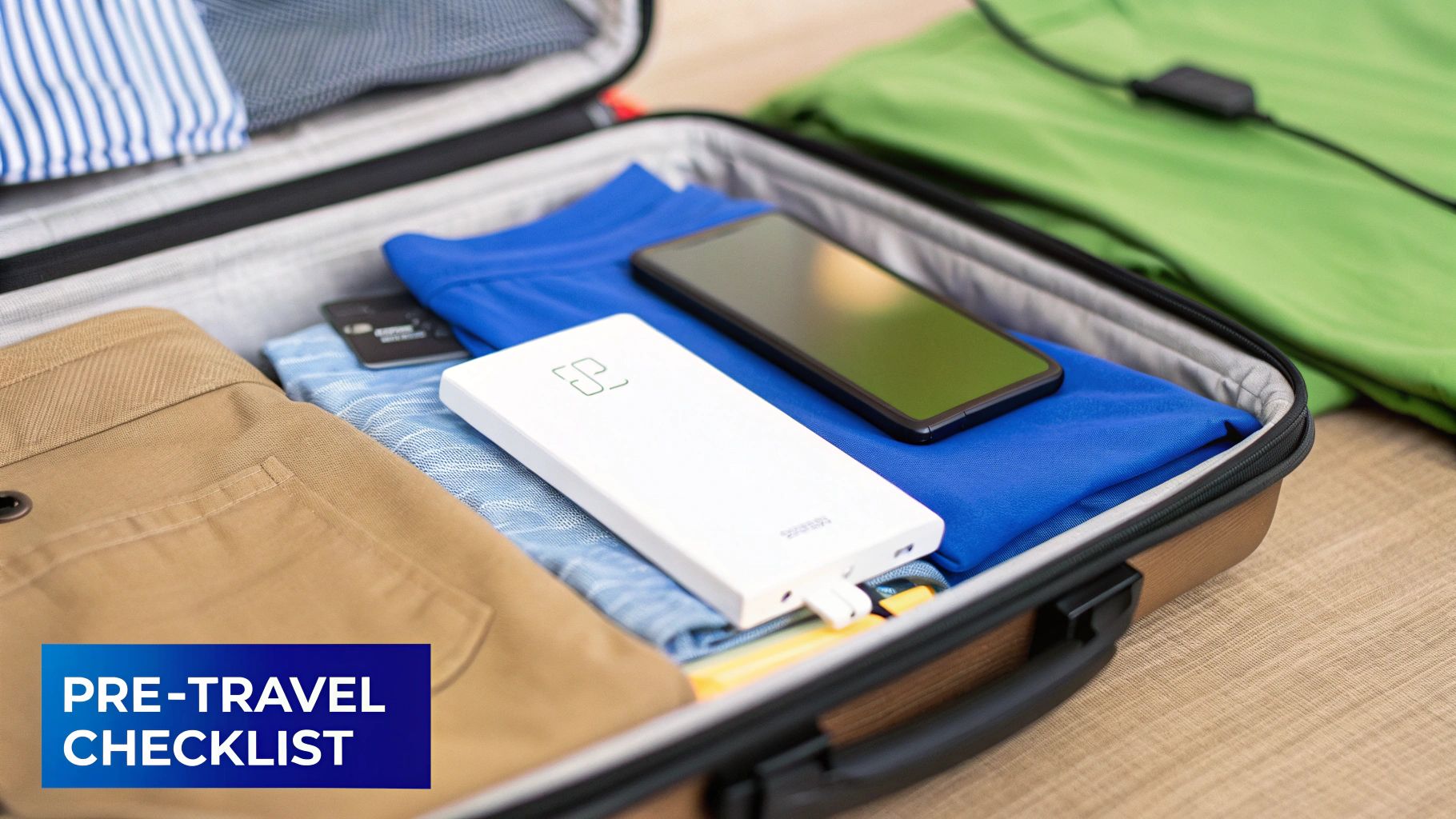
Your Pre-Travel Activation Checklist
There’s nothing worse than landing in a new country and immediately starting the frantic search for Wi-Fi. Sorting out your mobile data before you go is one of the smartest things you can do. It turns what could be a stressful arrival into a smooth, connected experience from the get-go.
Just follow this simple checklist, and you’ll be online the second you switch off flight mode.
The whole process only takes a few minutes, giving you complete peace of mind before you’ve even packed your bags.
Step 1: Confirm Your Phone is Unlocked and eSIM Ready
First things first, let’s make sure your phone is up to the task. The most critical step is checking that your smartphone is compatible with eSIMs. While most modern devices are, it’s always wise to double-check. Your phone also needs to be ‘unlocked’ from your home network provider to accept an eSIM from another provider.
An easy way to check for eSIM support is to dive into your phone’s settings. Head to “Cellular” or “Mobile Data” and see if there’s an option like “Add eSIM” or “Add Data Plan”. If you see it, you’re all set.
Step 2: Choose the Right Data Plan
Now, think about where you’re going and for how long. A weekend break in Paris obviously needs a different data plan than a two-week adventure across Japan. Pick a pay-as-you-go package that genuinely matches your trip.
Be honest about how you’ll use your data. If you’re just using maps and sending a few messages, a smaller plan is fine. But if you plan to be streaming videos, making video calls, or working remotely, you’ll want a bigger data bundle to avoid the hassle of topping up mid-trip. You can easily browse plans by country or region to find the perfect fit.
Step 3: Purchase and Install Your eSIM From Home
Here’s the real beauty of a travel eSIM – you can buy and install it from your sofa, days or weeks before you even think about leaving for the airport. Once you’ve bought your plan, you’ll get an email with a QR code.
Installing your eSIM before you travel is the key to a stress-free arrival. It means you’re prepared to connect the instant you need to, without relying on spotty airport Wi-Fi or searching for a physical SIM store.
Just follow your phone’s on-screen prompts to scan the QR code and add the new data plan. It’s a really simple process, and our guide on how to activate an eSIM on your iPhone walks you through it click by click.
Step 4: Keep Your Primary SIM Active
One of the best things about using an eSIM for travel is that it works in tandem with your regular SIM card. This means you can keep your home number active for important calls and texts (like those crucial two-factor authentication codes from your bank) while using your new eSIM for all your mobile data needs. It’s the best of both worlds.
Step 5: Know How to Switch Data Lines
Finally, take a moment to get comfortable with your phone’s settings. Before you take off, pop into your cellular settings and switch your ‘mobile data’ line over to the travel eSIM you just installed. This tells your phone to automatically use the new, affordable data plan as soon as you land.
And while you’re getting your tech in order, don’t forget about power. Reliable charging solutions, like these wireless charging stations, are a lifesaver on the road. With these few steps sorted, you’re all set for a seamless, connected journey.
Frequently Asked Questions About PAYG Travel SIMs
When you start digging into pay-as-you-go SIMs, the same questions tend to pop up. Getting straight, practical answers can be the difference between a smooth trip and a frustrating one. Here are the most common things travellers ask, with answers based on real-world experience.
Can I Keep My Home Phone Number Active?
Yes, you absolutely can. This is actually one of the biggest perks of using a modern travel eSIM. Most travel eSIMs are data-only, meaning they handle all your internet needs without interfering with your primary phone number at all.
This clever setup lets you keep your regular, physical SIM card active in your phone. You’ll still get important calls and texts, like those two-factor authentication codes from your bank, on your usual number. At the same time, you’ll be using the affordable, high-speed data from your travel eSIM for everything else—navigating with maps, browsing the web, or making calls on apps like WhatsApp or FaceTime.
Is It Cheaper to Buy a SIM at the Airport?
This is the classic dilemma: save a few dollars or save yourself a headache? While you might occasionally stumble upon a slightly cheaper local PAYG SIM at an airport kiosk, it often comes with a handful of problems. Think long queues after a long flight, language barriers, and confusing plans not really built for tourists.
Buying and installing a travel eSIM before you even leave home is a game-changer for convenience and peace of mind. Landing in a new country and being instantly connected is priceless—it means you can book a taxi, pull up your hotel details, or message family without a moment of stress.
Choosing an eSIM beforehand means you touch down and you’re online. No frantic hunt for Wi-Fi or a SIM vendor. For most travellers, dodging that initial hassle is easily worth the comparable, and often more transparent, cost.
What Happens If I Run Out of Data?
Running out of data mid-trip used to be a real pain, usually sending you on a mission to find a local shop for a top-up voucher. Thankfully, modern travel eSIMs have made this a non-issue.
With a provider like TapSim, topping up is straightforward and happens instantly. If you see you’re getting low on data, you just buy another package directly from their website. It only takes a couple of clicks, the new plan kicks in immediately, and you stay connected without missing a beat. It gives you full control, without having to leave your hotel or café.
Do All PAYG Plans Allow Hotspotting?
No, and this is a crucial detail to verify before you buy, especially if you plan on working or sharing your connection with others. Many traditional pay-as-you-go SIMs, and even some travel eSIM providers, block hotspotting (also called tethering) or charge extra for it.
Always double-check the plan details to confirm hotspotting is included. This feature is what turns your phone into a portable Wi-Fi hub, letting you connect your laptop, tablet, or a friend’s device to the internet. Most plans from TapSim come with hotspot functionality, giving you the flexibility you need. Checking this one little detail can save you from a massive connectivity headache on the road.
Ready to find a data plan that just works for your next adventure? TapSim offers transparent, pay-as-you-go eSIMs for over 150 destinations, so you can land connected and stay in control.
You’ve just landed in a new country, phone in hand, but the internet isn’t working. It’s a modern traveler’s nightmare, but don’t worry—the fix is usually surprisingly simple. Before you…
Dual SIM technology is a bit like having a hybrid car. It intelligently switches between two power sources to give you the best performance and efficiency. For your phone, this…
Figuring out how much data you’ll need for a trip can feel like a shot in the dark, but it really doesn’t have to be. For a standard week-long holiday,…
Getting a new iPhone is always exciting, but for a traveler, ensuring your eSIM transfers smoothly is crucial. Whether it’s your primary number or a travel data plan for an…
Activating a travel eSIM is one of the smartest pre-trip tasks you can do, and it’s much simpler than it sounds. Think of it as a digital SIM card that…
Not long ago, staying connected abroad meant navigating a minefield of eye-watering roaming charges or scrambling to find a local SIM card the moment you landed. Thankfully, things have moved…
You’ve just landed, your travel eSIM is activated, but… no internet. It’s a classic travel headache, and the culprit is often a tiny, overlooked detail: your APN settings on iPhone.…