Remember the old travel routine? The frantic search for airport Wi-Fi, the fiddly process of swapping out tiny plastic SIM cards, and that stomach-sinking feeling when you see your post-trip phone bill. An eSIM for Europe travel is here to change all that. It’s a simpler, more affordable way to get online from the moment you land in Paris to your final day in Rome, without any of the old-school hassle.
The Modern Way to Stay Connected in Europe
When you’re hopping across multiple European countries, staying connected can quickly become a logistical challenge. A trip from Spain to Italy and then over to Croatia could mean buying three different SIM cards or facing eye-watering roaming charges from your provider back home. This is exactly where an eSIM, or embedded SIM, completely changes the game.
Think of it as a digital SIM card that’s already built right into your phone. Instead of physically swapping a piece of plastic, you just download a data plan, switch it on when you arrive, and you’ve got instant internet. This guide will walk you through exactly how to use an eSIM for your European adventure to keep you connected effortlessly and save you money along the way.
Connectivity Options for European Travel at a Glance
To really get why so many travelers are making the switch, it helps to see all the options laid out side-by-side. While every method has its place, the advantages of an eSIM really shine through when it comes to convenience and cost, especially for a multi-country European tour.
Here’s a quick look at how a travel eSIM stacks up against the more traditional choices.
Feature
Travel eSIM
Local Physical SIM
Home Provider Roaming
Activation
Instant; install before you go and simply activate on arrival.
In-person purchase required; you need to find a store, buy the card, and manually swap it.
Usually automatic, but you often have to enable it with your carrier first.
Convenience
Top-notch. Everything is managed through an app, and you keep your primary number.
Low. You lose access to your primary number and have to physically change cards.
High. It works instantly without any setup, but there’s a catch.
Cost
Very affordable with clear, prepaid data plans. No surprises.
Generally cheap, but prices and plans can vary wildly from country to country.
Often extremely expensive. Think high daily fees or steep per-MB rates.
Flexibility
Perfect for multi-country trips with regional plans that cover the continent.
Poor. You’re typically locked into one country’s network, requiring a new SIM for the next stop.
Good for very short trips, but the costs quickly spiral out of control.
Best For
Tourists, digital nomads, and anyone visiting several countries.
Long-term stays or deep dives into a single country.
Short, single-destination trips where absolute convenience outweighs the high cost.
As you can see, the eSIM has a clear edge for the typical European traveler who values a blend of affordability, flexibility, and pure simplicity.
Understanding How an eSIM Works for Travel
So, what exactly is an eSIM? Let’s try a simple analogy. Think of it like a digital boarding pass on your phone versus a classic paper one. Both get you on the plane, but one is clearly designed for modern, hassle-free travel.
An eSIM (or embedded SIM) is a tiny, rewritable chip that’s already built into your smartphone’s hardware. You can’t see it, and you certainly can’t lose it between the seats at the airport gate. It’s a permanent part of your device, just waiting to be told which network to connect to.
This clever bit of tech lets you download and install a data “profile” directly onto your phone. When you buy a European travel eSIM, you’re basically purchasing a digital key that gives you access to mobile networks all over the continent.
From Purchase to Connection
The whole process is refreshingly simple. You can buy your plan from the comfort of your own home, get a QR code in your email, and have it installed before you’ve even finished packing. With TapSim, travelers can activate data instantly before takeoff.
Then, when your plane touches down, you can forget about the usual scramble to find a SIM card kiosk. All you do is hop into your phone’s settings, switch your mobile data to the eSIM profile you installed, and that’s it. You’re online instantly, ready to look up directions, call a taxi, or let everyone back home know you’ve landed safely.
This move to digital SIMs is catching on fast. In Europe, there are now around 282 million eSIM smartphone connections, which is almost the same as the 281 million traditional SIMs. While many people are still learning about the tech—only about 33% of British adults know what an eSIM is—a whopping 56% love the idea of using it for travel. It just makes practical sense.
How It Works Alongside Your Main SIM
One of the best parts is that you don’t have to ditch your regular phone number. An eSIM works right alongside your main physical SIM card, thanks to a feature called Dual SIM capability.
This means you can:
Keep your primary number active for important calls and texts, like those verification codes from your bank.
Use your travel eSIM purely for cheap mobile data, sidestepping the eye-watering roaming fees from your home provider.
It’s the best of both worlds. You stay reachable on your familiar number while using affordable local data for everything else. No more choosing between staying connected and saving money.
This dual-SIM setup is a real game-changer for anyone traveling through Europe. All your apps like WhatsApp, your banking apps, and social accounts stay linked to your primary number, while the eSIM quietly handles all the heavy lifting for internet access. For a closer look at the technical side, check out our guide on how do eSIMs work. It’s a seamless system built for today’s traveler.
Key Benefits of Using an eSIM in Europe
Using an eSIM for Europe travel is about more than just getting online. It completely transforms how you start your trip, trading the old, familiar travel hassles for genuine convenience and control. The advantages are obvious from the moment your plane touches down.
Get Connected Instantly on Arrival
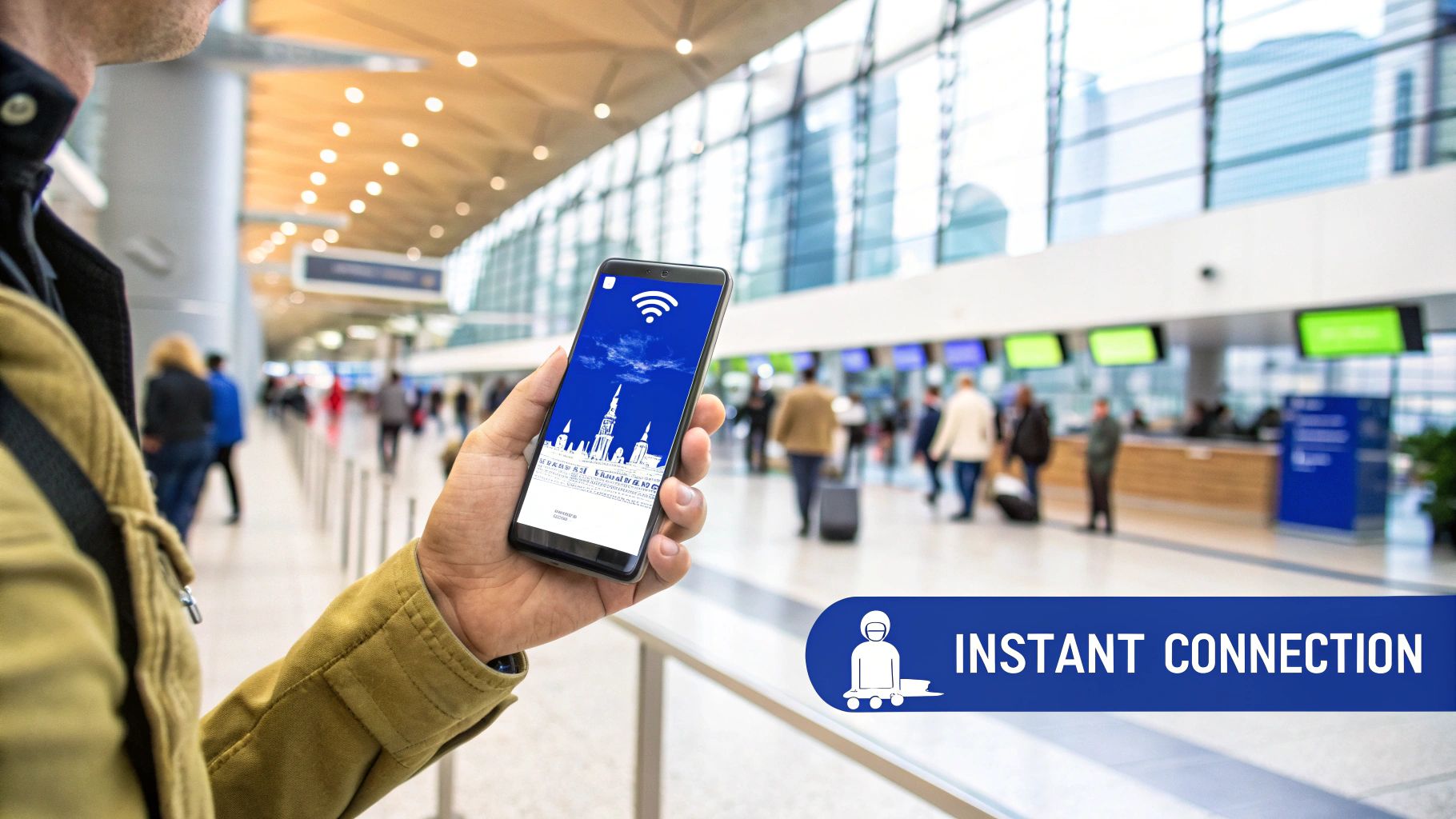
Imagine landing in a new European city. Instead of the usual frantic hunt for a shop selling local SIMs or trying to connect to patchy airport Wi-Fi, you just switch your phone off airplane mode. In seconds, you’re connected.
That’s the magic of an eSIM. You can buy and install your data plan before you even leave home. Upon arrival, a quick tap in your settings is all it takes to activate it. This means you can book a taxi, pull up directions to your hotel, or let your family know you’ve landed safely, all without a moment’s delay.
Keep Your Home Number Active
One of the biggest annoyances of using a physical travel SIM is having to swap out your primary SIM card. Suddenly, you can’t receive calls or texts on your regular number, which is a major issue for things like two-factor authentication from your bank or urgent messages from back home.
An eSIM neatly solves this problem. It’s digital, so it works right alongside your physical SIM, letting you use both simultaneously.
Your primary SIM stays in your phone, ready for important calls and security texts.
Your travel eSIM takes care of all your mobile data, giving you access to affordable, local rates.
This dual-SIM setup means you get the best of both worlds: the security of your home number and the savings of a local data plan.
Save Money by Avoiding Roaming Charges
Let’s be honest—nobody wants to come home from a holiday to a massive mobile phone bill. Roaming charges from your home provider can be astronomical, with expensive daily flat rates or eye-watering per-megabyte costs that add up incredibly fast.
An eSIM offers a clear, budget-friendly alternative. You buy a prepaid data package upfront, so you know exactly what you’re spending from the start. No hidden fees, no nasty surprises.
This puts you firmly back in control of your travel budget. You can pick a plan that fits your trip perfectly, whether it’s a 3 GB bundle for a short city break or a hefty 20 GB package for a month-long adventure across the continent. With a provider like TapSim, it’s incredibly easy to manage your data and even top up if you need more, right from an app.
Enhance Your Travel Security
It’s surprisingly easy to misplace that tiny piece of plastic that is your SIM card, and losing your phone abroad is a traveler’s nightmare. An eSIM provides a layer of security that a physical SIM just can’t match.
Because an eSIM is embedded directly into your device, it can’t be physically removed and popped into another phone if yours is lost or stolen. This makes it far more difficult for a thief to take over your number. You can also have your eSIM profile deactivated remotely, securing your data and preventing anyone from using it. It’s a simple feature that offers some much-needed peace of mind while you explore.
Travel More Sustainably
Every little choice we make can have an impact, and switching to an eSIM is a greener way to stay connected. Physical SIM cards are made from plastic and add to the growing problem of electronic waste. While a single card might seem insignificant, millions of travelers buying them for short trips creates a huge environmental footprint.
By choosing a digital eSIM, you get rid of the plastic altogether. It’s a small change that helps create a more sustainable way to travel and aligns with the growing desire to make more conscious, eco-friendly choices.
How to Choose the Best Europe eSIM Plan
Picking the right eSIM plan for your European adventure isn’t a one-size-fits-all deal. A plan that’s perfect for a weekend city break in Lisbon will be totally wrong for a month-long backpacking trip from Amsterdam to Athens. To avoid running out of data when you need it most, you have to match the plan to your specific itinerary.
It’s about looking beyond the headline price. You need to get three things right: where it works, how much data you actually need, and how long the plan lasts. Nailing these three factors is the key to staying connected smoothly and without any surprises.
Check the Regional Coverage
Europe might feel like one big destination, but its mobile networks are a patchwork of different providers spread across dozens of countries. The crucial thing to remember is that not every “Europe eSIM” covers every single nation. This is the most important detail to check, especially if you’re hopping between several countries.
Before you hit ‘buy’, take a close look at the list of supported countries. If you’re sticking to the big EU destinations like France, Spain, and Italy, most regional plans will have you covered without any issues.
Where you need to be careful is if your trip takes you outside the EU. Think Switzerland, the UK, or Balkan countries like Albania or Montenegro. These are often left out of standard EU-wide packages, so you might need a different, more comprehensive regional plan to stay online.
Actionable Takeaway: Always pull up your itinerary and check it against the eSIM provider’s country list. Don’t just assume a “Europe” plan covers the entire continent. A quick two-minute check can save you from landing in a new country and finding you have no signal.
Estimate Your Data Allowance
Figuring out how much data you need is a bit of a balancing act. Buy too little, and you’ll be scrambling to top up at an inconvenient time. Buy too much, and you’re just throwing money away. The trick is to be realistic about how you’ll be using your phone on the road.
Are you a light user who just needs Google Maps and the occasional WhatsApp message? Or are you a digital nomad who will be on video calls and streaming in the evenings? How you use your phone directly dictates how many gigabytes (GB) you should get.
To give you a rough idea, here’s a look at how much data common travel activities use.
Estimate Your European Travel Data Needs
This table should help you get a better handle on your potential data consumption based on what you plan to do each day.
Activity (per hour)
Estimated Data Usage
Web Browsing & Email
50–100 MB
Social Media (scrolling)
150–250 MB
Google Maps Navigation
5–10 MB
Music Streaming (standard quality)
50–80 MB
Video Streaming (standard definition)
250–500 MB
Video Call (e.g., Zoom, FaceTime)
400–700 MB
As a rule of thumb, for a typical week-long holiday filled with maps, social media, and a bit of browsing, a 5 GB plan is a great place to start. If you’re staying longer or know you’ll be a heavier user, jumping up to a 10 GB or 20 GB plan will give you better value and, more importantly, peace of mind. Transparent providers like TapSim lay out all the options clearly, so you can easily pick a plan that fits your trip.
Match the Validity Period to Your Trip Length
Every eSIM plan has a validity period – that’s how many days the plan stays active from the moment you first connect. This is just as important as the data allowance itself. A massive 30 GB plan that expires in seven days is completely useless for a month-long trip.
Here’s a simple breakdown:
Short Trips (1–7 days): Look for plans with 7 or 15-day validity.
Standard Holidays (8–21 days): A 30-day plan is your best bet; it’s the most common and offers great flexibility.
Long-Term Travel (22+ days): Go for a 30-day plan but double-check how easy it is to top up if you need to.
Always make sure the validity covers your entire stay. It’s far better to have a few extra days you don’t use than to have your plan cut out the day before you fly home.
This shift towards flexible, traveler-first connectivity is only getting bigger. In fact, projections show that global revenue from travel eSIMs is expected to hit $1.8 billion by the end of 2025 – that’s an 85% jump from 2024 alone. For multi-country European tours, an eSIM means no more fumbling with tiny plastic SIMs at every border. You can dive deeper into these trends by reading the full research on travel eSIMs.
Setting Up Your Europe eSIM Step-by-Step
Getting your eSIM sorted for a trip to Europe is a world away from the old routine of queuing for a physical SIM card at the airport. The entire process, from buying the plan to getting it on your phone, takes just a few minutes. You can genuinely have it all done before you’ve even zipped up your suitcase.
Here’s a simple rundown to get you connected without any fuss.
Step 1: Check Your Phone’s Compatibility
First things first, let’s make sure your phone is ready for an eSIM. You need to confirm two things: that your smartphone is eSIM-compatible and that it’s unlocked. Most phones made since 2018 have an eSIM chip inside, but it never hurts to double-check.
An unlocked phone is non-negotiable. It just means your device isn’t tied to one specific network, so you’re free to use an eSIM from any provider. If you bought your phone straight from the manufacturer (like Apple or Samsung), it’s almost certainly unlocked. If you got it on a contract, a quick call to your mobile operator will clear things up.
Actionable Takeaway: The quickest way to check for eSIM support is in your phone’s settings. On an iPhone, go to Settings > Mobile Data. If you see an option like “Add eSIM” or “Add Cellular Plan,” you’re all set.
Step 2: Purchase and Install Your eSIM Plan
Once you know your phone is good to go, it’s time to pick your plan. With TapSim, you can browse plans that cover all of Europe, choosing the data allowance and duration that makes sense for your trip. The whole purchase happens online in a couple of clicks.
Right after you buy, a QR code will land in your email inbox. Think of this code as the digital key to getting the eSIM onto your phone. It’s a smart move to do this part while you’re still at home with a reliable internet connection.
This infographic breaks down how to pick the perfect plan based on your travel style.
As you can see, the trick is to balance where you’re going, how much data you’ll actually use, and how long you’ll be away. This way, you get exactly what you need without paying for data you’ll never touch.
Installing it is as easy as pointing your phone’s camera at the QR code. Your phone will then walk you through a few simple prompts. If you’d like a more detailed guide, check out this walkthrough on how to activate an eSIM on your iPhone.
Step 3: Activate Your Data When You Land
Here’s the great part: your plan’s clock doesn’t start ticking the moment you install the eSIM. The validity period only kicks in once the eSIM connects to a network in Europe. This means you can get everything set up well in advance without wasting a single day of your plan.
When your plane touches down, just follow these simple steps to get online:
Switch off airplane mode.
Head into your phone’s mobile or cellular settings.
Choose your new eSIM as the line for mobile data.
Make sure Data Roaming is toggled on for your eSIM. This is the crucial step that allows your eSIM to connect to local partner networks.
Give it a minute or two, and you’ll see the signal bars pop up. Just like that, you’re connected and ready to find your way to that first espresso.
Quick Troubleshooting for Common Snags
Even with a process this simple, you might hit a small bump. If you’re not getting a connection after landing, here are a few things to check before reaching out for help:
Is Data Roaming On? This is the culprit nine times out of ten. Go back into your settings and make sure data roaming is definitely enabled for your eSIM line.
Have You Selected the Right Line? Double-check that your phone is set to use the eSIM for mobile data, not your home SIM.
Did You Try a Restart? The classic “turn it off and on again” works wonders. A simple restart often forces your phone to search for and register on a local network.
Pro Tips for Using Your Travel eSIM
So, your eSIM is up and running. Great! But getting connected is only half the battle. Now it’s about making that data last. A few smart habits can make a huge difference, helping you stretch every last gigabyte. Think of it like this: your mobile data is for the important stuff—navigating the cobbled streets of Rome, finding that hidden gem of a café—while Wi-Fi handles all the heavy lifting.
This approach means you’re always connected when it matters, without needlessly burning through your data plan. Here are a few practical tips to help.
Conserve Data with Smart Downloads
This one is a game-changer and incredibly simple. Before you even step out of your hotel or Airbnb, use their Wi-Fi to prep for the day ahead. It’s the easiest way to slash your data usage.
Here’s a quick pre-departure checklist:
Download offline maps: Both Google Maps and Apple Maps let you save huge chunks of a city or region. This means you can get directions, find landmarks, and navigate public transport without using a single byte of mobile data.
Save your entertainment: Planning on a long train journey? Download your Spotify playlists, podcasts, or a few Netflix episodes over Wi-Fi. Streaming video and even high-quality audio can drain a data plan faster than anything else.
Pre-load articles and guides: If you’re using travel blogs or digital guidebooks, save the pages for offline reading.
A few minutes of prep in the morning means your data is there when you actually need it.
Manage Your App Settings
You’d be shocked at how many apps are silently eating up your data in the background. They’re constantly refreshing feeds, updating content, and syncing files, often when you don’t even have the app open.
Take a moment to dive into your phone’s mobile data settings. You can see a list of every app and how much data it’s using. Go through it and toggle off data access for anything non-essential. Also, look for the “Background App Refresh” setting and switch it off for apps that don’t need to be constantly up-to-date. This alone can save a surprising amount of data.
By taking control of which apps can use your mobile data, you’re telling your phone what’s a priority. It’s a small tweak that can easily make your plan last days longer.
Keep Your Primary Number for Calls and Texts
One of the best things about using an eSIM for Europe travel is that your phone can handle two lines at once. This means you can keep your regular SIM active for phone calls and texts while letting the eSIM handle all your data needs affordably. It’s the perfect setup for receiving important calls from back home or those crucial two-factor authentication codes from your bank.
To wrap things up, let’s tackle some of the most common questions travelers have. Getting these sorted will help you head off on your trip feeling confident and ready to stay connected from the moment you land.
Can I Still Get Calls on My Normal Number?
Yes, you absolutely can, and this is one of the best things about using an eSIM. Your eSIM handles the data, but your regular physical SIM card can stay active in your phone.
This means you can still receive important calls and texts (like those two-factor authentication codes from your bank) on your usual number, all while using the eSIM’s affordable data for everything else.
What if I Use Up All My Data?
Don’t worry, running out of data mid-trip isn’t the disaster it sounds like. Good eSIM providers make it incredibly simple to add more.
With a service like TapSim, for instance, you can just hop into the app, buy another data pack, and it kicks in straight away. You’ll be back online before your coffee gets cold.
Why Must My Phone Be Unlocked?
An unlocked phone is key because it isn’t tied to one specific mobile provider. Think of it as being “free” to connect to any network it’s compatible with.
Travel eSIMs work by connecting to local networks in each country you visit. If your phone is locked to your home provider, it simply won’t be allowed to connect to these other networks, and the eSIM won’t work.
Will One eSIM Cover Me in Several European Countries?
It certainly will, and that’s precisely why they’re perfect for a European adventure. Regional Europe eSIMs are designed for this exact purpose, giving you seamless coverage across dozens of countries with a single plan.
You can hop on a train from Portugal to Spain and then fly to Poland, all without ever thinking about your connection. It just works.
Actionable Takeaway: Before you buy, always glance at the list of countries included in a regional plan. This ensures all your destinations are covered, especially if you’re visiting non-EU spots like Switzerland or the UK.
Ready for simple, honest data that just works? With TapSim, you can get your Europe eSIM set up in minutes and be connected the second you touch down.
You’ve just landed in a new country, phone in hand, but the internet isn’t working. It’s a modern traveler’s nightmare, but don’t worry—the fix is usually surprisingly simple. Before you…
Dual SIM technology is a bit like having a hybrid car. It intelligently switches between two power sources to give you the best performance and efficiency. For your phone, this…
Figuring out how much data you’ll need for a trip can feel like a shot in the dark, but it really doesn’t have to be. For a standard week-long holiday,…
For any traveler, the best pay-as-you-go (PAYG) option is almost always a modern eSIM. Think about it from a practical standpoint: you get instant activation right from your phone, transparent…
Getting a new iPhone is always exciting, but for a traveler, ensuring your eSIM transfers smoothly is crucial. Whether it’s your primary number or a travel data plan for an…
Activating a travel eSIM is one of the smartest pre-trip tasks you can do, and it’s much simpler than it sounds. Think of it as a digital SIM card that…
Not long ago, staying connected abroad meant navigating a minefield of eye-watering roaming charges or scrambling to find a local SIM card the moment you landed. Thankfully, things have moved…