Your Ultimate Guide to Using an eSIM for USA Travel
Share:
What exactly is an eSIM for the USA? Simply put, it’s a digital SIM that lets you connect to local mobile networks without fiddling with a tiny piece of plastic. It’s a downloadable data plan you install right onto your phone, giving you internet access the moment your plane touches down.
Your Guide to Stress-Free Mobile Data in the US
Picture this: you’ve just landed in a US city and you’re online before the cabin doors even open. No more searching for unreliable airport Wi-Fi, no queuing at a phone shop, and definitely no dreading a massive roaming bill when you get home. This is what using an eSIM for your USA travels feels like.
This guide is designed to unlock simple, affordable mobile data for your entire trip. An eSIM, which stands for embedded SIM, is the modern answer to staying connected abroad. It puts you in control.
Why Travelers Are Switching to eSIMs
For years, staying connected overseas was a hassle. You either had to accept expensive roaming charges from your home network or buy a local physical SIM card, which often meant dealing with language barriers and paperwork. An eSIM changes the game completely.
Here’s why it’s a better choice for your trip to the United States:
Instant Activation: Buy and install your data plan from home before you even start packing.
No Physical Hassle: Say goodbye to that tiny plastic card you’re always afraid of losing. Your eSIM is stored digitally and safely on your device.
Cost-Effective: Travel eSIMs are almost always cheaper than international roaming packages, with clear, upfront pricing.
Keep Your Home Number: You can keep your primary SIM active for calls and texts while using the eSIM for all your mobile data.
An eSIM for the USA removes the guesswork. You land, switch it on, and you’re connected. It turns travel connectivity from a stressful chore into a simple, pre-planned part of your journey.
A Smarter Way to Travel
Whether you’re visiting for a two-week holiday, embarking on a cross-country road trip, or settling in for a months-long work assignment, an eSIM gives you the flexibility you need. With a provider like TapSim, you can pick a data plan that perfectly matches the length of your trip and how much data you’ll use.
This approach gives you one less thing to worry about, freeing you up to focus on navigating new cities, sharing your experiences, and staying in touch with everyone back home. It’s the modern, stress-free choice for any savvy traveler. This guide will walk you through exactly how to get started.
How an eSIM Works for Your US Trip
So, what’s going on behind the scenes with this technology? Let’s break it down. An eSIM, short for embedded SIM, is a tiny chip already soldered onto your phone’s motherboard during manufacturing. It’s a permanent part of your device.
Unlike the plastic SIM cards we’ve been popping in and out of our phones for years, an eSIM gets its instructions by downloading a digital “profile.” This profile holds all the information needed to let your phone talk to local mobile networks once you arrive in the USA.
A good way to think about it is like downloading an app, but for your internet connection. When you buy an eSIM for USA travel, you’re not getting a physical product. You’re buying a data plan that gets sent to you digitally, usually as a simple QR code.
From a Digital Code to a 5G Connection
Once you’ve got your eSIM plan, the rest is surprisingly simple. You’ll typically scan a QR code with your phone’s camera, which tells your phone to download the network profile. It’s best to do this while you’re still at home and connected to a reliable Wi-Fi network.
Your phone then saves this new eSIM profile right alongside your regular one. Most modern phones can store multiple eSIM profiles at once, which is fantastic if you’re hopping between different countries.
As soon as your flight touches down in the US, you just need to go into your phone’s settings and tell it to use the new travel eSIM for mobile data. That’s it. Your phone will automatically connect to a major American network like AT&T or T-Mobile, giving you instant access to high-speed data.
The beauty of an eSIM lies in its simplicity. There are no credit checks, no need for a local address, and no confusing contracts to sign. You get the same top-tier network access as a local, but with the freedom and ease a traveler needs.
Why the US is a Perfect Place for an eSIM
The United States is one of the easiest places in the world to use an eSIM. It’s a global leader in adopting this tech, with a massive 184 million eSIM smartphone connections active as of April 2025 – officially more than traditional physical SIMs. This shift was partly kickstarted when Apple released eSIM-only iPhones in the US, encouraging networks and users to get on board. You can read more about how the US leads in eSIM adoption and what it means for the industry.
This widespread acceptance is great news for you. It means the network support is excellent and the experience is incredibly smooth. The infrastructure is robust and ready for your travel eSIM, ensuring you get a reliable connection whether you’re in New York City or Yellowstone.
What This Means for Your Trip
Understanding how an eSIM works can build your confidence. Once you realize it’s just a digital download that connects you to well-established local networks, any worry about the technology being “too complicated” melts away.
Here’s a quick recap of the process:
Buy Your Plan: Pick a data package that matches your trip’s length.
Install the eSIM: Scan the QR code at home over Wi-Fi to download the profile.
Activate on Arrival: When you land in the US, switch your phone’s mobile data over to the new eSIM.
Get Connected: Your phone instantly connects to a local network, and you’re online.
With a provider like TapSim, this entire process is built to be fair, quick, and honest. You see clear pricing and get your connection sorted in minutes, letting you focus on your American adventure instead of your phone. It’s powerful technology made simple, putting you in control.
Is Your Phone Ready for an eSIM?
Before you can get instant data for your US trip, there’s one quick check you need to do: making sure your phone supports eSIM technology. Most modern phones do, but it’s always smart to confirm before buying a plan.
The good news? It only takes a minute, and you don’t need to be a tech expert to figure it out.
Quick Ways to Check for Compatibility
The most reliable way to know for sure is to look in your phone’s settings. This tells you exactly what your specific device is capable of, with no guesswork involved.
Here’s how to do it on the two main types of phones:
For iPhone: Go to Settings > Mobile Service (or Mobile Data). If you see an option like “Add eSIM” or “Add Data Plan,” you’re good to go.
For Android: The exact steps can differ between brands like Samsung and Google, but you’ll generally find it under Settings > Network & Internet > SIMs. Look for a plus (+) icon or an “Add eSIM” option.
Another giveaway is an “EID” number (Embedded Identity Document). If you can find this long string of digits in your phone’s information settings, your device definitely has an eSIM.
If you’d rather not dig through menus, you can use a simple online tool. TapSim offers a great resource to help you find out if your phone supports eSIMs in just a few seconds.
Popular eSIM-Compatible Smartphone Models
Most phones released over the last few years come with eSIM capability as standard. In fact, the number of eSIM-compatible smartphone models in the US is projected to hit 226 by April 2025—a huge 33% jump from the year before. It shows how quickly manufacturers are getting on board.
This quick reference table covers some of the most common models travelers use, but remember, the best way to be certain is to check your own device’s settings.
Brand
Popular Models
Apple
iPhone 11 series and newer, iPhone SE (2nd gen onwards), iPhone XS/XR
Samsung
Galaxy S20 series and newer, Galaxy Z Fold/Flip series, Note 20 series
Google
Pixel 3 series and newer
The shift towards eSIMs in the US is happening fast, particularly with younger, more tech-savvy travelers. The 25 to 34 age group is leading the charge with a 27% adoption rate. What’s more, people with 5G phones are even more likely to make the switch—29% of them use an eSIM, compared to just 21% on 4G networks.
Taking a moment to check your phone’s compatibility is a small but vital step. It guarantees a smooth, hassle-free start to your connected travels in the USA. Once you get the green light, you can confidently pick the perfect data plan for your adventure.
Choosing the Best USA eSIM Plan for Your Trip
No two trips are the same, so why should your data plan be? Picking the right eSIM for your journey to the USA isn’t about finding a generic solution; it’s about finding a plan that fits your itinerary, your phone habits, and your budget.
Think about it: a tourist on a one-week city break has different needs than a digital nomad on a month-long road trip or a truck driver crossing state lines. Your connection should work for you. Let’s walk through what really matters so you can make a smart choice.
How Much Data Do You Really Need?
First, let’s be realistic about your data habits. Do you just use maps and messaging, or are you constantly streaming videos and joining work calls?
Light Use (1GB – 5GB): This is the sweet spot for a short trip of up to a week. It’s enough for Google Maps, hailing a ride, checking emails, and some social media scrolling.
Moderate Use (10GB – 20GB): Perfect for a two or three-week holiday. This much data lets you post to social media, stream playlists, and watch a bit of video without constantly checking your usage.
Heavy Use (30GB+ or Unlimited): If you’re a digital nomad, a business traveler, or anyone staying for a month or more, this is for you. It gives you the freedom for frequent video calls, streaming movies, and using your phone as a hotspot for your laptop.
Being honest with yourself here will stop you from paying for data you don’t need or, even worse, running out when you need it most.
Matching the Plan’s Validity to Your Stay
The validity period is just how long your eSIM plan lasts before it expires. Most eSIM providers offer plans that last anywhere from 7 to 30 days, which covers most travel plans.
For a quick business trip, a 7-day plan makes sense. But for a classic two-week American adventure, a 15 or 30-day plan offers better value and one less thing to worry about. A good rule of thumb is to pick a validity period that’s slightly longer than your trip, just in case of any flight delays.
Transparent pricing is a must. The price you see should be the price you pay. No sneaky activation fees or surprise charges. At TapSim, we believe in fair and honest pricing, so what you see is always what you get.
Making a Smart Choice for Your Trip
The world of travel eSIMs is growing fast, with projections showing that revenue from these plans in the US will reach $1.8 billion by 2025. All this growth means you have more options than ever. To help cut through the noise, our complete guide on the best eSIM for USA travel goes into much more detail on specific plans.
To give you a better idea of what might work for you, let’s look at a few common travel styles.
Which USA eSIM Plan Fits Your Travel Style?
Finding the right data plan comes down to matching it with your trip’s length and how you’ll be using your phone. This table breaks it down for different types of travelers.
Traveller Profile
Typical Trip Length
Recommended Data
Key Feature
The City Explorer
5-7 Days
3GB – 5GB
Short-term validity with enough data for navigation and social media.
The Road Tripper
14-21 Days
10GB – 20GB
A balanced plan with solid data for streaming music and maps.
The Digital Nomad
30+ Days
30GB+ or Unlimited
Maximum data and longer validity for work and entertainment.
The Business Traveller
3-5 Days
5GB – 10GB
Ample data for emails, calls, and hotspotting on the go.
By thinking through your data needs and how long you’ll be away, you can find the perfect eSIM for USA travel without any guesswork. It means you get great value and can focus on what really matters—enjoying a smoothly connected trip across the States.
Activating Your USA eSIM in Five Simple Steps
Getting your travel eSIM working is surprisingly simple. Gone are the days of fiddling with tiny plastic SIM cards and paperclips. Now, you can get connected in just a few minutes, right from your phone, before you even leave for the States.
Think of it as one less thing to worry about. With a few taps, your phone will be prepped and ready for data the moment your plane touches down.
The Five Key Actions for Activation
I’ve boiled down the entire setup into five straightforward actions. Follow these, and you’ll go from buying your plan to being online in the US without a single hiccup.
Purchase Your Ideal Plan: First, pick a data plan that suits your trip. Consider how long you’re staying and what you’ll be doing. Are you a light user who just needs maps and messaging, or will you be streaming and uploading photos? Choose accordingly.
Receive Your QR Code: As soon as you complete your purchase, an email will land in your inbox with a unique QR code. This square is the digital key to your new data plan.
Scan and Install at Home: Before you travel, while you have a solid Wi-Fi connection, open your phone’s camera and scan the QR code. Your device will then walk you through a quick installation process to add the eSIM profile.
Activate in Your Settings: Once installed, you’ll see the new eSIM listed in your phone’s mobile data or cellular settings. It’s a good idea to leave it switched off for now. This prevents the plan’s validity period from starting before you arrive.
Connect When You Land: The second you land in the USA, just pop back into your settings, turn on your new eSIM, and set it as your primary line for mobile data. Within moments, your phone should automatically connect to a local American network.
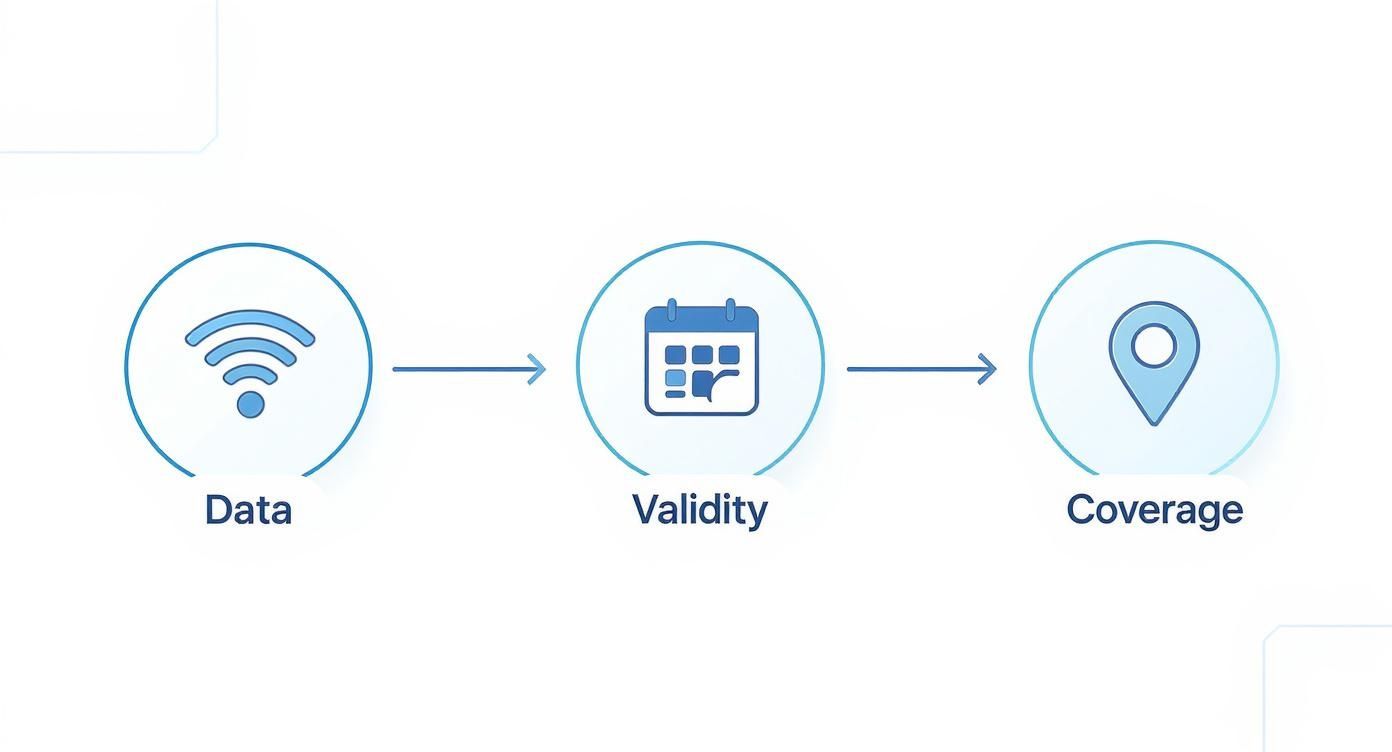
This visual breaks down the three main things to look for when choosing your plan: how much data you get, how long it lasts, and where it works.
Nailing these three elements—data, validity, and coverage—is the secret to picking the right plan every time.
Quick Tips for a Flawless Setup
To make sure everything goes off without a hitch, here are a couple of practical tips. First, always scan the QR code and install the eSIM while you’re connected to your reliable home Wi-Fi. Trying to do this on patchy airport Wi-Fi is just asking for trouble.
Second, resist the temptation to switch the eSIM on until you’ve landed in the USA. Most plans activate the moment they connect to a network, so waiting until you arrive means you get every single day of service you paid for.
One of the most common snags people hit is a QR code that refuses to scan. Don’t panic. Nine times out of ten, it’s just a smudge on your phone’s camera lens or bad lighting. Give the lens a quick wipe, and you’re usually good to go.
Any good eSIM provider, like TapSim, will have clear instructions and support ready if you do get stuck. The whole point is for this to be easy. For iPhone users, our guide offers extra help on how to activate your eSIM on an iPhone, complete with screenshots to guide you through each menu. By following this simple process, you’ll be online and exploring from the moment you step off the plane.
Common Questions About Using an eSIM in the USA
Even after you’ve picked your plan, a few practical questions might pop into your head. It’s totally normal. To make sure you’re feeling confident before your trip, here are straightforward answers to the things travelers ask most.
Can I Still Get Calls and Texts on My Normal Number?
Yes, you absolutely can, and this is one of the best features of using an eSIM. Because your phone can handle two SIMs at once, your physical home SIM card can stay active.
This means you can still receive calls and texts on your regular number. While that’s happening, you can set your new eSIM as the go-to for all your mobile data. It’s a perfect setup: you’re still reachable on your familiar number, but you’re using the eSIM for affordable data and avoiding high roaming fees from your home provider. No more fumbling with tiny plastic cards at the airport.
What Happens If I Use Up All My Data?
It’s a common fear – running out of data just when you need to pull up Google Maps. But don’t worry, adding more is easy. You won’t have to hunt down a local shop or buy a completely new plan.
Most eSIM providers have this figured out. With a service like TapSim, you just open their app or website, pick a top-up, and buy it in a couple of taps. The new data gets added to your current eSIM almost instantly, so you’re never stuck without a connection.
Will I Get a Local US Phone Number?
This is a great question, and the short answer is: probably not. The vast majority of travel eSIMs are data-only. They’re built to give you a solid internet connection but don’t usually include a local US phone number for making traditional calls or sending SMS texts.
That might sound like a downside at first, but think about how we communicate these days. A data-only eSIM is often exactly what you need.
You’ll use apps anyway: You can make calls and send messages just fine with apps like WhatsApp, FaceTime, Messenger, and Telegram.
Services are online: Everything from booking an Uber to ordering food is done through apps that need data, not a phone number.
It keeps things simple and cheap: Focusing purely on data makes these plans much more affordable and easy to activate. You skip the complicated registration that often comes with getting a local number.
A data-only eSIM cuts through the noise. It delivers exactly what you need for modern travel—fast, reliable internet—so you can navigate, share, and connect using the apps you already love, all without the fuss of a temporary phone number.
This approach is all about keeping your travel tech simple and focused on what really counts: a seamless link to the online world.
Ready to travel with less hassle? Stay connected from coast to coast with a data plan from TapSim. Find the right package for your US adventure and get online in minutes.
You’ve just landed in a new country, phone in hand, but the internet isn’t working. It’s a modern traveler’s nightmare, but don’t worry—the fix is usually surprisingly simple. Before you…
Dual SIM technology is a bit like having a hybrid car. It intelligently switches between two power sources to give you the best performance and efficiency. For your phone, this…
Figuring out how much data you’ll need for a trip can feel like a shot in the dark, but it really doesn’t have to be. For a standard week-long holiday,…
For any traveler, the best pay-as-you-go (PAYG) option is almost always a modern eSIM. Think about it from a practical standpoint: you get instant activation right from your phone, transparent…
Getting a new iPhone is always exciting, but for a traveler, ensuring your eSIM transfers smoothly is crucial. Whether it’s your primary number or a travel data plan for an…
Activating a travel eSIM is one of the smartest pre-trip tasks you can do, and it’s much simpler than it sounds. Think of it as a digital SIM card that…
Not long ago, staying connected abroad meant navigating a minefield of eye-watering roaming charges or scrambling to find a local SIM card the moment you landed. Thankfully, things have moved…