Pay As You Go eSIM: The Smart Choice for Global Travel
Share:
A pay as you go eSIM is a digital SIM card that lets you buy prepaid data for your travels, straight from your phone. Think of it like a top-up data voucher for the internet; instead of a physical card, it’s installed digitally with a simple scan or tap.
Your Guide to Instant Travel Connectivity
Landing in a new country used to kick off a frantic search for a local SIM card shop or force you to rely on patchy airport Wi-Fi. A pay as you go eSIM completely rewrites that script, offering a much smarter way to get online the moment you touch down.
It’s all built on a simple promise: you only pay for the data you need, for the time you need it. No more, no less.
How Does a Pay As You Go eSIM Work?
An eSIM, or embedded SIM, is a tiny chip that’s already built into most modern smartphones. Instead of fiddling with tiny plastic cards, you just download a digital “profile” onto this chip. This profile is what tells your phone how to connect to a local mobile network at your destination.
The “pay as you go” bit is just as straightforward. You purchase a specific data package upfront—say, 5 GB of data to use over 30 days in Europe. This approach puts you firmly in control of your spending.
No Contracts: You’re never tied into a long-term commitment or a monthly subscription.
No Hidden Fees: The price you see is the price you pay. There are no nasty surprise roaming charges waiting for you back home.
Total Flexibility: You can buy a plan for a short city break in Asia or a month-long road trip across the Americas. It’s entirely up to you.
This model is a direct answer to the expensive and often unpredictable roaming plans offered by many home providers. For a deeper look at the tech behind it all, check out our guide that explains what is an eSIM in more detail.
Why This Gives You More Flexibility and Control
Picture your travel data as fuel for your phone. With traditional roaming, you’re often forced to buy a full tank at a premium price, even if you only need a quarter of it for your trip. A pay as you go eSIM is like filling a portable canister with just enough fuel to get you exactly where you need to go.
A pay as you go eSIM puts you in the driver’s seat. It offers the freedom to choose exactly how much data you need for your trip, eliminating waste and giving you complete budget control from the moment you leave home.
For example, a tourist visiting Japan for a week might only need a few gigabytes for maps and social media. A digital nomad working from Portugal, on the other hand, might need a much larger data package to stay productive. A pay as you go model handles both scenarios perfectly, letting you tailor your connectivity to your own travel style.
With TapSim, travelers can activate data instantly before takeoff.
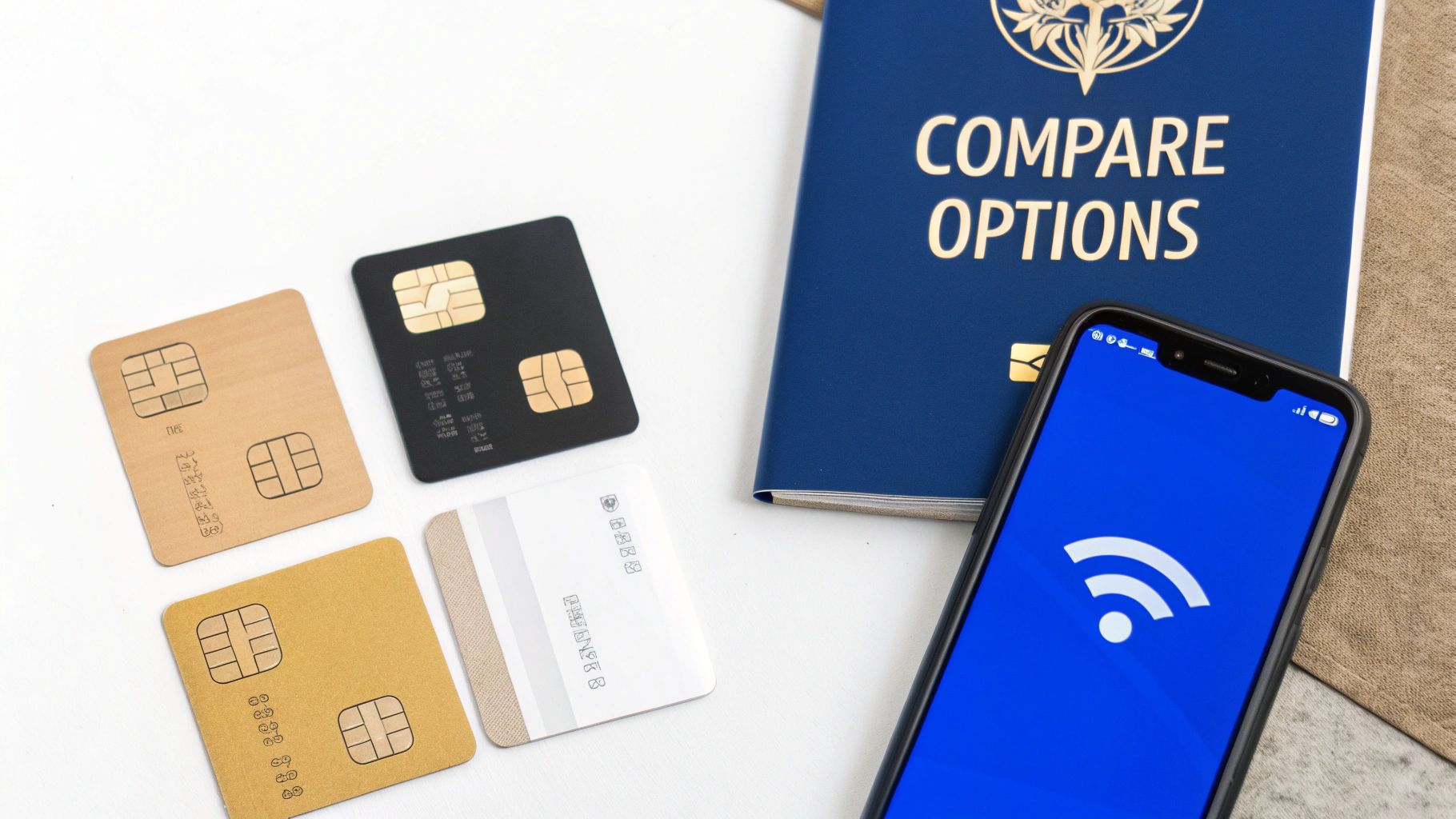
Comparing Your Options for Staying Connected Abroad
When you travel these days, getting online is as essential as packing your passport. But the ways to do it are all over the map. You’ve got everything from shockingly expensive roaming charges to the classic scramble for a SIM card at the airport. Each one has its quirks and costs.
A pay as you go eSIM is the modern answer to this puzzle, but to really see why it works so well, it helps to look at how it compares to old-school methods. Let’s break down the choices from a traveler’s point of view, focusing on what actually matters on the road: price, ease, and keeping you in the driver’s seat.
Your Home Carrier’s Roaming Plan
This is the path of least resistance, and often, the most expensive. Just landing and using your phone like you do at home is incredibly simple, but that simplicity can cost a fortune. Many providers hit you with a flat daily fee—often $5 to $10 per day—which can turn a week-long holiday into a very expensive phone bill.
Worse still, these plans are notorious for their restrictive data caps and vague “fair use” policies. One long video call home or a few hours using Google Maps could see your internet speed throttled to a crawl. The biggest fear for any traveler is that dreaded bill shock waiting for them back home.
The Local Physical SIM Card
For a long time, this was the savvy traveler’s secret weapon. Grabbing a local SIM card after landing is almost always cheaper than roaming and gives you a local number, which can come in handy. But this method has its own share of headaches.
First, you have to find a decent vendor, usually right after a long, tiring flight. This often means wading through language barriers, trying to decipher confusing plans, and going through a formal registration that requires your passport. Then there’s the fiddly business of popping out your home SIM and trying not to lose the tiny thing.
The real problem with a local SIM is that you’re offline when you need it most. You can’t order a taxi or check your hotel booking until you’ve stood in a queue and got yourself connected.
Subscription-Based eSIM Services
Some eSIM providers offer subscription services. These can be convenient for frequent flyers who are constantly hopping between the same few countries, offering a set amount of data for a monthly fee. It’s convenient, but that recurring cost doesn’t make sense for everyone.
If you only travel a couple of times a year or your destinations are always changing, a monthly subscription can be a waste. You could easily end up paying for a service you’re not even using, which misses the point of finding a smart, affordable way to get online.
The Pay As You Go eSIM Advantage
This is where the pay as you go eSIM really shines, as it cleverly sidesteps the main problems of every other option. It gives you the low cost of a local SIM but with even more convenience than your home roaming plan.
You’re in control: You buy exactly the amount of data you need, for exactly how long you need it. No hidden costs, no automatic renewals.
It’s instant: You can buy and install your plan from the comfort of your sofa before you even leave. With TapSim, you’re connected the second you turn off airplane mode.
It’s hassle-free: No more hunting for a shop, fumbling with different languages, or handling tiny bits of plastic.
To help you see the differences side-by-side, here’s a quick breakdown of how each option stacks up.
Travel Connectivity Options at a Glance
Feature
Pay As You Go eSIM
International Roaming
Local Physical SIM
Subscription eSIM
Upfront Cost
Low; you buy what you need
None, but high daily fees
Low; you buy a local plan
Medium; monthly fee
Convenience
Excellent; activate from home
Excellent; works instantly
Poor; requires finding a store
Good; activate from home
Cost Control
Excellent; no surprise fees
Poor; risk of bill shock
Good; fixed local price
Fair; recurring monthly cost
Flexibility
Excellent; ideal for any trip
Poor; locked into one provider
Fair; tied to one country
Fair; best for frequent travel
Setup Process
Simple; scan a QR code
None; seamless
Inconvenient; requires SIM swap
Simple; scan a QR code
Ultimately, choosing the right option comes down to your travel style. But for most people, the pay as you go model just makes the most sense.
For anyone living out of a suitcase, like a digital nomad or remote worker, reliable internet is non-negotiable. Finding the best eSIM for travel means balancing cost, convenience, and control. A pay as you go eSIM simply delivers the most stress-free and sensible solution for today’s traveler.
How Pay As You Go eSIM Pricing Works
One of the best things about a pay as you go eSIM is how refreshingly simple the pricing is. We’ve all been stung by traditional roaming plans, where the real costs are buried deep in the fine print. With a pay as you go eSIM, everything is out in the open.
Getting your head around how these plans are put together is the key to finding a genuinely good deal for your trip. Most of the time, it boils down to two things: how much data you get and how long you have to use it. This clarity means you can find a plan that fits your travel itinerary perfectly, so you’re not paying for data you’ll never touch.
Breaking Down the Pricing Models
When you start looking for an eSIM, you’ll notice the plans are usually laid out very clearly. For instance, a plan for a European holiday might be advertised as “10 GB for 30 days.” That simplicity is exactly what makes it so appealing.
Here’s a look at the common setups you’ll come across:
Data and Validity Bundles: This is the one you’ll see most often. You buy a specific chunk of data (say, 5GB, 10GB, or 20GB) that’s valid for a set time (like 7, 15, or 30 days). The plan ends when you use up the data or the time runs out, whichever comes first. It’s perfect for most holidaymakers and business travelers.
Validity-First Plans: Some providers focus on the duration, offering a 7-day or 15-day pass. These often advertise “unlimited” data, but you’ll definitely want to check the fair usage policy on these.
Data-Only Plans: These are less common for short trips. They give you a block of data with a really long expiry date, sometimes up to a year. They’re a better fit for people who travel to the same region every now and then.
With TapSim, you see exactly what you’re paying for right from the start. It makes it easy to pick a package without having to worry about nasty surprises on your bill later.
Finding True Value and Avoiding Hidden Catches
You need to know that not all “unlimited” plans are truly unlimited. Many of them operate under a fair usage policy, which is a critical detail to look for. What this usually means is you get a certain amount of high-speed data each day (maybe 2GB), but once you hit that limit, your connection speed is slowed right down—or “throttled”—for the rest of the day.
A plan’s fair usage policy is something you absolutely have to understand. A plan offering a solid 10GB of full-speed data might be much more useful than an “unlimited” one that slows to a crawl after you’ve only used 1GB.
When you’re comparing plans, always hunt for the full-speed data allowance. If you plan on making video calls, streaming shows, or using your phone as a hotspot, you need that consistent speed. A transparent provider will make this information easy to find, not hide it away.
The Real Savings Compared to Roaming
The price difference between a pay as you go eSIM and your network’s roaming charges can be absolutely staggering. The big carriers might charge a flat daily rate of $5 to $10 just to use your regular plan abroad, but an eSIM gives you data for a tiny fraction of that cost. In fact, travelers can save around 75% per gigabyte by choosing a travel eSIM instead of sticking with standard roaming.
This is especially true in popular travel destinations, where you can find really flexible and affordable data plans.
Think about it this way: a week-long trip to Southeast Asia could easily cost you $70 or more in roaming fees from your home provider. A pay as you go eSIM from TapSim for the same trip might only set you back $10-$15, and that’ll get you more than enough data to last. Those savings add up fast, leaving more money in your pocket for what really matters—enjoying your trip.
Getting Your eSIM Ready Before You Fly
Setting up your pay as you go eSIM is far easier than you might think. The whole process is designed to be sorted in minutes, ensuring you have internet access the moment you land. It really just boils down to a quick compatibility check and a few simple steps you can handle from your sofa.
The golden rule here is to install your eSIM while you have a stable Wi-Fi connection at home, but hold off on activating it until you actually arrive at your destination. This little trick prevents you from starting the clock on your data plan too early and means you’re ready to go online the second you turn off airplane mode.
First Things First: Is Your Phone eSIM-Compatible?
Before you even think about buying a plan, you need to make sure your smartphone actually supports eSIMs. Most phones from the last few years do, but it’s always smart to double-check and avoid any last-minute hassle. It takes less than a minute.
Here’s a quick way to find out:
On an iPhone: Head to Settings > Mobile Data. If you see an option to “Add eSIM” or “Add Mobile Plan,” you’re good to go.
On an Android: The path can differ a bit depending on the brand. A good place to start is Settings > Connections > SIM Manager. If you see an “Add eSIM” option, your phone is compatible.
This simple check is your first step towards stress-free travel data. Once you’ve confirmed, you’re all set to pick a plan.
Your Three-Step Guide to Getting Connected
Getting a pay as you go eSIM up and running is a straightforward, three-part process: buy your plan, install it on your phone, and finally, switch it on when you land. It’s all about convenience, letting you get everything sorted before you’ve even finished packing.
Let’s walk through the setup.
Buy Your Plan: First, pick a data bundle for your destination. With a provider like TapSim, you can browse plans for over 150 countries, choose one that matches your trip length, and buy it online. A QR code will land in your email inbox almost instantly.
Install the eSIM: This is the crucial part to do before you leave home. While you’re still on your Wi-Fi, just open your phone’s camera and scan the QR code from the email. Your phone will then walk you through a couple of prompts to install the eSIM profile. Think of it as downloading a digital key that will unlock local networks when you’re abroad.
Activate on Arrival: As soon as you land, dive back into your phone’s mobile data settings. All you need to do is switch your data line from your home SIM to the new travel eSIM you just installed. The plan activates automatically the moment it connects to a local network, and just like that, you’re online.
The real beauty of this is being prepared. No more hunting for a SIM card kiosk in a busy airport or trying to connect to patchy public Wi-Fi. You’ve got everything you need, ready and waiting on your phone.
For a more detailed, step-by-step guide, check out our full instructions on how to activate your eSIM and get connected without a hitch.
By following these simple steps, you can take complete control of your travel connectivity. You land, you switch it on, and you’re online—freeing you up to focus on the trip itself, not on finding a signal.
What to Look for in a Pay As You Go eSIM Provider
With the pay as you go eSIM becoming so popular, new providers are popping up everywhere, each promising the best deal. The trick is to sift through the noise and find a service that’s genuinely reliable, because that’s what will make or break your trip. A great provider isn’t just selling you data; they’re offering you peace of mind.
Making the right choice really just boils down to knowing what to look for. The best services are built around clarity and features that actually help travelers, turning what could be a technical headache into a simple, confidence-boosting part of your journey. It’s all about finding a partner that makes staying connected feel completely effortless.
Transparent Pricing and Clear Policies
The number one thing to look for is honest pricing. A trustworthy provider will lay out the total cost right from the start, with no hidden fees or nasty surprises waiting for you later. What you see should be exactly what you pay.
Just as important is how clear they are about their data policies. Keep an eye out for providers who are upfront about their “fair usage” rules. An “unlimited” plan that grinds to a halt after you’ve used just 1GB isn’t nearly as useful as a plan with a generous, clearly stated high-speed data allowance.
A provider’s commitment to transparency is a direct reflection of how they value their customers. If the pricing and policies are simple and easy to understand, you can trust that the rest of their service is built on the same honest foundation.
Instant Delivery and Simple Activation
The whole point of an eSIM is the convenience and speed. A top-notch provider will make sure your plan lands in your inbox as a QR code the second your payment goes through. There should be zero waiting around.
The activation process itself needs to be just as smooth. Look for simple, step-by-step instructions that walk you through the whole thing. Companies like TapSim have perfected this, making it as easy as scanning a code and flicking a switch in your phone’s settings. You should be online in minutes.
Responsive and Helpful Support
Even with the simplest tech, things can go wrong or questions can pop up. Knowing that a real human is there to help is crucial, especially when you’re thousands of miles from home in a completely different time zone.
A reliable provider offers customer support you can actually reach, ready to help with activation snags or answer questions quickly. This commitment to helping travelers isn’t just a nice-to-have; it’s essential. And if an activation does fail, a fair provider will have a straightforward refund policy, standing by their promise to deliver a working service.
Essential Features for Modern Travelers
Beyond the basics, a handful of features can make a huge difference to your travel experience. These are the practical extras that show a provider really gets what travelers need on the road.
Before you buy, check if they offer these must-haves:
Tethering and Hotspot Support: Being able to share your data connection with a laptop or your travel companion’s phone can be a lifesaver. This is especially true for digital nomads or families. Not all providers allow it, so always double-check.
Easy Top-Up Options: If you find yourself running low on data halfway through your trip, adding more shouldn’t be a hassle. The best providers let you top up your plan right from their app or website, without forcing you to buy a brand-new eSIM.
Broad Network Coverage: A good eSIM provider partners with major local mobile networks. This ensures you get a strong, reliable 4G or 5G signal pretty much wherever you go, not just in the capital city.
By keeping these points in mind, you can confidently pick a pay as you go eSIM provider that actually delivers on its promises, letting you stay connected without any of the stress.
Why eSIMs Are Reshaping Travel Connectivity
The buzz around pay as you go eSIMs is more than just another travel hack; it’s a sign of a massive shift in how we stay connected. Let’s be honest, the days of getting stung by extortionate roaming charges or hunting for a tiny SIM card shop the moment you land are well and truly numbered. Technology is finally putting the power back where it belongs—in your hands.
This whole movement is fueled by a simple, universal demand: people want smarter, fairer ways to get online abroad. We’re just not willing to put up with surprise bills or the faff of physical SIMs anymore. The speed at which travelers are adopting eSIMs proves this isn’t just a passing fad; it’s a genuine evolution in how we explore the world.
The Digital Shift is Gaining Serious Momentum
The growth in the eSIM market tells you everything you need to know about where we’re headed. What started as a niche feature on a few high-end phones is fast becoming the go-to solution for international travel. It’s a change driven by what we, as travelers, now expect, alongside the tech that makes it all possible.
Globally, the market is expanding at a remarkable pace. The travel eSIM niche, in particular, is on track for explosive growth, with some analysts forecasting 47% annual growth right through to 2030. That’s a huge indicator that traditional roaming is on its way out.
This isn’t just happening in a vacuum. Changing regulations and a more competitive mobile industry are pushing networks worldwide to get on board with eSIMs. As more phone makers start ditching physical SIM trays altogether, the switch will become less of a choice and more of a necessity.
Getting to grips with a pay as you go eSIM today isn’t just a smart move for your next trip—it’s about staying ahead of the curve. You’re adopting what will soon be the standard for global connectivity.
What This Means for Your Travels
This shift hands an incredible amount of choice and control directly to you. Instead of being locked into whatever your home provider decides to charge, you can now shop around for the best data deals for your destination, all from an app on your phone.
Here’s a glimpse of how this will make your future trips even better:
More Competition, Better Prices: As more providers jump into the eSIM space, competition will naturally push prices down and force service quality up.
A Smoother Travel Experience: Don’t be surprised to see eSIMs integrated into your entire travel booking process. Soon, you might be offered a data plan right alongside your flight or hotel booking.
Instant Connection, Anywhere: The dream of landing, switching on your phone, and being instantly online is no longer science fiction. It’s quickly becoming our reality.
By getting comfortable with eSIMs now, you’re essentially future-proofing your travels. Choosing a provider like TapSim means you’re already using a tool designed for the modern traveler, one that ensures you stay connected easily, affordably, and on your own terms, wherever your adventures take you next.
Common Questions About Pay As You Go eSIMs
Stepping into the world of eSIMs for your travels can feel a bit new, so it’s natural to have a few questions. Let’s clear up some of the most common ones to get you ready for a hassle-free trip.
Can I Still Get Calls and Texts on My Normal Number?
Yes, you absolutely can. This is one of the best things about using a data-only travel eSIM. It runs in parallel with your primary SIM card (whether it’s a physical one or another eSIM).
This dual-SIM setup means your travel eSIM handles all the heavy lifting for affordable mobile data, while your home number stays active for important calls and texts from your bank, family, or friends. Just hop into your phone’s settings and select the travel eSIM for mobile data – it’s that simple.
What if I Run Out of Data Halfway Through My Trip?
That’s a classic travel worry, but it’s easily solved. With a flexible provider like TapSim, you’re not left stranded. You can simply top up your data right from their app or website.
There’s no need to buy and set up a whole new eSIM. You just add more data to the plan you already have, and it kicks in within moments. You’ll be back online before your coffee gets cold.
Do I Need to Hunt for Wi-Fi to Get My eSIM Working?
Nope, and this is a game-changer for your arrival. You install the eSIM profile at home, where you have a reliable Wi-Fi connection. But the plan itself only activates the moment it connects to a network in your destination country.
This means you can switch it on as soon as the plane lands. No more desperately searching for a spotty airport Wi-Fi signal just to book a taxi or message family. You’re connected from the get-go.
Ready to travel with total control over your mobile data? TapSim offers fair, fast, and honest eSIMs for over 150 destinations, so you can connect the moment you land.
You’ve just landed in a new country, phone in hand, but the internet isn’t working. It’s a modern traveler’s nightmare, but don’t worry—the fix is usually surprisingly simple. Before you…
Dual SIM technology is a bit like having a hybrid car. It intelligently switches between two power sources to give you the best performance and efficiency. For your phone, this…
Figuring out how much data you’ll need for a trip can feel like a shot in the dark, but it really doesn’t have to be. For a standard week-long holiday,…
For any traveler, the best pay-as-you-go (PAYG) option is almost always a modern eSIM. Think about it from a practical standpoint: you get instant activation right from your phone, transparent…
Getting a new iPhone is always exciting, but for a traveler, ensuring your eSIM transfers smoothly is crucial. Whether it’s your primary number or a travel data plan for an…
Activating a travel eSIM is one of the smartest pre-trip tasks you can do, and it’s much simpler than it sounds. Think of it as a digital SIM card that…
Not long ago, staying connected abroad meant navigating a minefield of eye-watering roaming charges or scrambling to find a local SIM card the moment you landed. Thankfully, things have moved…
You’ve just landed, your travel eSIM is activated, but… no internet. It’s a classic travel headache, and the culprit is often a tiny, overlooked detail: your APN settings on iPhone.…