Planning a trip to Japan means sorting out your internet access is high on the to-do list. The choice typically comes down to two main options: renting a traditional Pocket WiFi device or using a modern eSIM that works directly with your phone.
For most people traveling alone or as a couple, an eSIM is hard to beat for sheer convenience and instant connectivity. But if you’re with a larger group that plans to stick together, a Pocket WiFi might be the more cost-effective way to go. Ultimately, the right choice hinges on how you travel.
Picture this: you’re navigating the brilliant organized chaos of Tokyo’s Shinjuku station or trying to find a hidden temple in the serene bamboo forests of Kyoto. A solid internet connection isn’t just a nice-to-have; it’s essential. You’ll need it for everything from using Google Maps to find the best ramen joint to booking a last-minute Shinkansen ticket. This brings every traveler to the same crossroads: Pocket WiFi or eSIM?
A Pocket WiFi is a small, portable router you rent for your trip. It creates a private WiFi hotspot, letting multiple devices—your phone, a laptop, maybe a tablet—connect at the same time. You’ll usually book it online before you fly and pick it up at the airport when you land in Japan.
An eSIM, short for embedded SIM, is a digital SIM card that’s already built into your smartphone. It lets you download a data plan for Japan without having to physically swap out your home SIM card. The whole process, from buying the plan to activating it, is done online.
To make things a bit clearer, let’s break down the key differences side-by-side.
The table below gives you a quick snapshot of how these two options stack up against each other.
| Feature | Pocket WiFi | eSIM |
|---|---|---|
| Setup Process | Requires physical pickup and return, often at the airport or a hotel. | Completely digital; instant download via a QR code or an app. |
| Portability | It’s a separate device you have to carry and remember to charge. | Built right into your phone, so there’s no extra hardware to worry about. |
| Best For | Ideal for families or groups (3+ people) sharing a single connection. | Perfect for solo travelers, couples, or anyone who prioritizes convenience. |
| Activation | Simple: just turn on the device and connect using the WiFi password. | Quick and easy: scan a QR code and activate it in your phone’s settings. |
| Device Sharing | Easily connects 5-10 devices at once, no problem. | You need to use your phone’s personal hotspot feature to share data. |
| Compatibility | Works with any device that has WiFi, including laptops and tablets. | You’ll need a newer smartphone model that is eSIM-compatible. |
This decision isn’t just about the tech; it’s about what will make your trip run more smoothly. With TapSim, travelers can activate data instantly before takeoff, simplifying things immensely.
Of course, the one crucial catch with an eSIM is compatibility. Before you commit, you absolutely must check if your phone can handle it. To find out more, you can check if your phone supports eSIM and make sure you’re good to go for a hassle-free digital experience in Japan.
Deciding between a Pocket WiFi and an eSIM for your trip to Japan goes far beyond just looking at the price tag. It’s really about what fits your travel style, from the second you touch down to your last day of exploring. Let’s dig into the real-world differences that will shape your journey.
This side-by-side look gets straight to the point, showing how renting a physical Pocket WiFi stacks up against using a digital eSIM for your travels in Japan.

The takeaway here is pretty clear: an eSIM is a modern, built-in solution that doesn’t require any extra hardware, whereas a Pocket WiFi is the classic, shareable hotspot that you have to carry around.
To help you decide what’s best for your trip, here’s a detailed look at how they compare on the things that actually matter.
| Comparison Point | Pocket WiFi | eSIM | Key Takeaway for Travelers |
|---|---|---|---|
| Cost | Daily rental fee plus a hefty deposit (often over $150). Risk of loss/damage fees. | One-time, upfront payment for a data plan. No hidden fees or hardware liability. | eSIM offers more predictable, transparent pricing without the financial risk. |
| Convenience | Requires physical pick-up and drop-off, usually at the airport. Adds an extra step to your travel logistics. | Purchased online and installed digitally in minutes via a QR code. Activate instantly upon arrival. | eSIM is the clear winner for convenience. No queues, no rental counters, just instant connection. |
| Portability | An extra device to carry and keep charged. Battery life is typically 6-15 hours. | Completely digital and integrated into your phone. No extra hardware to carry or charge. | For minimalist travelers, the eSIM is a game-changer, simplifying your daily carry. |
| Group Use | Excellent for groups. One device can connect multiple phones, tablets, and laptops. | Primarily for a single device, though you can tether. Not ideal for multiple heavy users. | Pocket WiFi is tailor-made for families or groups traveling with multiple devices. |
| Reliability | Depends on the rental unit’s condition and battery. Forgetting to charge it means no internet. | Relies on your phone’s battery. As long as your phone is on, you have data. | eSIM reliability is tied to your phone, eliminating a separate point of failure. |
Ultimately, your choice hinges on whether you prioritize the shareable convenience of a single hotspot or the streamlined simplicity of a digital solution.
When you’re budgeting, it’s easy to just look at the daily rental fee for a Pocket WiFi and think it’s a great deal. But that’s not the whole story. You’re renting a physical gadget, and if it gets lost, stolen, or damaged, you could be on the hook for a penalty fee that can easily exceed $150. That’s a nasty surprise that can turn a cheap option into a very expensive one.
With an eSIM, what you see is what you get. You buy a data package for a fixed price, and that’s it. There’s no hardware to lose or break, which means zero risk of unexpected charges popping up on your credit card.
For many travelers, the numbers often favor the eSIM, too. A typical 7-day unlimited data Pocket WiFi plan for Japan might set you back around $25. In comparison, some unlimited eSIM plans are often closer to $21. That makes eSIMs not just simpler, but often 15-20% cheaper for the same data, especially if you’re traveling solo or as a couple.
Traveler’s Takeaway: If you want a straightforward, predictable cost with absolutely no surprise fees, an eSIM is the smarter choice. You pay for your data upfront, and that’s the end of your financial commitment.
Japan has world-class mobile infrastructure, with giants like NTT Docomo and SoftBank blanketing the country in excellent coverage. The great news is that both Pocket WiFi services and reputable eSIM providers use these very same networks.
This means that whether you’re navigating the packed streets of Tokyo or hiking in the quiet countryside of Hokkaido, you can count on a fast, reliable connection from either option.
In the real world, you’re highly unlikely to spot any meaningful difference in performance between the two, especially in cities and popular tourist spots. Your connection will be more than fast enough for Google Maps, streaming videos, and uploading your travel photos. With TapSim, for instance, you can browse various data plans for Japan that all connect to these premier local networks.
This is where the two options couldn’t be more different. A Pocket WiFi adds a layer of admin to your trip. You have to arrange to pick it up—usually at an airport counter or your hotel—and, more importantly, you have to remember to return it before you fly out. It’s one more thing to juggle during an already busy travel schedule.
An eSIM, on the other hand, is completely digital and incredibly simple.
That instant connectivity is a genuine game-changer. No queues, no hunting for rental desks, and no extra device to worry about.
A Pocket WiFi is another piece of tech you have to babysit. It has its own battery, which will usually last somewhere between 6 to 15 hours, depending on the model and how much you use it. For a full day of sightseeing, you’ll probably need to carry a power bank just to keep it alive, on top of the one you already have for your phone.
If you forget to charge the Pocket WiFi overnight, you start your day completely disconnected.
Because an eSIM is part of your phone, it just draws power from your phone’s battery. Of course, using mobile data consumes power, but you’re completely free from the hassle of managing and charging a second device. This really simplifies your daily routine, letting you focus on your trip instead of your tech. For anyone who likes to travel light, this is a massive plus.
Knowing the tech specs of a Pocket WiFi versus an eSIM is useful, but the real question is: which one actually makes sense for your trip to Japan? The best choice really boils down to how you travel, who you’re with, and what you value most on the road.
Let’s walk through a few common traveler scenarios. See which one sounds most like you.

If you’re flying solo or traveling as a pair, convenience is everything. You’re probably aiming for a minimalist setup, traveling light without the hassle of extra gadgets, cables, and power banks. Your data usage is personal—Google Maps, social media, a few video calls back home.
For this kind of trip, an eSIM is almost always the better bet.
A Pocket WiFi just adds another piece of tech to your daily checklist. For the solo adventurer or couple, an eSIM offers a far more seamless and integrated experience.
When you’re wrangling a family or a group of friends (think three or more people) who plan to stick together, keeping everyone connected is the main goal. You need a simple, budget-friendly solution that works for everyone.
This is where a Pocket WiFi often makes the most financial sense.
A single Pocket WiFi device can typically connect 5 to 10 devices at once. Instead of buying an eSIM for every person, the whole group shares one connection, which can slash your overall costs.
This approach just simplifies things. One person minds the device, and everyone else connects to the WiFi signal just like they would at home. It’s a dead-simple way to get everyone online, from the kids’ tablets to your friend’s laptop.
For anyone traveling for work, a rock-solid internet connection isn’t a luxury—it’s essential. You need to be able to jump on video calls, upload large files, and stay in constant contact with your team, no excuses. Your data needs are likely high, and reliability is paramount.
An eSIM is the professional’s choice. It provides robust, high-speed data directly on your most important device: your smartphone.
Here’s why it works so well:
A Pocket WiFi introduces another point of failure. Forgetting to charge it could mean disaster. An eSIM ensures your connection is as reliable as your phone itself.
Heading to Tokyo for a long weekend or a quick city break in Kyoto? Simplicity and speed are what you need. You don’t have time to mess around with complicated logistics—you want to get online and start exploring the moment you arrive.
On a short trip, the eSIM is the undisputed winner.
The sheer flexibility of buying a small, affordable data package for just a few days makes it the most practical and economical option. You buy exactly what you need without being locked into a longer rental period. And with instant activation, you can land, flick on your data, and be on your way in minutes, making the most of every moment.
You’ve decided between a Pocket WiFi and an eSIM—that was the hard part. Actually getting online once your plane touches down in Japan is surprisingly simple. Whether you’ve chosen a physical gadget or a digital profile, a bit of prep before you leave home means you’ll be connected in minutes.
The two paths are quite different, though. One involves picking up and dropping off a physical device, while the other is handled entirely on your phone. Let’s walk through what each one looks like so you know exactly what to expect.
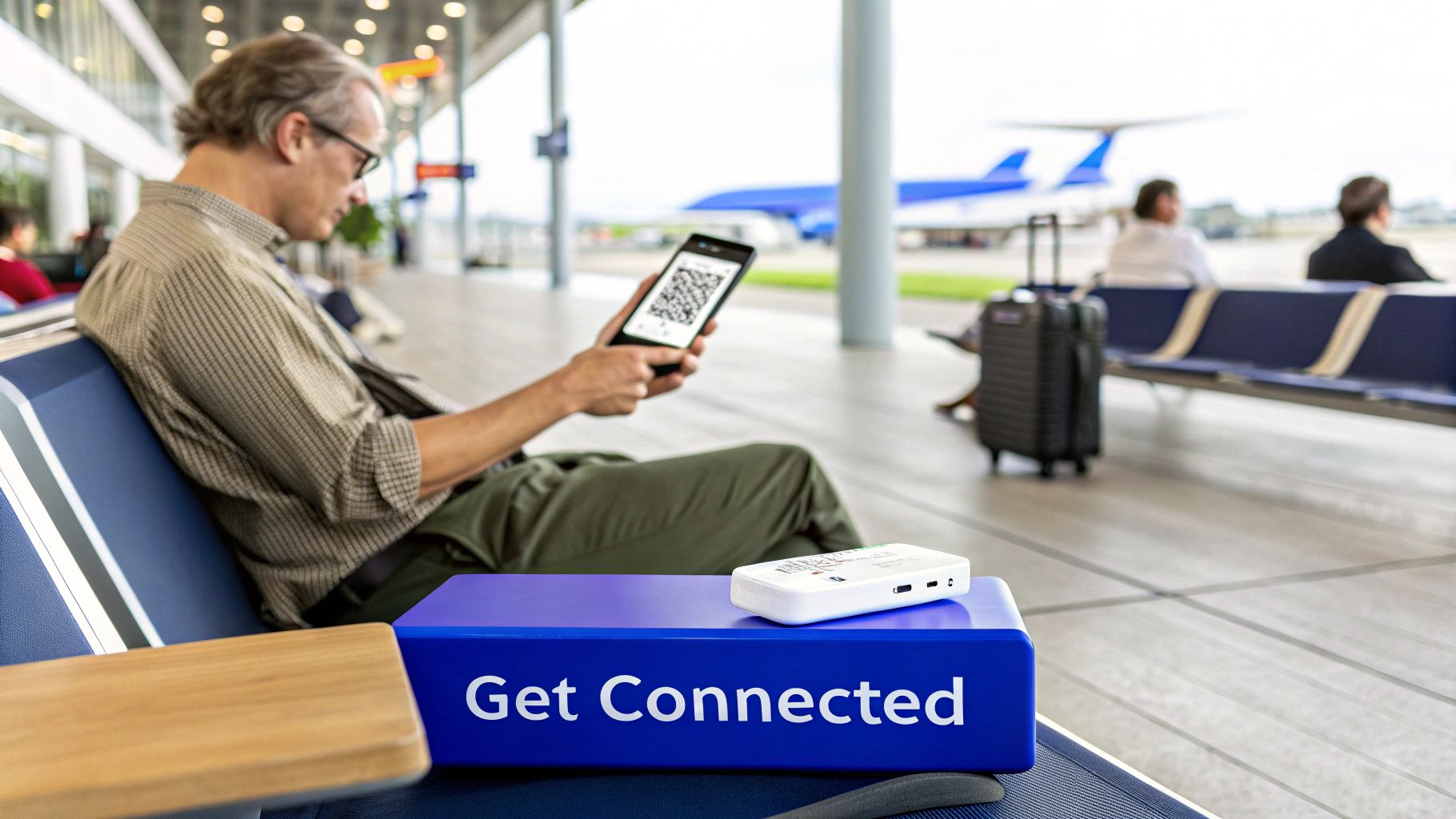
Think of getting a Pocket WiFi as a four-step dance: book, collect, use, and return. It’s a well-rehearsed routine for travelers in Japan, but you need to follow the steps to avoid any missteps.
The Pocket WiFi Process, Step-by-Step:
The Bottom Line: The Pocket WiFi is easy to use but comes with physical baggage. The biggest risk? Forgetting to return it and getting hit with a hefty penalty fee.
The eSIM experience is completely digital. You can sort everything out from your sofa before you’ve even thought about what to pack, which means no queues or paperwork when you arrive. You’re online the second you’re ready.
With an eSIM, it all happens on your phone. The whole process is designed to be quick and painless, turning what sounds like a technical job into just a few taps.
Your eSIM Activation Checklist:
Japan’s top-tier mobile infrastructure, dominated by giants like NTT Docomo and SoftBank, means your eSIM performance will be solid. Most eSIMs latch onto NTT Docomo’s extensive 4G network, giving you reliable internet from the heart of Tokyo to more remote spots. Many plans even offer 5G access in major hubs like Tokyo and Osaka, so you can tap into some seriously fast speeds.
The way we travel has changed, and our tech is changing with it. Modern travelers, especially those heading to tech-savvy destinations like Japan, are increasingly ditching physical rental gadgets in favor of digital-first solutions. This trend is crystal clear when you see how quickly eSIMs are becoming the obvious choice for staying online.
The whole appeal boils down to pure, simple convenience. With an eSIM, you can forget about the logistical headaches that come with renting a Pocket WiFi. No more queuing at the airport to pick up a device, no extra gadget to remember to charge every night, and definitely no last-minute panic trying to return it before your flight home.
It’s an approach that just makes sense, fitting in perfectly with how we already manage our trips—from digital boarding passes on our phones to online hotel bookings.
Today’s travelers expect things to be instant and seamless. The old-school idea of carrying a separate, valuable piece of hardware just for internet access feels clunky and outdated. An eSIM, on the other hand, lives securely inside your phone, which means one less thing to lose or worry about on your travels.
Even better, it puts you firmly in control. You can manage your data plan directly from your smartphone, topping up if you need to without having to hunt down a physical shop or get in touch with a rental company. This kind of flexibility is a massive advantage, letting you adapt your connection to whatever you actually need on the ground.
Providers like TapSim are built for this new reality, offering straightforward pricing and instant activation. You can sort out your entire data plan before you leave home, ensuring you’re connected from the moment you land at Narita or Haneda.
This isn’t just a hunch; it’s a measurable shift in how people travel. Recent surveys of international travelers show a significant move towards eSIMs. One study revealed that 56% of travelers were keen on using eSIMs to sidestep high roaming fees, while 10% were already using them.
Globally, the trend is even more pronounced. This past summer, 19% of all international travelers used an eSIM, a figure that completely overshadows the 3.3% who opted for a Pocket WiFi. While there’s still a way to go in terms of awareness—with 40% of those surveyed still not familiar with the tech—the desire for the cost savings and convenience is undeniable.
The data tells a clear story: as soon as travelers learn what an eSIM is, its popularity skyrockets.
Japan is a country where efficiency and technology are woven into the fabric of daily life. Everything, from its flawless public transport to its automated convenience stores, is designed to be smooth and intuitive. Using an eSIM for your internet connection fits perfectly into this modern travel experience.
It simply removes friction from your journey by cutting out unnecessary steps and potential problems.
Key Takeaway: The rise of the eSIM isn’t just about a new piece of technology. It signals a fundamental shift in what travelers now prioritize: simplicity, security, and immediate access have become the new gold standard for staying connected abroad.
By choosing an eSIM, you’re not just picking a data plan; you’re opting for a smarter, more streamlined way to explore. It lets you focus all your energy on soaking up the incredible sights, sounds, and tastes of Japan, completely confident that your connection is already taken care of.
We’ve covered a lot of ground, but you might still have a few questions buzzing around. Choosing between a Pocket WiFi and an eSIM for Japan often comes down to those nagging little “what if” scenarios. Let’s tackle the most common questions from travelers, so you can make your choice with complete confidence.
Think of this as the final check-in before your flight—clear, simple answers to ensure you’re ready for a smooth trip from the moment you land.
You can, but I wouldn’t recommend it. Using your home SIM for data in Japan means you’re at the mercy of international roaming charges from your network. These costs are notoriously high and can easily lead to a jaw-dropping bill waiting for you back home.
What about just using free public WiFi? It’s not a reliable strategy. You’ll find hotspots in airports, major train stations, and some coffee shops, but the coverage is patchy. Worse still, you often have to go through a clunky sign-up process for every single network. For crucial tasks like navigating with Google Maps or booking a last-minute train, you need a stable connection that public WiFi just can’t deliver.
A dedicated travel plan, whether it’s an eSIM or a Pocket WiFi, isn’t just a nice-to-have. It’s a smart financial move that protects you from bill shock and keeps you properly connected throughout your adventure.
This is the big one. It’s the single biggest risk with renting a Pocket WiFi and a major reason so many travelers are now switching to eSIMs. If you lose the device, or if it gets damaged or stolen, you are on the hook for the full replacement cost. Rental companies are very upfront about this in their terms and conditions.
The penalty fee can be a nasty surprise, often running $150 or more, depending on the company and the model you rented. This charge goes straight onto the credit card you used for the security deposit. It’s an expensive mistake that can put a real damper on your holiday budget.
This is where the beauty of an eSIM really shines. Because it’s just a digital profile on your phone, there’s no physical hardware to lose, break, or return. You completely sidestep the risk of any penalty fees.
Most modern smartphones have eSIM capability built-in, but it’s always best to double-check before buying a plan. Thankfully, it’s a simple process that takes less than a minute.
Here’s a quick way to check on your device:
Many popular Android phones, like the Google Pixel series and recent Samsung Galaxy devices, are compatible. For a foolproof answer, most eSIM providers have a compatibility checker on their website. With TapSim, you can quickly verify your phone before you buy, which guarantees a hassle-free setup.
Yes, absolutely. Most modern smartphones let you share your eSIM’s data connection with a laptop, tablet, or your partner’s phone by creating a personal hotspot. This effectively turns your phone into a mini portable WiFi hub.
It’s a brilliant feature for getting another device online for a short while, but there are a couple of things to bear in mind:
While a Pocket WiFi is built specifically to connect lots of devices, an eSIM’s tethering feature gives you fantastic flexibility for most travel situations.
For a simple, secure, and instantly available internet connection in Japan, an eSIM is the clear choice for the modern traveler. With TapSim, you can sort your data plan out before you even pack your bags.