A Traveler’s Guide to SIM Cards for International Travel
Share:
Using a SIM card for international travel is one of the smartest ways to get affordable mobile data when you’re abroad, letting you sidestep the often eye-watering roaming charges from your provider back home. These days, the best choice for most travelers is a travel eSIM, which you can buy online and set up in minutes, giving you a connection from the moment you land. It’s all about convenience and keeping costs down, so you can focus on your trip, not a surprise phone bill.
Navigating Your International Data Options
That ‘no service’ message flashing on your screen just after landing is a uniquely modern travel headache. We’ve all been there, scrambling to figure out how to get online without racking up a massive bill. This guide is here to cut through the confusion and show you how to get reliable, affordable mobile data pretty much anywhere your travels take you.
We’ll look at the main options available to travelers today: buying a local SIM card on arrival, using a dedicated international SIM, or embracing the sheer convenience of a travel eSIM.
Why Your Home Roaming Plan Is Rarely the Best Deal
Flicking the roaming switch on your home plan might seem like the easiest option, but it’s almost never the cheapest. Many home mobile providers have brought back daily roaming charges, with some plans costing several dollars per day just to use your regular allowance in popular destinations like Europe.
Go any further afield, and those costs can climb dramatically. A quick Google Maps search or a social media update could end up being a very expensive tap. This is why so many savvy travelers are now looking for smarter ways to stay connected that offer a lot more data for a lot less money.
Finding a Smarter Way to Stay Connected
The real goal is to find that perfect balance of cost, convenience, and coverage. You need data that just works, without the hassle of hunting for a shop in a new city or wrestling with a tricky activation process.
This is where understanding the difference between a traditional plastic SIM and a modern eSIM really matters.
A travel eSIM, like those from TapSim, puts you in control. You can buy a data plan from your sofa, scan a QR code, and have your phone ready for your destination before you’ve even packed your bags.
A little planning goes a long way. It means you can skip the airport kiosk queues and the stress of trying to find a local SIM card shop when all you want to do is get to your hotel. This guide will demystify the tech, lay out the real-world pros and cons of each choice, and help you pick the right SIM for your trip. You can also explore our guide on cheaper data alternatives for international travel to compare your options.
Comparing Your International Connectivity Options
When you’re traveling, the last thing you want to worry about is how you’ll get online. Let’s cut through the jargon and look at the three main ways people stay connected abroad: buying a local SIM card, getting an international SIM before you go, and using a modern travel eSIM. Each has its place, and the right one for you really depends on your trip and your travel style.
Figuring this out ahead of time means you can land, get your bags, and order a ride without scrambling for a Wi-Fi signal.
The Local Physical SIM Card
Think of a local SIM as going native. It’s often the cheapest way to get data, especially if you’re staying in one country for a while. You get great local network speeds and feel like a savvy traveler.
The catch? You have to hunt one down after you arrive. This could mean navigating an airport kiosk or a high-street mobile shop, often with a language barrier and your passport in hand for registration. For a month-long immersion in Italy, it’s brilliant. But if you’re on a two-week whirlwind tour of three different countries, you’ll be repeating that little scavenger hunt every time you cross a border.
The International Physical SIM Card
An international SIM is like a pre-booked travel pass. You order it online, it arrives at your home, and you pop it in your phone before you even leave for the airport. It’s a solid option for multi-country trips, like backpacking through Southeast Asia, because you land with a working phone number.
That convenience comes at a price, though. The cost per gigabyte is usually higher than a local SIM, and they can be a bit rigid. If you burn through your data faster than expected, topping up can sometimes be a clunky online process. And, of course, you still have to physically swap out your home SIM, which means finding a safe place to keep that tiny, easy-to-lose piece of plastic.
The Travel eSIM: The Digital Solution
A travel eSIM is the modern, digital answer to all this. There’s no physical card to swap or lose because it’s built right into your phone. You simply buy a data plan online, scan a QR code, and you’re good to go. It’s the digital equivalent of having all your boarding passes in your phone’s wallet.
This is where convenience truly meets control. You can set it all up from your sofa a week before your flight, which means the moment the plane’s wheels touch down, you’re connected. That’s a game-changer for looking up a map to your hotel or letting family know you’ve arrived safely.
A key advantage of the travel eSIM is the ability to store multiple plans on your phone at once. Imagine having a European plan and an Asian plan ready to go—you just switch between them in your settings as your journey unfolds. No more fumbling with SIM card trays.
With TapSim, the entire process is designed to be simple and clear, so you know exactly what you’re paying for and what you’re getting.
Comparing International Connectivity Options
To help you decide, it’s useful to see how these options stack up side-by-side. Think of this as a quick cheat sheet for picking your travel tech.
Feature
Local Physical SIM
International Physical SIM
Travel eSIM
Activation
In-person purchase, manual installation, potential ID check.
Order online, wait for delivery, manual installation.
Instant online purchase, digital installation via QR code.
Convenience
Low. Requires finding a local store upon arrival.
Medium. Arrive with a working SIM but need to swap cards.
High. Install before travel, activate instantly on arrival.
Multi-Country
No. Requires a new SIM for each country.
Yes. Designed for multi-country trips but can be less flexible.
Yes. Easily switch between regional and single-country plans.
Cost
Generally the cheapest for long stays in one country.
Often more expensive than local SIMs for comparable data.
Competitive pricing, often cheaper than roaming or international SIMs.
Flexibility
Low. Topping up can require visiting a store.
Medium. Top-ups may be possible online but can be complex.
High. Easy to top up or buy a new plan via an app or website.
Best For
Budget travelers staying in one country for an extended period.
Travelers visiting multiple countries who prefer a physical card.
Digital nomads, frequent flyers, and anyone seeking convenience.
So, what are the best sim cards for international travel? It really comes down to what you value most. If you want maximum convenience and instant connectivity, the travel eSIM is the clear front-runner for modern travel. It’s particularly powerful when weighed against other options like portable hotspots; you can see a full breakdown in our guide on pocket Wi-Fi vs eSIM for Japan travel.
Why Travel eSIMs Are a Game-Changer
Travel eSIMs have quickly become the go-to for savvy travelers, and it’s easy to see why. Let’s break down what they actually are. An eSIM isn’t a fiddly piece of plastic you need to pop out with a paperclip; it’s a digital SIM profile you download straight onto your phone. This means you can get connected in a new country in minutes, without hunting for a local shop or worrying about losing your tiny home SIM.
This move to digital is so much more than a convenience. It completely changes how we plan for international travel, putting the power to connect right back where it belongs: in your hands.
Get Connected the Moment You Land
The biggest win for eSIMs is how fast you can get them working. As long as you have Wi-Fi at home, in a coffee shop, or at the airport, you can buy and install your data plan before your plane even pushes back from the gate.
With TapSim, it’s incredibly simple: pick where you’re going, buy your plan, and scan a QR code. That’s it. Your phone is then primed and ready to connect to a local network the second you land. Say goodbye to the frantic search for airport Wi-Fi just to book a taxi or pull up your hotel address.
The real magic of an eSIM is landing in a new country, switching off flight mode, and seeing that signal bar pop up instantly. It’s a small thing that just erases a massive travel headache.
Having data right away gives you a sense of security and calm, letting you enjoy the thrill of arrival instead of stressing about the logistics of getting online.
Keep Your Home Number for Calls and Texts
One of the most practical perks of using an eSIM for data is that your main physical SIM card stays right where it is. Most modern phones are Dual SIM, which means they can run both your physical SIM and an eSIM at the same time.
This means you can keep your normal phone number active for important calls and SMS messages (like those two-factor authentication codes from your bank), while the travel eSIM handles all your data needs at a much lower cost. You just hop into your phone’s settings and assign mobile data to the eSIM. It’s the best of both worlds: people can still reach you on your usual number, but you’re dodging your home provider’s eye-watering roaming charges.
Here’s a simple look at that setup:
Your Primary SIM: Stays active for voice calls and texts.
Your Travel eSIM: Is set as the go-to for all mobile data (apps, maps, browsing, etc.).
This dual setup is a massive improvement on the old way of doing things, where swapping physical SIMs meant you had to choose one number or the other.
A Plan for Every Itinerary
The flexibility you get with eSIMs is something physical SIMs just can’t compete with. Because they’re digital, you can store several eSIM profiles on your phone at once. Planning a multi-country trip through Europe? You can have a regional European eSIM good to go. Decided on a last-minute side trip to Turkey? Just download a separate plan for that.
Being able to switch between plans right from your phone’s settings makes staying connected across borders totally seamless. You’re not forced to buy a new SIM card every time you get a new stamp in your passport. This adaptability is a huge reason they’ve taken off, especially for travelers who are now facing unpredictable roaming charges. In fact, research shows that travelers could save significantly on data by using an eSIM over standard network roaming passes, highlighting how much the game has changed for managing travel costs.
Choosing the Right Plan for Your Trip
The perfect connectivity plan really comes down to your journey. Picking the right one can be the difference between a smooth trip and a frustrating one. After all, not every trip needs an unlimited data plan, but a tiny package won’t cut it for a month-long workation.
By matching a plan to your specific travel style, you stop yourself from overpaying for data you’ll never use or, worse, running out just when you need it most.
Let’s figure out what makes sense for you. Think about what kind of traveler you are. Is this a short city break all about sightseeing, or a multi-country adventure where you’ll be crossing borders every few days? Knowing this makes the choice simple and practical.
For the Weekend Explorer
Heading to Paris for a three-day city break or a long weekend in Rome? For short trips like these, simplicity and speed are your best friends. You don’t need a massive data allowance—just enough to navigate with Google Maps, post a few photos, and find the best local restaurants.
A single-country eSIM with a few gigabytes of data is ideal. It’s usually the most affordable option and gives you high-speed data right where you need it. You can install it before you even leave home and switch it on the moment you land, saving you from wasting precious holiday time hunting down a physical SIM card.
For the Multi-Country Adventurer
Maybe you’re about to embark on a two-week tour of Europe, hopping between Spain, Italy, and Croatia. Or perhaps you’re backpacking through Southeast Asia, with Thailand, Vietnam, and Malaysia on the itinerary. Buying a new local SIM card at every border is a hassle that gets old, fast.
This is where a regional eSIM plan really shines. These plans cover multiple countries under a single data package, so you get seamless connectivity as you travel. For instance, a Europe-wide eSIM means your phone automatically connects to a local network whether you’re in Lisbon or Berlin, with no extra hassle. It’s the ultimate set-and-forget solution for country-hopping travelers.
The real beauty of a regional plan is the freedom it gives you. You can cross a border and your phone just works, letting you focus on the journey itself rather than the logistics of staying online.
For the Digital Nomad and Business Traveler
For digital nomads, remote workers, and anyone traveling for business, reliable internet isn’t just a nice-to-have—it’s non-negotiable. You need a stable connection for video calls, uploading files, and staying in touch with clients or colleagues. A small data plan simply won’t do the job.
In these situations, look for larger data packages or plans that are easy to top up. With TapSim, it’s incredibly easy to add more data on the fly through our website if you start running low. You should also check if the plan allows hotspot tethering, which is a deal-breaker if you need to connect your laptop. Prioritizing a plan with a generous data allowance from a trusted provider ensures your productivity never takes a hit.
This flowchart shows the core benefits of using an eSIM, guiding you through its advantages like instant activation and keeping multiple numbers on one phone.
The key takeaway? eSIMs offer a flexible, instant, and global solution, making them a fantastic choice for pretty much any travel scenario.
For the Budget Backpacker and Family on Holiday
If you’re traveling on a shoestring budget or trying to coordinate a family trip, keeping costs under control is probably your main goal. You want to avoid any surprise bills while making sure everyone has enough connection for safety and basic coordination.
Budget Backpackers: Look for smaller, short-term data plans. A 1GB plan that lasts for seven days is often more than enough for essential navigation and messaging, and it’s incredibly cheap.
Families: A regional plan can be a great way to manage everyone’s connectivity without breaking the bank. Alternatively, if one person has a plan that supports hotspotting, they can share their connection with others when you’re all together, saving you from buying multiple plans.
Ultimately, the best sim cards for international travel are the ones that perfectly match your itinerary, budget, and data habits. You can check out the eSIMs available for over 150 destinations on TapSim.net to find the perfect fit for your next adventure.
Your Step-by-Step Activation Guide
Getting connected in a new country should be the easy part. Whether you’ve gone for a classic physical SIM or a modern eSIM, this guide will walk you through getting it set up, so you can get online the moment you land. Knowing what to do beforehand takes away that last-minute travel stress, letting you focus on the adventure ahead.
With a straightforward provider like TapSim, the whole process is designed to be quick and painless. You’ll be connected in minutes.
Activating a Physical SIM Card Abroad
If you’ve opted for a traditional physical SIM card, the process is pretty hands-on. It’s simple enough, but a little bit of prep work is key to making it a smooth experience.
First things first: before you even leave home, you have to make sure your phone is ‘unlocked’. An unlocked phone isn’t tied to a specific network, which means it can accept a SIM from any provider around the world. If you bought your phone directly from a manufacturer like Apple or Samsung, it’s probably unlocked already. If you got it on a contract, just give your mobile provider a quick call to check. They can usually unlock it for you.
Once you’ve landed, your next job is to buy the SIM. You’ll find them at kiosks in most airports, but be warned, they can be a bit pricier. For better deals, it’s often worth waiting until you get into the city centre and finding an official mobile provider shop or an authorized reseller.
After you’ve bought your SIM, follow these steps:
Power Down: Turn your phone completely off.
Find the SIM Tray: Use a SIM ejector tool (a paperclip works in a pinch!) to pop open the small tray on the side of your phone.
Do the Swap: Gently take out your home SIM and put the new local one in. Just be sure to tuck your home SIM away somewhere safe!
Power Up: Turn your phone back on. It should automatically detect and connect to the new network. Sometimes you’ll get a welcome text with a final activation step, like sending a specific code or visiting a website.
Your Guide to Activating a Travel eSIM
The real magic of a travel eSIM is how simple and fast it is. The whole thing is digital, so you can get sorted before you’ve even locked your front door. No fiddling with tiny bits of plastic or hunting for a shop in an unfamiliar place.
The first step is to check if your phone is eSIM-compatible. Most newer smartphones are, including iPhones from the XS model onwards and recent Google Pixel and Samsung Galaxy devices. The easiest way to check is to dive into your phone’s settings under ‘Mobile Data’ or ‘Network’ and look for an option like ‘Add eSIM’ or ‘Add Mobile Plan’.
Once you’ve confirmed your phone is ready, activation is just a few taps away.
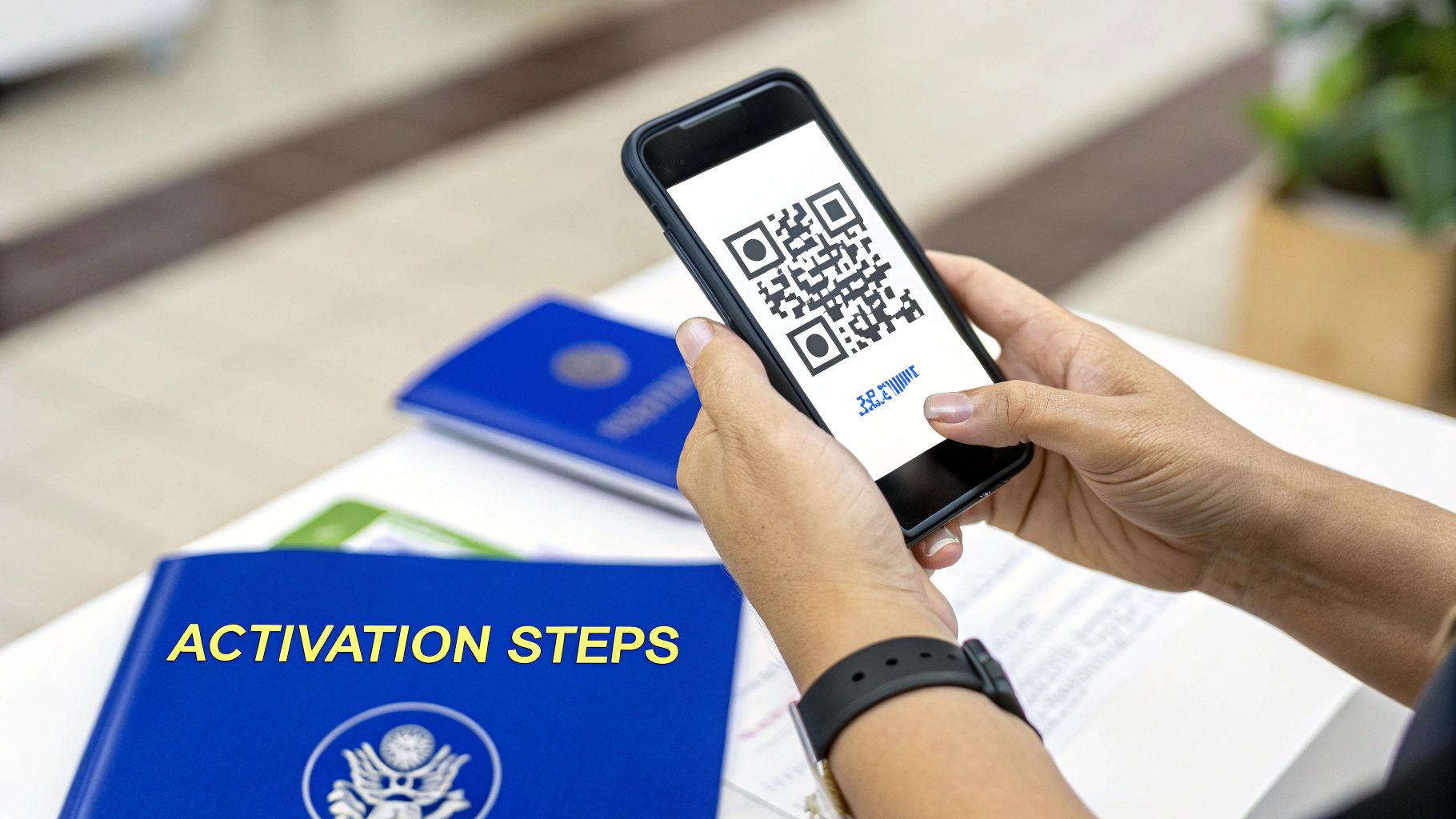
Buy Your Plan: Pick your destination and data package online from a provider like TapSim.
Scan the QR Code: You’ll get a QR code in your email almost instantly. In your phone’s settings, choose to ‘Add eSIM’ and simply point your camera at the code.
Label Your eSIM: Your phone will ask you to give the new eSIM a name. Calling it something like “Spain Data” makes it much easier to manage your plans.
Tweak Your Settings: Tell your phone to use this new eSIM for mobile data. You can keep your primary SIM active for calls and texts, which is great for receiving important verification codes from your bank. Our guide has more details on how to activate an eSIM on an iPhone.
Connect on Arrival: Keep the eSIM turned off until you land. The moment you arrive, just switch your mobile data line over to your travel eSIM, and you’ll connect to the local network automatically.
With TapSim, activation is instant. You can be online within minutes of switching off airplane mode, ready to find your way to the hotel or let family know you’ve arrived safely.
Troubleshooting Common Connection Issues
Every now and then, technology needs a gentle nudge. If your SIM or eSIM doesn’t connect right away, don’t panic. Here’s a quick checklist to run through for both types of sim cards for international travel.
Check Your Settings: Make sure mobile data is actually turned on and that you’ve selected the correct SIM or eSIM to be used for data. It’s an easy mistake to make!
Toggle Airplane Mode: This is the oldest trick in the book for a reason. Switch airplane mode on for 30 seconds and then off again. This forces your phone to search for networks from scratch.
Restart Your Device: You’d be surprised how often the classic “turn it off and on again” works. A simple restart can fix all sorts of minor glitches by refreshing the network connection.
Check APN Settings: In rare cases, you might need to manually input the Access Point Name (APN) settings. Your SIM or eSIM provider will give you these details, which you can enter in your phone’s mobile network settings.
These simple steps should sort out most connection headaches, letting you get back to what you’re really there for: enjoying your trip.
Your Questions, Answered
Heading into the world of international SIMs can feel a bit confusing at first. To make sure you’re feeling confident and ready for your trip, here are answers to the most common questions from fellow travelers. No jargon, just straight-up, practical advice to help you stay connected.
Can I Still Use My Regular Phone Number with a Travel eSIM?
Yes, you absolutely can, and this is one of the best things about using an eSIM. Most modern phones have Dual SIM capabilities, meaning they can handle both your physical SIM and an eSIM at the same time.
Here’s how it works in practice: you leave your home SIM in its slot to receive calls and texts on your normal number. Then, you simply tell your phone to use the travel eSIM for all your mobile data. It’s a quick change in your settings that gives you the best of both worlds—you’re always reachable on your main number, but you’re dodging those outrageous data roaming charges from your provider back home.
What Happens If I Run Out of Data?
Running out of data mid-trip used to be a real hassle, usually meaning you had to track down a local shop for a top-up card. Thankfully, those days are pretty much over with modern eSIMs.
With TapSim, you can add more data in a matter of seconds, right from our website. You’ll typically get a heads-up notification when you’re running low, so you have plenty of time to top up. It’s seamless, meaning you won’t get cut off while you’re trying to navigate with Google Maps or post that perfect sunset photo.
How Can I Tell If My Phone Works with eSIMs?
Good news: most flagship smartphones from the last few years are eSIM-ready. We’re talking models like the iPhone XS and newer, the Google Pixel 3 and newer, and the Samsung Galaxy S20 series and newer.
But there are a couple of quick ways to be certain.
Dive into your phone’s settings. Head to ‘Mobile Data’ or ‘Network & Internet’ and look for an option that says ‘Add eSIM’ or ‘Add Mobile Plan’. If it’s there, you’re good to go.
Another neat trick is to dial *#06# from your phone’s keypad. A screen with device information will pop up. If you see a number labeled ‘EID’, your phone definitely supports eSIMs.
Most eSIM provider websites also keep a running list of compatible devices, so you can always double-check there before you commit.
When’s the Best Time to Install My Travel eSIM?
The golden rule is to install your eSIM before you leave home. Do it while you’ve still got a reliable Wi-Fi connection. You can scan the QR code and get the plan all set up on your phone without actually starting the clock on it.
Your eSIM’s validity period and data allowance won’t kick in until it first connects to a network at your destination. By installing it ahead of time, you’re guaranteeing a connection the second you touch down.
This little bit of prep work is a massive stress-saver. When you land, all you need to do is switch your phone’s cellular data over to the eSIM, and you’re instantly online. You can book a ride, pull up your hotel address, or just let everyone know you’ve arrived safely. It’s a simple step that makes the first hour of any trip infinitely smoother. The right sim cards for international travel are all about making things easy, right from the very start.
Ready to travel without the roaming bill shock? With TapSim, you can get affordable, instant data in over 150 destinations. Find the perfect plan for your next adventure and get connected the moment you land.
You’ve just landed in a new country, phone in hand, but the internet isn’t working. It’s a modern traveler’s nightmare, but don’t worry—the fix is usually surprisingly simple. Before you…
Dual SIM technology is a bit like having a hybrid car. It intelligently switches between two power sources to give you the best performance and efficiency. For your phone, this…
Figuring out how much data you’ll need for a trip can feel like a shot in the dark, but it really doesn’t have to be. For a standard week-long holiday,…
For any traveler, the best pay-as-you-go (PAYG) option is almost always a modern eSIM. Think about it from a practical standpoint: you get instant activation right from your phone, transparent…
Getting a new iPhone is always exciting, but for a traveler, ensuring your eSIM transfers smoothly is crucial. Whether it’s your primary number or a travel data plan for an…
Activating a travel eSIM is one of the smartest pre-trip tasks you can do, and it’s much simpler than it sounds. Think of it as a digital SIM card that…
Not long ago, staying connected abroad meant navigating a minefield of eye-watering roaming charges or scrambling to find a local SIM card the moment you landed. Thankfully, things have moved…