What are roaming charges? A guide to avoid surprise fees
Share:
Ever received a shockingly high phone bill after a trip abroad? The culprit is almost always roaming charges. These are the extra fees your mobile provider adds when you use your phone for calls, texts, or data outside your home country.
What Are Roaming Charges and How Do They Actually Work?
Think of it this way: your home mobile provider doesn’t have its own signal towers in Spain, Thailand, or the United States. To keep you connected, it has to strike a deal with a local network in the country you’re visiting.
Essentially, your phone “roams” by borrowing another company’s network to make calls or get online. That local company then bills your provider for the service. Your provider, in turn, passes that cost—often with a hefty markup—straight on to you in your monthly bill.
Here’s a quick breakdown to simplify the concept.
Roaming Charges at a Glance
Concept
Simple Explanation
What is Roaming?
Your phone connecting to a different mobile network when you’re abroad.
Who is Affected?
Any international traveler—from tourists to digital nomads—using their phone for calls, texts, or data.
Why Does it Cost Money?
Your home provider pays a local foreign network for using its infrastructure, and you pay the markup.
This entire process involves complex agreements that happen behind the scenes, which is why the final bill can be so unpredictable for travelers.
Why Roaming Costs Can Feel So Random
The reason roaming charges seem so arbitrary and expensive boils down to a few key factors that are completely out of your control as a traveler.
Behind-the-Scenes Deals: Your provider negotiates wholesale rates with foreign networks. These “inter-operator agreements” set the base price, which can vary wildly from one country to another.
Patchy Regulation: Some regions, like the EU, have policies to manage these costs for member countries. However, for many travelers, including those from the UK visiting Europe post-Brexit, these protections no longer apply. In much of the world, there are no caps at all, giving providers free rein to charge what they like.
Infrastructure Overheads: Creating and maintaining a global network for seamless billing and connectivity is a massive undertaking. A portion of that operational cost is inevitably passed on to you.
Getting your head around what mobile data roaming is is the first step to avoiding bill shock. Once you understand the system, you can start finding ways to work around it.
This is precisely why something as simple as your phone downloading an email in the background or an app updating itself can lead to surprisingly high charges. Modern alternatives like a TapSim eSIM give you a way to sidestep this old-fashioned system, letting you connect directly to local networks at transparent, prepaid rates.
How Roaming Fees Add Up So Quickly
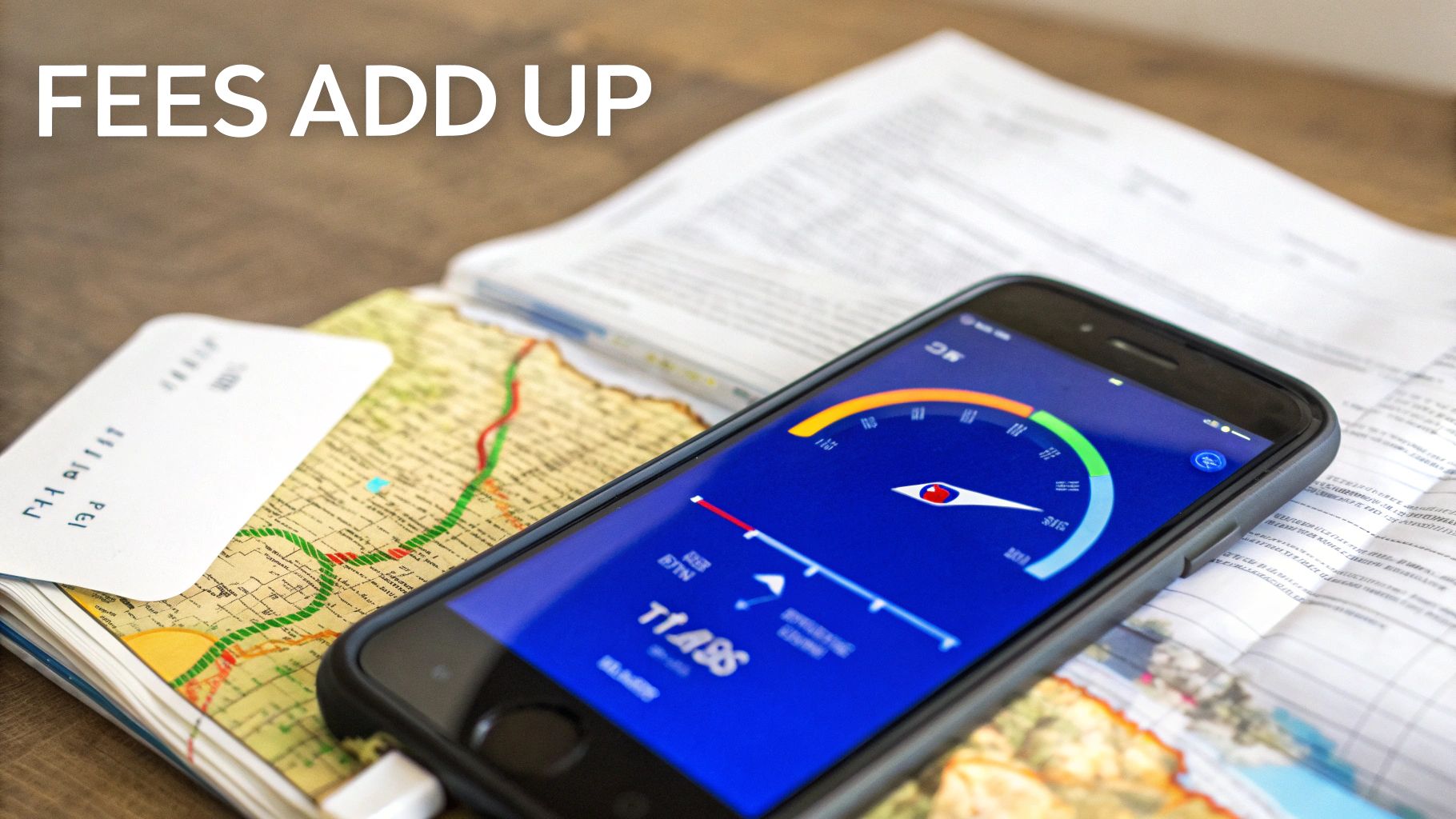
We’ve all heard the horror stories. A traveler returns from a fantastic trip only to be hit with a mobile bill that looks more like a car payment. The real shock of roaming isn’t just that it costs money—it’s how astonishingly fast those fees can spiral out of control.
It often boils down to a single, easily overlooked detail: how your provider actually calculates your data usage abroad. Back home, you probably have a generous data allowance, but overseas, the rules change completely.
Many networks don’t bill you for the exact, tiny kilobytes your phone uses. Instead, they round up, often charging you for a full megabyte (MB) at a time. This means even a minuscule bit of background data—an app refreshing in your pocket, a quick notification ping—can trigger the charge for a whole megabyte. It’s a billing practice that can quickly turn a small amount of usage into a massive expense.
Your phone is a chatterbox. It’s constantly sending and receiving small packets of data for background tasks like syncing emails, fetching weather updates, and keeping your apps current. At home, this is harmless. When roaming, every one of those tiny actions could be costing you.
How Different Services Are Charged
To make things more complicated, your provider doesn’t treat all your phone activity the same. When you’re roaming, they typically split your bill into separate charges for data, calls, and texts, each with its own expensive pricing model.
Data Charges: This is usually the biggest culprit behind bill shock. Billed per megabyte (MB), data is what fuels everything you do online—from checking Google Maps and browsing websites to streaming music and using social media.
Voice Calls: Most carriers charge you by the minute for calls. That often includes not just the calls you make, but also the ones you receive. Yes, that means an incoming call from a friend back home could be costing you money just to answer it.
Text Messages (SMS): While a simple text is usually billed per message, don’t get complacent. Sending photos or videos (MMS) is a different beast entirely, as it uses mobile data and can be surprisingly pricey.
Even if you think you’re being careful, your smartphone’s constant background chatter can quietly rack up charges without you ever touching it. This is why a simple day trip or even a short airport layover can sometimes result in an unexpected bill.
A travel eSIM from a provider like TapSim offers a much saner approach. You simply buy a prepaid data plan for your destination, giving you a fixed cost upfront. This completely sidesteps the risk of unpredictable per-megabyte charges and hidden fees from background data.
Real-World Scenarios That Send Your Roaming Bill Sky-High
It’s one thing to know what roaming charges are, but quite another to see them in action. Habits that cost you nothing at home can turn into shockingly expensive mistakes the moment you step off the plane. This is where most travelers get caught out, leading to that gut-wrenching bill when they get back.
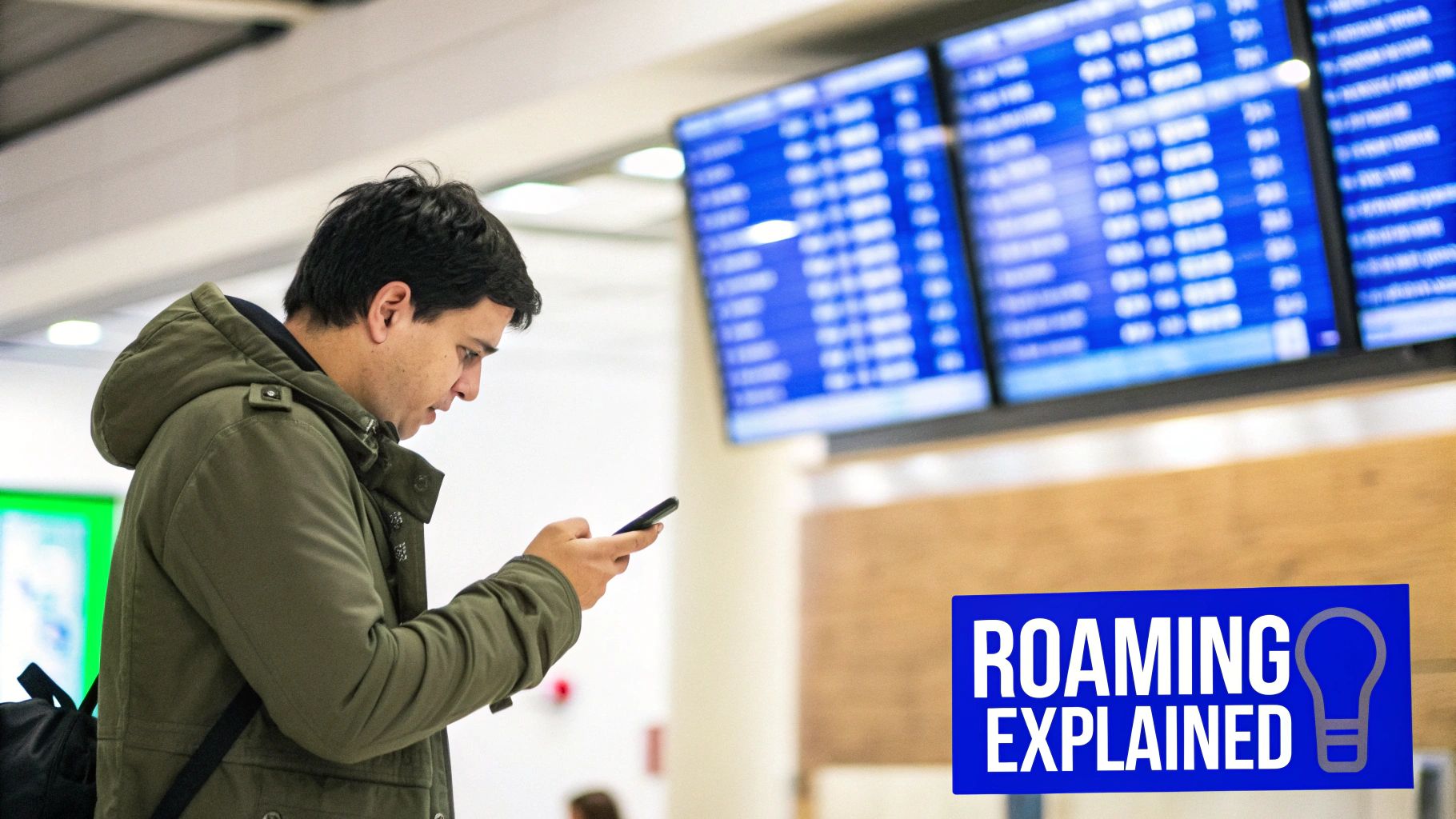
Think about it: you’ve just landed, and while you’re waiting for your bags, your phone connects to a local network. In that instant, it springs to life—pulling down emails, refreshing your social media feeds, and syncing your travel photos to the cloud. Every single one of those actions chews through data, and you could easily rack up significant charges before you’ve even left the airport.
Or what about a multi-country trip? A classic European road trip or a backpacking adventure through Asia sounds amazing, but it’s a minefield for roaming costs. Let’s say you drive from France into Spain for a quick lunch. The moment your phone crosses that invisible border, your provider might automatically start a brand-new daily roaming pass. Just like that, you’ve paid twice for a single day.
The Data Guzzlers You Don’t See
The biggest culprits aren’t the things you do, but the things your phone does on its own. These background processes are the silent assassins of your travel budget.
Automatic App Updates: Your phone is programmed to keep its apps up-to-date, and it doesn’t care if it’s using your free home Wi-Fi or an expensive foreign mobile network.
Cloud Syncing: Services like iCloud and Google Photos are brilliant until they start uploading your entire holiday photo album in the background. That can burn through gigabytes of data without you even realizing.
Background App Refresh: Your weather, news, and social media apps are constantly “phoning home” for the latest updates. This creates a slow but steady data drain that quickly turns into a deluge.
When the Rules Suddenly Change
Sometimes, the goalposts move without you even knowing it. For anyone from the UK traveling in Europe, the post-Brexit rule changes have been a huge wake-up call. The “Roam Like at Home” policy that was once taken for granted is no longer guaranteed.
Many major UK providers have brought back daily roaming fees. As of 2025, you can expect to be charged anywhere from £2 to £6 per day just to use your phone in popular European destinations. It’s a nasty surprise for travelers who aren’t in the loop. It’s well worth reading up on the current UK roaming charges to stay informed before you travel.
Smart Ways to Dodge High Roaming Charges
Heading overseas doesn’t have to mean coming home to a shocking phone bill. With a bit of forward planning, you can easily sidestep those eye-watering roaming charges and stay connected without breaking the bank. It’s all about making a conscious choice before you travel, rather than letting your phone make an expensive one for you.
This decision tree shows just how easily normal travel moments can rack up charges if you haven’t prepared.
As you can see, the biggest traps are often the most innocent actions, like your phone automatically connecting to a local network the moment your flight lands. Here are the most effective ways to take control and keep your costs down.
Comparing Your Options to Avoid Roaming Fees
There’s no single “best” way to get data abroad; it really depends on your trip’s length, your destination, and how much you plan to use your phone. We’ve laid out the most common methods below so you can see what might work for you.
Method
Best For
Potential Downsides
Local Physical SIM Card
Longer stays in one country and heavy data users.
Requires finding a shop, swapping your home SIM, and losing access to your main number.
Travel eSIM (like TapSim)
Short trips, multi-country tours, and travelers who value convenience.
Requires a newer, eSIM-compatible phone.
Your Provider’s International Plan
Short trips where absolute convenience is the top priority.
Often the most expensive option, with daily fees that add up quickly.
Turning Off Data Roaming
Budget-conscious travelers who are happy to hunt for free Wi-Fi.
Leaves you without maps or messaging on the go, which can be a real pain.
Ultimately, the goal is to find the sweet spot between cost, convenience, and connectivity. Let’s dig into each of these a bit more.
A Closer Look at Each Strategy
Turn Off Data Roaming Completely
The simplest, most surefire way to avoid charges is to dive into your phone’s settings and flick the “Data Roaming” switch to off. It’s a zero-cost, zero-risk approach. The catch? You’ll be completely dependent on Wi-Fi for everything, from checking Google Maps to sending a quick WhatsApp message.
Buy a Local Physical SIM Card
This is a classic traveler’s trick, especially for longer stays. Popping a local SIM into your phone gives you a local number and access to much cheaper, domestic data rates. The downside is the hassle. You’ll need to find a shop when you arrive, swap out your home SIM (meaning you can’t receive calls or texts to your normal number), and top it up if you run out.
Purchase an International Plan from Your Provider
Most home carriers offer international add-ons or daily passes. They’re certainly convenient because everything just works. However, this convenience comes at a premium. Daily passes from major UK providers can run from £2 to £7 per day. That might not sound like much, but for a two-week holiday, you could be looking at a bill of over £50 just for basic access.
Use a Travel eSIM
eSIMs are the modern, flexible answer to roaming. An eSIM is a digital SIM that you download straight to your phone, letting you buy a data plan for your destination before you even pack your bags. With an eSIM from a provider like TapSim, you can activate it the moment you land and get online instantly. It’s perfect for avoiding the fuss of physical SIMs, and many phones let you use an eSIM alongside your regular SIM. You can learn more about this in our guide on how dual SIM technology works.
Your Pre-Travel Roaming Prevention Checklist
A little prep work before you jet off is your best weapon against eye-watering roaming charges. Just think of this as your pre-flight check for your phone—a few simple steps that can save you a serious amount of money and holiday stress.
Most of these only take a couple of minutes but can make all the difference. By getting ahead of the game, you stay in control of your mobile costs from the moment your plane touches down.
Before You Leave Home
Check Your Current Plan: First things first, log into your mobile provider’s app or website. Find their international roaming policy and get a clear picture of what they charge for data, calls, and texts where you’re headed. Don’t just assume—know the rates.
Turn Off Automatic Backups and Updates: Dive into your phone’s settings and disable automatic app updates and cloud photo syncing over mobile data. These background data hogs are notorious for chewing through expensive roaming data when you least expect it.
Download Everything You Need: Get everything you need for the trip while you’re still on your home Wi-Fi. Download offline maps, save your travel playlists, and grab any films or shows you plan to watch. Every megabyte you download now is one you won’t have to pay for later.
Set Up Your Connectivity
The savviest travelers sort out their data before they even leave for the airport. This completely sidesteps the frantic search for a local SIM shop or a decent Wi-Fi connection when all you want to do is get to your hotel.
Installing a travel eSIM before you depart is the key to a seamless connection. You can activate your data plan the second you touch down, giving you instant access to maps and messaging without risking any roaming charges from your home SIM.
An eSIM from TapSim, for instance, gives you affordable, high-speed data that’s ready to go. You just scan a QR code at home, and you’re all set for your destination. If you’re new to the idea, our guide explains what an eSIM is and how it works in simple terms. It’s easily the most hassle-free way to start your trip.
Got More Questions? Let’s Clear Things Up
To wrap things up, let’s tackle a few common questions that pop up when people talk about roaming. Getting these details straight can be the difference between a smooth trip and a surprise bill.
Can I Still Be Charged if My Mobile Data Is Turned Off?
You’d think the answer would be a simple ‘no’, but surprisingly, yes, it can happen. While switching off mobile data is your best line of defence, some sneaky background services can still try to connect. For example, some phones may still try to retrieve Visual Voicemail updates or certain multimedia messages (MMS), which could ping a local network and trigger a minimum data charge.
The only way to be 100% certain is to put your phone in Airplane Mode. Once that’s on, you can then manually re-enable Wi-Fi and Bluetooth. This physically blocks your phone’s modem from even looking for a cellular signal, so there’s zero chance of an accidental connection.
What’s a “Fair Usage Policy”?
Ah, the classic “Fair Usage Policy” (FUP). It’s the fine print your provider uses to manage heavy data users, even on plans advertised as “unlimited.” Think of it as a soft cap.
Once you burn through a specific amount of data—say, 50GB in a month—your provider reserves the right to dramatically slow down your connection, sometimes to a crawl, for the rest of the month. It’s their way of keeping the network fair for everyone. For a traveler, this means that “unlimited” roaming deal might become painfully slow after just a few days of streaming or video calls. Always check the policy details.
A transparent data plan is crucial for avoiding surprises. With a TapSim eSIM, the amount of high-speed data you get is stated clearly upfront. There are no hidden speed reductions or confusing fair use clauses to worry about.
Is a Local SIM Cheaper Than a Travel eSIM?
It really boils down to your travel style. A physical, local SIM card can sometimes be the cheaper option if you’re planning a long-term stay (think a month or more) in just one country and need a massive amount of data. The trade-off, however, is the hassle: you have to find a shop upon arrival, navigate potential language barriers, and you can’t use your regular phone number.
For most people, especially those on shorter trips or hopping between countries in Europe or Asia, a travel eSIM is far more convenient and often more cost-effective. You can set it all up from your sofa before you even leave, it activates the second you land, and topping up is easy. The time and stress you save usually make it the smarter choice. With a service like TapSim, you buy exactly the data you need, so you never overpay.
Ready to say goodbye to roaming charges for good? TapSim offers transparent, affordable eSIM data plans for over 150 destinations worldwide.
You’ve just landed in a new country, phone in hand, but the internet isn’t working. It’s a modern traveler’s nightmare, but don’t worry—the fix is usually surprisingly simple. Before you…
Dual SIM technology is a bit like having a hybrid car. It intelligently switches between two power sources to give you the best performance and efficiency. For your phone, this…
Figuring out how much data you’ll need for a trip can feel like a shot in the dark, but it really doesn’t have to be. For a standard week-long holiday,…
For any traveler, the best pay-as-you-go (PAYG) option is almost always a modern eSIM. Think about it from a practical standpoint: you get instant activation right from your phone, transparent…
Getting a new iPhone is always exciting, but for a traveler, ensuring your eSIM transfers smoothly is crucial. Whether it’s your primary number or a travel data plan for an…
Activating a travel eSIM is one of the smartest pre-trip tasks you can do, and it’s much simpler than it sounds. Think of it as a digital SIM card that…
Not long ago, staying connected abroad meant navigating a minefield of eye-watering roaming charges or scrambling to find a local SIM card the moment you landed. Thankfully, things have moved…