Ever wondered how your phone magically stays connected when you step off a plane in another country? That’s mobile data roaming in action. It’s the service that lets your phone hop onto a partner network for data, calls, and texts when you’re outside your usual coverage area.
Think of it as a digital passport for your phone, granting it temporary access to stay online abroad. Without it, your phone would be little more than a paperweight as soon as you left your home network’s reach.
How Does Mobile Data Roaming Actually Work?
Picture your mobile provider as a local neighbourhood. Inside this zone, your phone connects to everything without a second thought. But when you travel, you wander into a completely different neighbourhood run by another company. Roaming is simply the friendly agreement between your provider (the home network) and that foreign provider (the visited network) that lets your phone connect as if it were a local.
It’s a bit like having a membership to your favourite coffee shop chain. Your local branch isn’t there when you travel, but thanks to a partnership, your membership card gets you a flat white at their affiliated cafe in the city you’re visiting. Your mobile provider has struck similar deals, known as roaming agreements, with networks all across the globe.
To put it simply, here’s a quick overview:
Mobile Data Roaming at a Glance
Concept
Simple Explanation
Home Network
This is your regular mobile provider—the company you pay your bill to every month.
Visited Network
This is the foreign mobile provider your phone connects to when you’re travelling abroad.
Roaming Agreement
A business deal between your home and a visited network that allows their customers to use each other’s services.
Authentication
The background process where the visited network confirms with your home network that you’re a legitimate customer.
This table captures the core idea: roaming is all about cooperation between different mobile companies to keep you connected.
The Handshake Between Networks
This partnership is what makes roaming possible. The moment you land in a new country and switch your phone off airplane mode, it starts searching for a signal. It’s specifically looking for a network that has a pre-existing deal with your provider back home.
A roaming agreement is basically a business contract. The visited network provides you with service and then sends the bill for whatever data you use back to your home network. This is precisely why roaming charges can get so eye-wateringly expensive—those costs are passed straight on to you, often with a hefty markup.
Once your phone finds a friendly network and establishes a connection, it gets authenticated in the background. Suddenly, you’ve got signal bars, and you can pull up Google Maps or send that “I’ve arrived safely!” message. While it all feels seamless, remember this convenience is built on a complex web of international agreements between operators, and it usually comes at a price.
How Mobile Roaming Keeps You Connected Abroad
Ever wonder how your phone magically finds a signal the moment you land in another country? It’s not magic, but a clever digital handshake that happens behind the scenes, usually before you’ve even unbuckled your seatbelt. This whole process relies on international agreements and some unique codes tucked away on your SIM card.
This instant connection is all thanks to roaming agreements. Your mobile provider back home has struck deals with hundreds of other operators across the globe. These partnerships are the bedrock of mobile roaming, essentially creating a worldwide club where networks agree to look after each other’s customers.
Your Phone’s Digital Passport
Think of your SIM card as a digital passport. It contains a few key bits of information that tell a foreign network exactly who you are and where you’ve come from. It’s not just one number, but a combination of codes working in harmony.
The three most important identifiers are:
IMSI (International Mobile Subscriber Identity): This is your unique ID number, tying you directly to your mobile account. It’s the core of your phone’s digital identity.
MCC (Mobile Country Code): A three-digit code that signals your home country. For instance, UK operators use codes like 234 or 235.
MNC (Mobile Network Code): This two or three-digit code pinpoints your specific network provider within that country, like Vodafone, O2, or EE.
When your phone powers on abroad, it broadcasts this IMSI, MCC, and MNC combination to nearby cell towers. The local network reads these codes, instantly recognising your home country and provider. It then quickly cross-references its list of roaming partners. If your provider is on the list, you’re in.
This infographic breaks down how your phone’s request is sent from the foreign network back to your home provider for a quick verification.
As you can see, there’s a crucial back-and-forth between the two networks. It’s this chat that confirms you’re a legitimate customer and gives your phone the green light to connect.
The Seamless Network Handover
Once you’re authenticated, you’re online. But the truly clever part is how your phone keeps you connected as you move about. Whether you’re on a train speeding through the countryside or just wandering through a new city, your phone is constantly scanning for the best signal from an approved partner network.
This is all part of a process called a network handover. When the signal from one cell tower starts to fade, your phone seamlessly and automatically latches onto a stronger one nearby. You won’t notice a thing, even if you’re in the middle of a video call or relying on Google Maps to find your hotel. The system is designed to be totally invisible, though glitches can happen. If you find yourself stuck without a connection, running through a guide for troubleshooting mobile data while travelling is always a good place to start.
Key Takeaway: Mobile roaming is a tag-team effort. Your SIM card’s unique codes (IMSI, MCC, MNC) identify you, while roaming agreements between your home network and foreign providers grant you access. This allows for instant authentication and smooth network handovers, so you can stay online without a second thought.
Understanding Roaming Charges and How You Get Billed
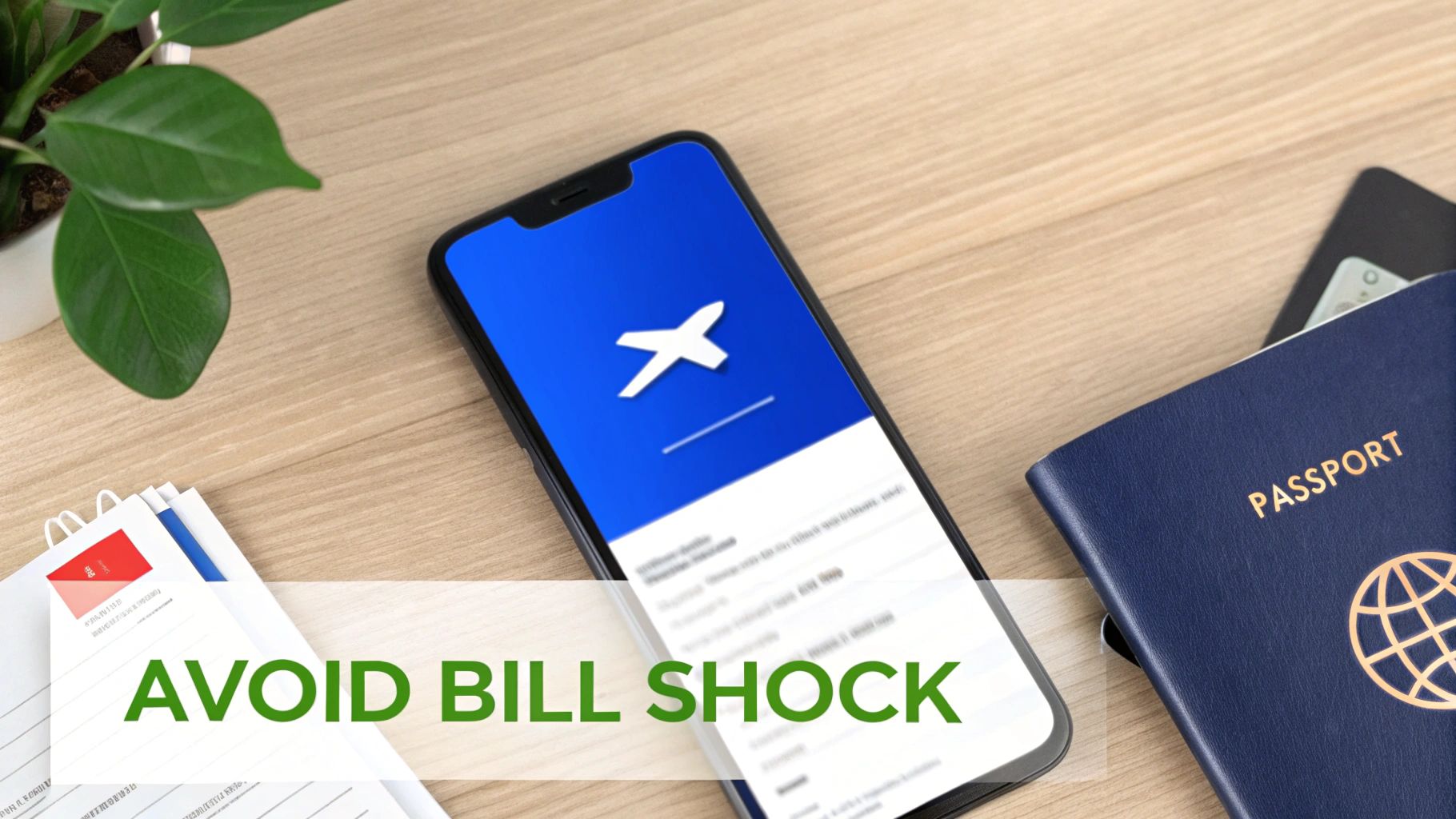
We’ve all heard the horror stories: the traveller who comes home from a dream holiday only to be hit with a mobile phone bill worth hundreds, or even thousands, of pounds. This dreaded “bill shock” is a very real risk, and it all comes down to how mobile data roaming is priced.
At its core, the high cost is a result of wholesale agreements between mobile operators. When you’re abroad, you’re using a “visited” network. That network doesn’t provide you service for free; it bills your home provider for every single megabyte of data you use, every text you send, and every minute you’re on the phone.
Of course, your home provider then passes that cost on to you, often with a hefty markup on top. That’s the simple, and often painful, reason roaming can be so expensive.
How You Are Billed For Roaming
Mobile providers have a few different ways of charging for roaming, and the difference between them can be huge for your wallet. It’s vital you know which model your plan uses before you even pack your bags.
The most common billing methods you’ll encounter are:
Pay-Per-Megabyte: This is the one to watch out for. It’s the old-school, and frankly most dangerous, way of billing. You’re charged for every single megabyte you use, and with today’s data-hungry apps, costs can spiral in minutes. Seriously, avoid this if you can.
Daily Passes or Bundles: A much safer bet. Many operators now offer a fixed-price daily pass that gives you a set allowance of data, calls, and texts for 24 hours. These are more predictable but can still add up, often costing around £5 to £7 per day.
Monthly Travel Add-Ons: If you’re going away for a week or more, look into a monthly add-on. You buy a larger bundle of roaming data to use over your trip, which usually works out cheaper than buying daily passes. The only catch is you need to estimate your usage upfront.
To put it into perspective: imagine you use your phone to check Google Maps for 10 minutes, scroll through Instagram for another 15, and stream a couple of songs on Spotify. On a pay-per-megabyte plan, that brief activity could easily cost you more than lunch. That’s how people get caught out.
The Shifting Landscape For UK Travellers
For those of us in the UK, things have gotten a bit more complicated recently, especially since Brexit. We used to enjoy the EU’s ‘Roam Like At Home’ policy, which meant we could use our phones across the EU with no extra charges. For many, that’s no longer the case.
Many UK operators have brought back roaming fees for EU destinations. While some providers, like Tesco Mobile, have promised to keep EU roaming free until 2025, others have switched to their own plans and packages. Coupled with new Ofcom regulations coming in from October 2024 that will require clearer alerts about charges, it’s clear the ground is shifting.
What this all means is that checking your provider’s specific roaming policy has gone from a smart tip to an essential pre-travel task. The days of just assuming your UK plan will work across Europe without any nasty surprises are, unfortunately, over.
Common Roaming Risks And How To Avoid Bill Shock
Even if you’ve set up a travel pass with your provider, the dreaded “bill shock” can still be a real risk. A few hidden pitfalls can quietly chew through your data allowance when you’re not looking, but knowing what they are is the first step to keeping your bill under control.
The most common culprits are often the apps whirring away silently in the background. Your phone is always busy fetching new emails, refreshing your social media feeds, and checking for app updates. These tiny data sips are barely noticeable at home, but they can quickly add up to a hefty sum when you’re roaming.
Another trap to watch out for is automatic software updates. Both iPhones and Androids are usually set to download these big updates over Wi-Fi, but a simple settings mistake could allow them to download using your mobile data. A single system update while you’re abroad could wipe out your entire travel data allowance in one go.
It’s easy to see why managing roaming is so critical. By early 2025, the UK had around 88.4 million active mobile connections. The average person now gets through 23GB of data every month—a massive 53% jump from 2022. This insatiable appetite for data, fuelled by video streaming and gaming, means we expect the same seamless connection when we travel, making the risk of a sky-high roaming bill greater than ever. You can read more on these trends in the Digital 2025 UK report.
Managing Your Roaming Settings
Thankfully, both iOS and Android give you all the tools you need to get a grip on your data usage. Spending just a few minutes in your settings before you fly can save you a whole lot of money and holiday stress.
Here’s a quick, practical guide to get your device travel-ready:
For iOS (iPhone) Users:
Head into Settings and tap on Mobile Service (or Mobile Data on older versions).
Go into Mobile Data Options.
You’ll see the Data Roaming toggle right there. Switch it off to completely block any data usage on foreign networks.
For more granular control, go back to the main Mobile Data screen and scroll down. You’ll see a list of all your apps—you can turn off mobile data access for the really greedy ones, like Netflix or YouTube.
For Android Users:
Open up Settings and find Connections (this might be called Network & Internet on some phones).
Tap on Mobile networks.
The Data roaming toggle will be in here. Just flick it off to stop your phone from connecting to data abroad.
As an extra safety net, you can set a data limit. Go to the Data usage section in your settings, where you can tell your phone to automatically cut off mobile data once you’ve used a certain amount.
The Sneaky Risk of Accidental Roaming
Here’s a less obvious one: accidental roaming. This can happen when you’re close to an international border and your phone latches onto a stronger signal from a network in the neighbouring country. You might not have even left the UK, but if your device connects to a French or Irish mast, for example, you could start racking up roaming charges.
The easiest way to prevent this is to dive into your phone’s network settings and manually select your home network instead of leaving it on automatic.
If you’re keen to make sure your holiday bill has no nasty surprises, our complete guide on how to avoid roaming charges is packed with more handy tips. A little bit of prep goes a long way.
Smarter Alternatives to Expensive Data Roaming
Thankfully, you don’t have to be at the mercy of your home provider’s pricey roaming packages anymore. Modern travellers now have far smarter and more budget-friendly ways to get online abroad, all without the dread of a massive bill waiting at home. These options put you back in the driver’s seat.
For a long time, the classic traveller’s trick was to buy a local SIM card right after landing. This strategy has its perks—you get access to cheap, local data rates that almost always beat what you’d pay for roaming. It’s a solid, old-school approach.
But let’s be honest, it’s not without its headaches. You have to hunt down a shop, maybe struggle with a language barrier to get it working, and worst of all, you have to physically swap out your main SIM. That means you can’t get calls or texts on your regular number, which is a real pain when you need a verification code from your bank or an urgent message from home.
The Modern Solution: eSIM Technology
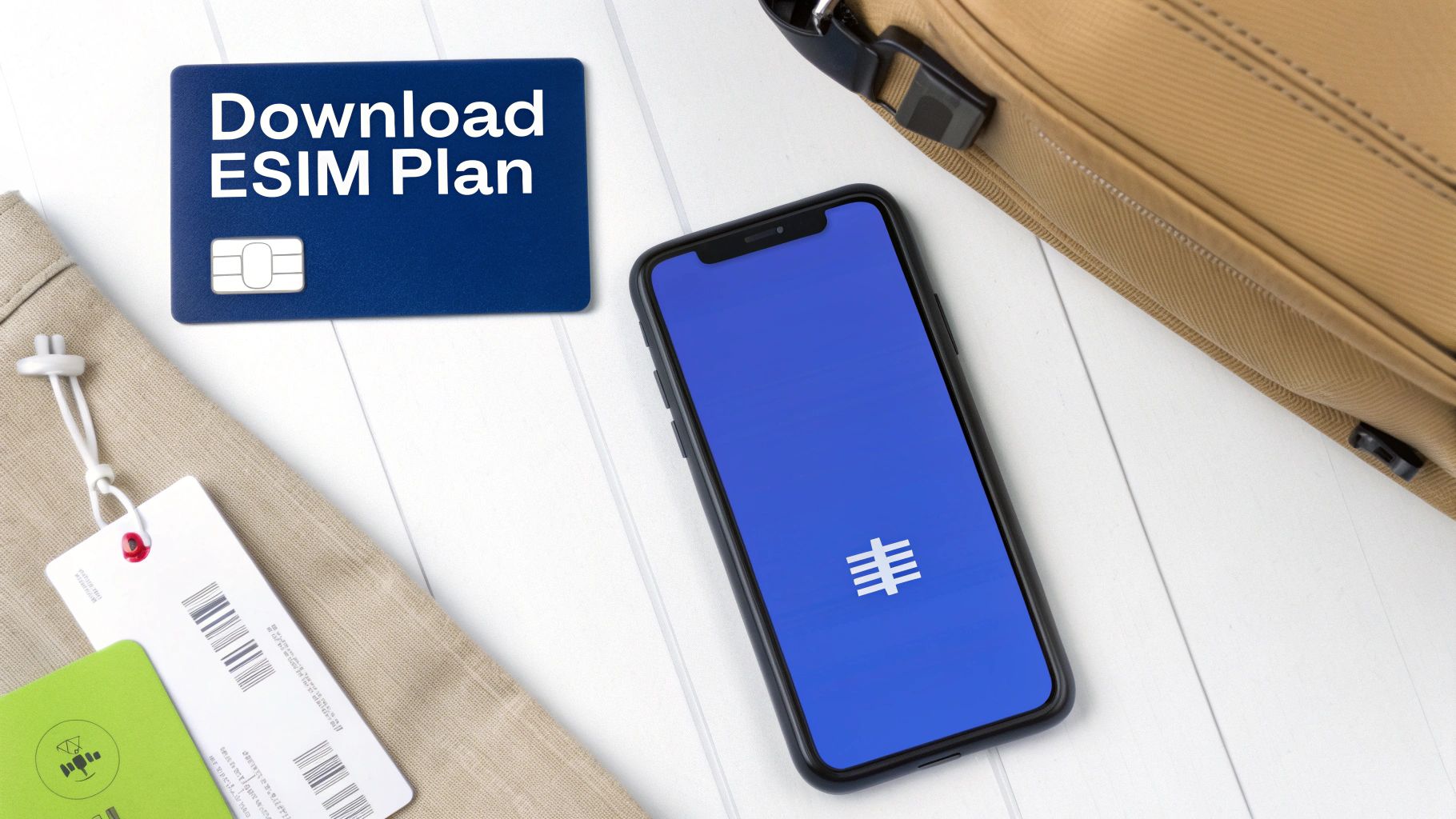
A much slicker solution has appeared in recent years: eSIM technology. An eSIM, or embedded SIM, is a digital SIM that’s already built into your phone. Instead of fumbling with a tiny piece of plastic, you just download a digital data plan for your destination.
This really is a game-changer for international travel. The benefits are impossible to ignore:
Convenience: You can shop for and install your travel data plan from your sofa before you’ve even packed your bags.
Instant Connectivity: Your plan kicks in the moment you land. No more desperate searches for airport Wi-Fi or a SIM card kiosk.
Keep Your Home Number: The eSIM handles the data, leaving your physical SIM slot free for your primary number. You won’t miss any important calls or texts.
Cost-Effective: eSIM data plans often offer rates that are just as good as local SIMs, giving you affordable data without any of the usual hassle.
The need for easy travel connectivity is exploding. From 2022 to 2023, UK spending overseas shot up by 17% as international travel roared back to life. This has helped push the global data roaming market towards a projected $95.43 billion by 2025, as more travellers rely on data for everything from maps to messaging. You can read more about the trends shaping the data roaming market on The Business Research Company.
How an eSIM Works for Travellers
The process couldn’t be simpler. You pick a data package for your destination, get a QR code in your email, and scan it with your phone to install the eSIM profile. It just sits there, ready and waiting.
Once you land, you switch it on in your phone’s settings, making it your primary source for mobile data.
This means you can step off the plane, turn off airplane mode, and instantly be online to book a ride, pull up your hotel reservation, or just let family know you’ve arrived safely. It’s the perfect blend of a local SIM’s low cost with the sheer convenience of modern tech. To dive deeper into how it all works, check out our guide that answers the question, what is an eSIM?
To help you decide, let’s break down how these options stack up against each other.
Comparing Connectivity Options for Travellers
Feature
Data Roaming
Local SIM Card
Travel eSIM
Cost
Generally the most expensive option.
Very affordable, local market rates.
Highly competitive, often similar to local SIMs.
Convenience
Automatic activation, but requires setup with home provider.
Requires finding a store, potential language barriers.
Purchase and install from anywhere before you travel.
Connectivity
Instantly active upon arrival.
Active once purchased and installed.
Instantly active upon arrival.
Your Home Number
Kept active for calls and texts (at roaming rates).
Temporarily inaccessible as SIM is removed.
Kept active in your phone for calls and texts.
Flexibility
Limited to your home provider’s partner networks.
Tied to one local network in one country.
Can buy plans for single countries, regions, or globally.
Best For
Short trips where convenience outweighs cost.
Longer stays in a single country and budget travellers.
Most travellers seeking the best balance of cost and convenience.
Ultimately, while traditional roaming offers some convenience, the high cost is a major drawback. Local SIMs are cheap but come with logistical challenges. For most modern travellers, a travel eSIM hits that sweet spot, offering the best of both worlds: affordability and incredible ease of use.
Got Questions About Data Roaming? We’ve Got Answers
Stepping into the world of mobile data roaming can feel a bit confusing. To make sure you’re fully clued up before your next trip, we’ve put together answers to some of the questions we hear all the time from travellers.
Will I Get Charged for Incoming Calls When I’m Roaming?
Yes, you almost certainly will. This is a common pitfall that catches many people out. Back home, incoming calls are usually free, but that rule doesn’t apply when you’re abroad. Your home network has to pay the foreign network to route the call to your phone, and they pass that cost straight on to you.
The exact rate can be all over the place, depending on your provider and where you are in the world. It’s always worth checking your plan’s specific roaming charges for calls before you jet off. A great tip is to ask friends and family to use apps like WhatsApp or FaceTime to reach you – these calls use data, not the traditional phone network, which can save you a bundle.
What’s the Difference Between Data Roaming and International Calls?
It’s easy to mix these two up, but the difference is actually quite simple. It all boils down to where you are physically located when you use your phone.
Data Roaming is what happens when you use your phone—for data, calls, or texts—while you’re physically outside your home country and connected to a foreign network.
International Calls are what you make when you’re in your home country, using your home network, to phone a number in another country.
Think of it this way: using Google Maps on your UK phone while wandering through Paris is roaming. Calling that same Parisian hotel from your sofa in London is an international call. The costs for each are calculated completely differently.
How Can I Tell if My Phone Works With eSIMs?
Good news – most modern smartphones now come with eSIM technology built-in. As a general rule of thumb, if you bought your phone in the last few years, it’s very likely to be compatible.
Here’s a quick way to find out for sure:
For iPhone users: Head to Settings > Mobile Service (or Mobile Data). If you see an option like “Add eSIM” or “Add Data Plan,” your phone is good to go.
For Android users: The path can differ a bit between brands, but you’ll usually find it under Settings > Connections > SIM manager. If there’s an option to add an eSIM, you’re all set.
Checking this before you travel is a smart move. It opens up a world of flexible and often much cheaper ways to stay connected on the road.
Heads Up: Your phone being eSIM-compatible is only half the battle. It also needs to be “unlocked” from your mobile provider. A locked phone will reject any SIM or eSIM from another company, which means you won’t be able to use a travel eSIM.
Why Is the Data Roaming Switch on My Phone Greyed Out?
This is a really frustrating one, and it always seems to happen just when you need to get online. If the data roaming toggle in your settings is greyed out and won’t switch on, it usually points to a handful of culprits.
It might be a restriction your mobile provider has placed on your account, a problem with your SIM card, or even a software bug. A good first step is to try a “network settings reset” on your phone. This won’t touch your personal data but often clears up these kinds of connection issues. If that doesn’t fix it, your next call should be to your home provider.
Ready to travel without the fear of roaming charges? With TapSim, you can get affordable, high-speed data in over 150 destinations. Simply choose your plan, install your eSIM before you fly, and connect the moment you land. Visit https://tapsim.net to find the perfect data plan for your next adventure.
You’ve just landed in a new country, phone in hand, but the internet isn’t working. It’s a modern traveler’s nightmare, but don’t worry—the fix is usually surprisingly simple. Before you…
Dual SIM technology is a bit like having a hybrid car. It intelligently switches between two power sources to give you the best performance and efficiency. For your phone, this…
Figuring out how much data you’ll need for a trip can feel like a shot in the dark, but it really doesn’t have to be. For a standard week-long holiday,…
For any traveler, the best pay-as-you-go (PAYG) option is almost always a modern eSIM. Think about it from a practical standpoint: you get instant activation right from your phone, transparent…
Getting a new iPhone is always exciting, but for a traveler, ensuring your eSIM transfers smoothly is crucial. Whether it’s your primary number or a travel data plan for an…
Activating a travel eSIM is one of the smartest pre-trip tasks you can do, and it’s much simpler than it sounds. Think of it as a digital SIM card that…
Not long ago, staying connected abroad meant navigating a minefield of eye-watering roaming charges or scrambling to find a local SIM card the moment you landed. Thankfully, things have moved…