Travel eSIM No Hidden Fees: What to Check
Choose a travel eSIM no hidden fees plan with confidence. Learn what providers hide, what to check, and how to avoid roaming bill shock abroad.
An eSIM for Turkey is a digital SIM card that lets you download a data plan directly to your phone. Instead of handling a physical plastic chip, you get internet access the moment you land. It’s the easiest way to stay connected while exploring Istanbul’s Grand Bazaar or watching hot air balloons in Cappadocia, without the worry of expensive roaming charges from your home provider.
Imagine landing at Istanbul Airport after a long flight. You want to book a taxi, check your hotel confirmation, or send a quick “I’ve landed!” message. Traditionally, this meant either paying a fortune for roaming or joining a long queue at a kiosk to buy a local SIM card, often navigating language barriers and confusing plans.
An eSIM sidesteps all that hassle.
Because an eSIM is a small chip already built into your phone, you can buy and set up a data plan from a provider like TapSim before you even leave home. This is a game-changer. It means as soon as your plane lands in Turkey, you just switch on your eSIM line, and you’re instantly online. No more hunting for patchy airport Wi-Fi or wasting the first hour of your trip in a phone shop.
The main benefits of using an eSIM for your Turkish adventure come down to a few key things.
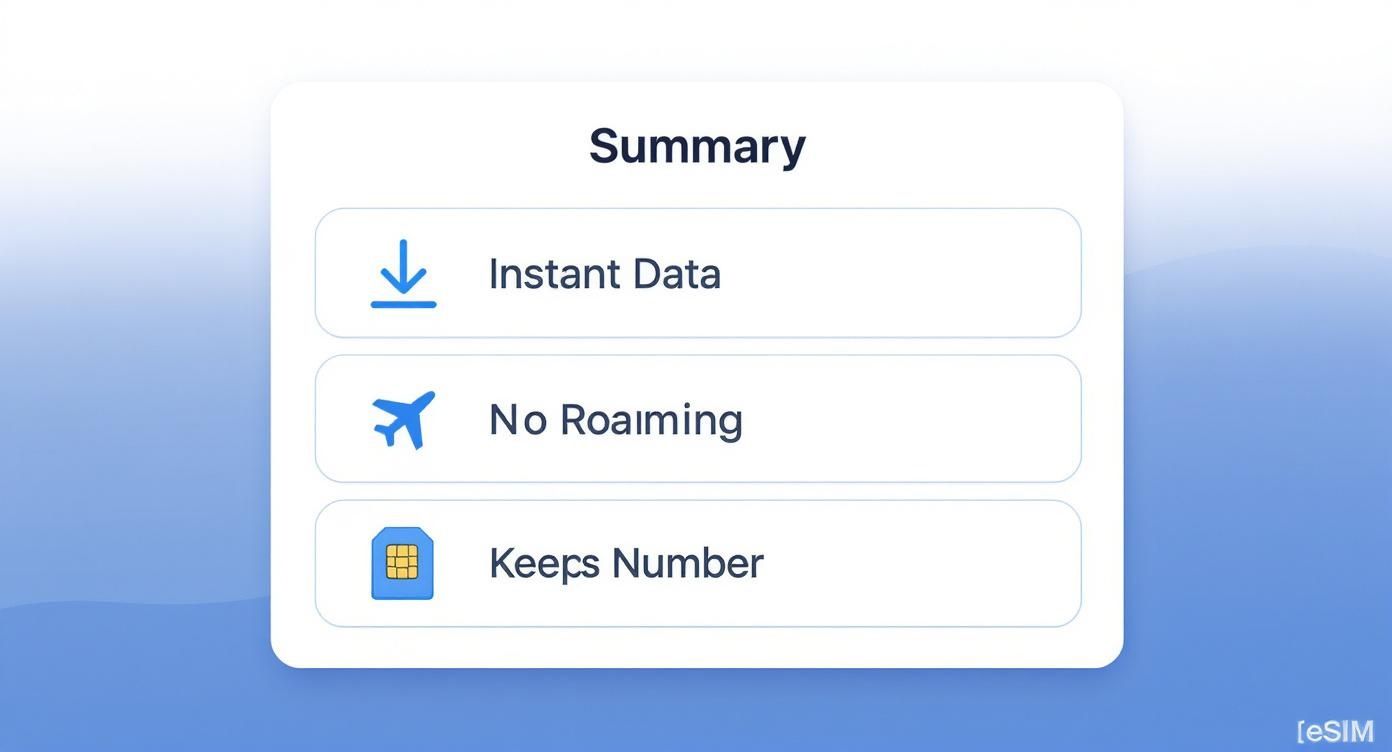
It’s all about getting online instantly, avoiding unexpected roaming fees, and keeping your regular phone number active for calls and texts from home.
For most travelers, an eSIM just makes more sense. It offers the perfect balance of convenience, cost, and control. Let’s see how it compares to the traditional options.
Here’s a quick look at how an eSIM stacks up against traditional methods like local SIM cards and international roaming.
| Feature | eSIM for Turkey | Local Physical SIM | Home Carrier Roaming |
|---|---|---|---|
| Activation | Instant; download before you fly. | Requires finding a store and a registration process. | Usually automatic, but can be slow to connect. |
| Cost | Affordable with clear, upfront pricing. | Tourist prices can be inflated, with hidden costs. | Often expensive, with high daily fees. |
| Convenience | Activate the moment you land. | Time-consuming process, often with a language barrier. | Easy to use, but at a very high price. |
| Flexibility | Keep your primary number for calls and texts. | You have to physically swap your home SIM card. | No SIM swapping needed, but no control over costs. |
The comparison speaks for itself. It’s clear why so many travelers are switching to eSIMs—they eliminate the guesswork and high costs of staying connected abroad.
The best part about an eSIM is the peace of mind. Knowing you have reliable, affordable data ready to go the moment you arrive means you can focus on enjoying your trip, not stressing about your phone bill.
Ultimately, an eSIM for Turkey makes your travel experience smoother. Whether you’re using Google Maps to navigate winding streets, uploading photos of your Bosphorus cruise, or using a translation app to order the perfect kebab, you’ll have all the data you need, without the usual hassle.
So, what exactly is an eSIM and how does it get you online in Turkey? Let’s break it down. An eSIM is an embedded SIM—a tiny chip already built into your phone by the manufacturer. Think of it as a permanent, digital version of the plastic SIM cards you’re used to, ready for a data plan to be loaded onto it.
Unlike a physical SIM, which holds your plan on a removable chip, an eSIM stores it all digitally. When you buy an eSIM for your trip to Turkey, you’re purchasing a digital “profile” that tells your phone how to connect to local mobile networks once you arrive.
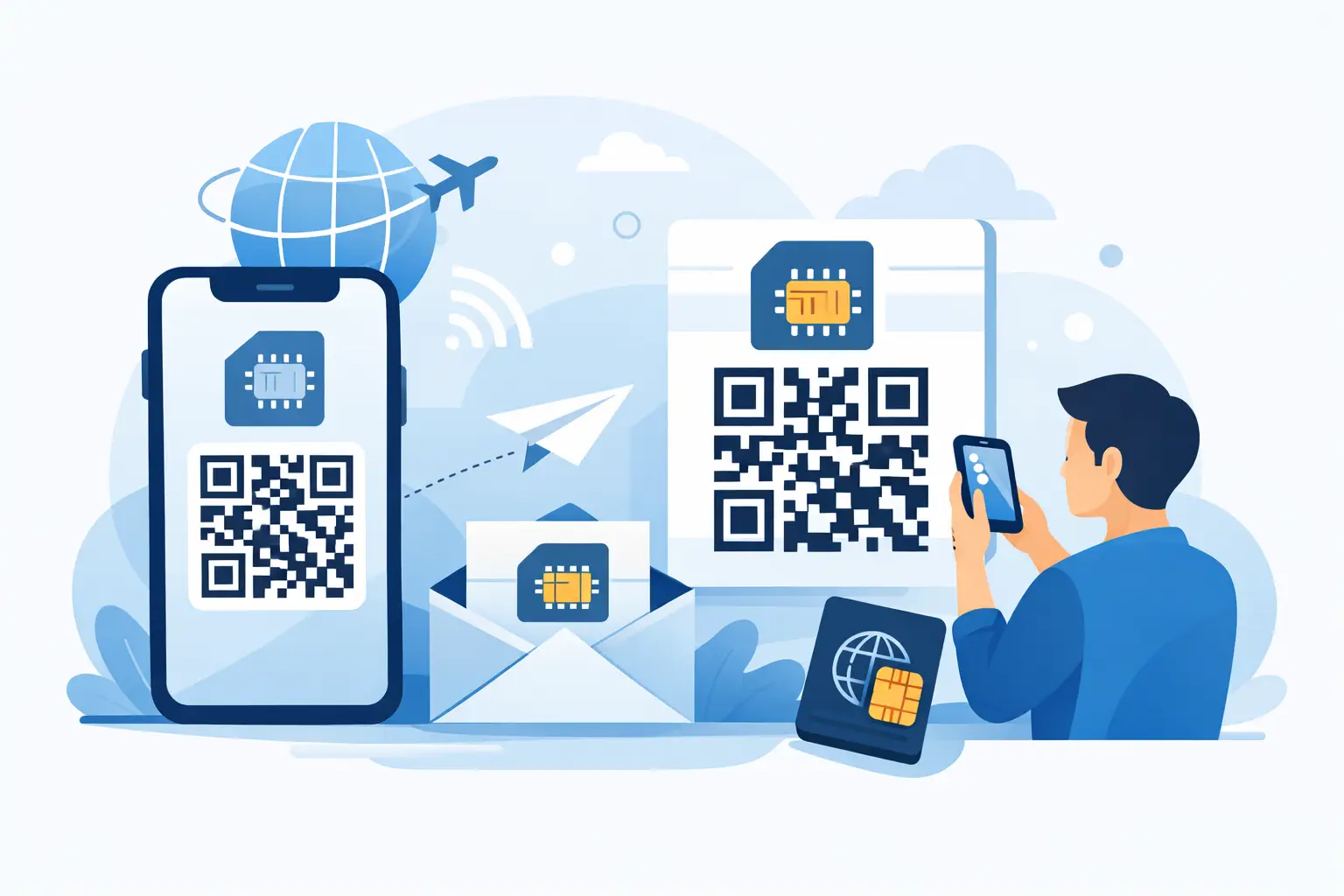
This process is usually handled with a simple QR code. You scan it, and your phone instantly downloads the data profile onto that embedded chip. This profile contains all the information needed to connect to a top network in Turkey, giving you fast and reliable 4G/LTE or even 5G data.
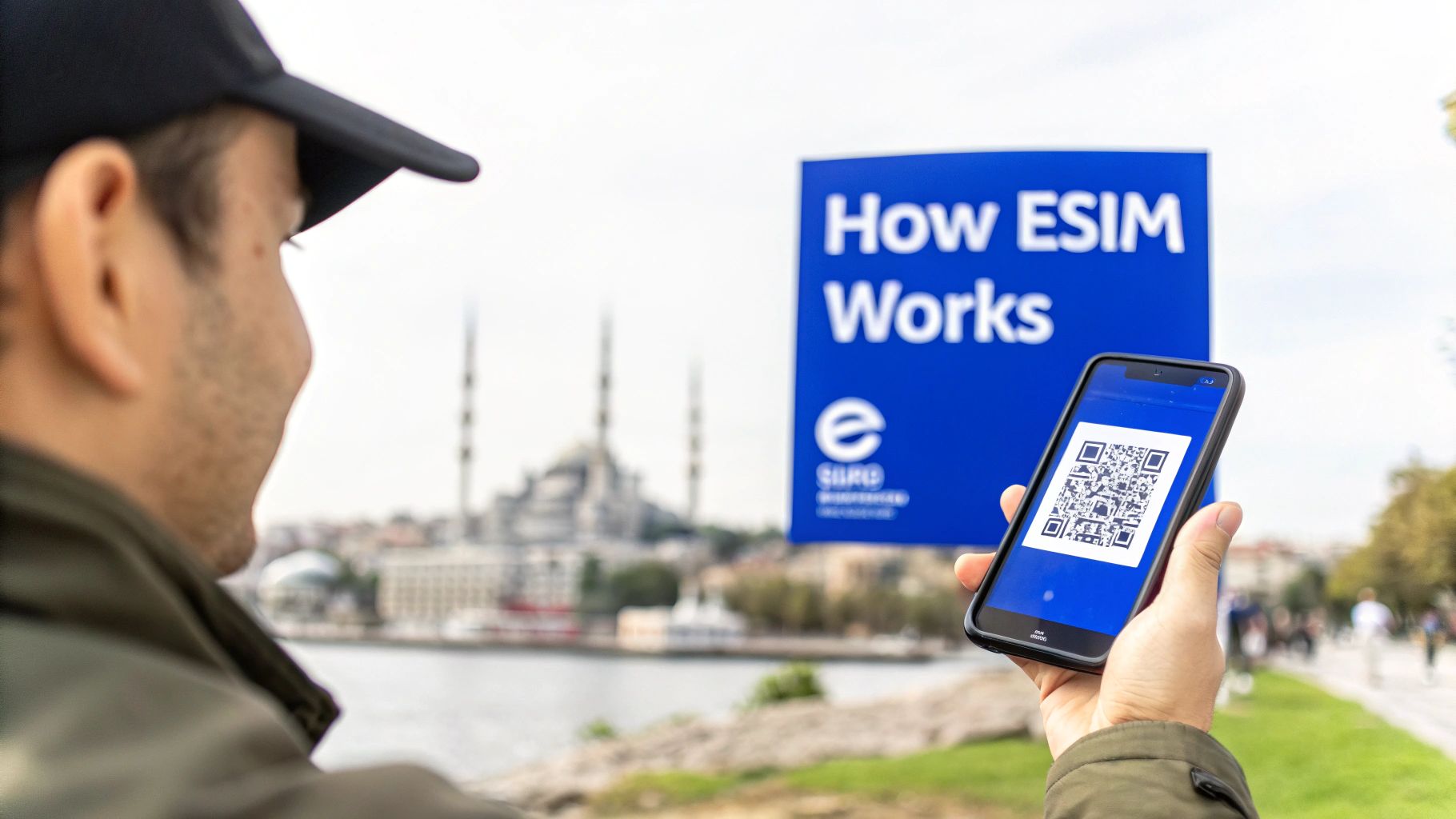
The real beauty of an eSIM is how it streamlines your travel prep. You can buy and install your plan from your sofa, using your home Wi-Fi, days before you even think about packing.
Here’s how that journey looks in practice:
This completely sidesteps the hassle of hunting for a SIM card shop at the airport, fumbling with foreign currency, or navigating language barriers. It’s a smooth, stress-free switch from your home network to a local Turkish one.
When you activate your eSIM in Turkey, it connects to major local carriers. This is key—it means you get the same quality of service as someone who lives there.
For instance, your eSIM will likely connect to Turkcell, which has extensive coverage across the country, reaching even remote areas. This ensures you have a solid connection not just while exploring Istanbul, but also when you’re relaxing on the Antalya coast or marveling at the landscapes of Cappadocia.
eSIM technology acts like a bridge. It connects your phone directly to a high-quality local network, but you manage it all through a simple, English-language app or website. You get local speeds without the local fuss.
A common question is what happens to your normal SIM card from back home. The simple answer is: nothing! It stays right where it is. Most modern smartphones are Dual SIM devices, meaning they can run a physical SIM and one or more eSIMs at the same time.
This feature is a game-changer for travelers. You can set your phone to use the Turkish eSIM for all mobile data, which is where expensive roaming charges usually come from. At the same time, your home SIM can remain active for receiving important calls and texts (like verification codes from your bank) on your regular number. You get the best of both worlds: affordable local data and the peace of mind of staying connected on your primary line.
Before you can enjoy the ease of using an eSIM in Turkey, there’s one quick but vital step: making sure your phone is compatible. The good news is that most newer smartphones come with this technology built-in, but it’s always smart to double-check.
This check involves two simple things. First, confirming your phone model supports eSIMs. Second, and just as important, ensuring your device is ‘unlocked’ from your home network so it’s free to connect to a Turkish provider.
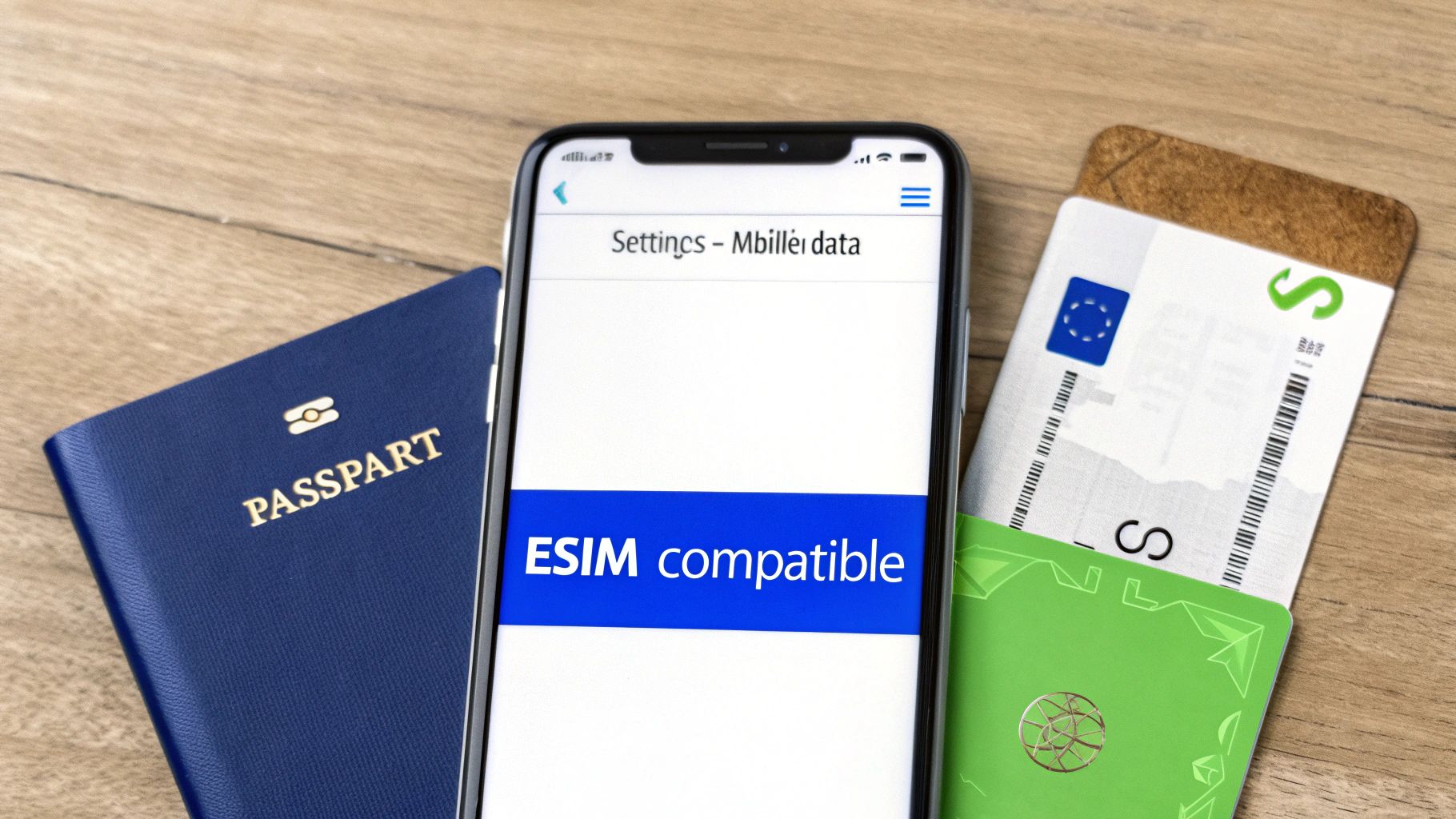
Figuring out if your phone has an embedded SIM only takes a moment. The exact steps can vary slightly between iPhones and Androids, but both are straightforward.
For iPhone Users:
For Android Users:
The path for Android can differ slightly depending on the manufacturer (like Samsung or Google), but the goal is the same.
Another handy trick for most phones is to dial *#06#. If you see an ‘EID’ (Embedded Identity Document) number on your screen, your phone definitely supports eSIMs. For a more detailed guide, learn how to determine if your phone supports eSIM technology.
The second piece of the puzzle is making sure your phone is carrier-unlocked. A ‘locked’ phone is tied to the mobile company you bought it from and will reject SIMs from any other network, meaning your Turkish eSIM wouldn’t work.
Most phones bought directly from the manufacturer (like Apple or Samsung) come unlocked. However, phones purchased on a contract from a mobile provider are often locked.
An unlocked phone gives you the freedom to connect to any network in the world. It’s a must-have for international travel, allowing you to use affordable local options like a travel eSIM instead of being forced into expensive roaming plans.
The surest way to find out if your phone is unlocked is to contact your home mobile provider. Give their customer service a quick call and ask them to confirm your phone’s status. If it is locked, you can ask them to unlock it—they are often required to do so once your contract is paid off.
Don’t worry, eSIM technology is becoming more mainstream every year. The number of phone models that work with eSIMs is growing, making it easier than ever for travelers to enjoy seamless connectivity abroad.
Getting your mobile data sorted for Turkey is easier than you might think. Say goodbye to long queues for physical SIM cards at the airport and fiddly registration forms. With an eSIM, everything is handled online, getting you connected in just a few minutes.
The whole process has three straightforward stages, designed to get you up and running the moment you land.
Let’s walk through each step to see just how simple it is to get online for your trip.
First, think about how much data you’ll need. Consider your travel habits. Are you a light browser who just needs Google Maps and WhatsApp, or will you be streaming videos and making video calls back home?
Picking the right plan means you won’t overpay for data you don’t use or run out when you need it most. For a week-long city break, a smaller 5GB plan is usually plenty for navigation, looking up restaurants, and posting photos. If you’re staying longer or working on the go, a 20GB package offers more freedom.
With a provider like TapSim, you can easily compare the options and find a plan that fits your trip. The pricing is transparent, so there are no surprises.
This is the golden rule for a stress-free arrival. Always install your eSIM while you’re still at home with a reliable internet connection. This doesn’t start the clock on your plan’s validity; it simply loads the eSIM profile onto your phone.
Here’s the quick rundown:
That’s it! The eSIM is now installed and will sit quietly on your phone until you need it. A little prep saves you from having to hunt for unreliable airport Wi-Fi. If you need a more detailed walkthrough, check out our guide on how to activate an eSIM on your iPhone.
Pro Tip: Make sure your new eSIM line is switched off in your phone’s settings until you land in Turkey. Your plan’s validity period only begins once it connects to a Turkish network for the first time.
This is the easiest part. Once the plane has landed and you’ve turned off flight mode, it’s time to activate your eSIM.
Just go back into your phone’s mobile data settings and do two things:
Within moments, your phone should connect to a local provider, and you’ll see the 4G or 5G symbol light up. Just like that, you’re online. You can now order a taxi, let your family know you’ve arrived, or pull up your hotel booking without a second thought.
Figuring out how much data you’ll need for your trip to Turkey doesn’t have to be a guessing game. The trick is to think about your travel style so you don’t end up paying for data you won’t use or running out halfway through your trip.
So, what does 1GB of data actually get you? It’s probably more than you think. A single gigabyte is enough to navigate with maps for hours, send thousands of WhatsApp messages, or scroll through social media for several hours. Knowing this makes picking the right plan much easier.
We all use our phones differently on holiday. A quick city break in Istanbul won’t have the same data needs as a month-long trek. Here’s a breakdown of common traveler types to help you find your sweet spot.
Most travel eSIMs, including those from TapSim, are data-only. This is a huge advantage for travelers. It lets you use your eSIM for all your internet needs while keeping your regular phone number active for calls and SMS texts.
With a data-only plan, you can easily make calls and send messages using apps like WhatsApp, FaceTime, or Skype. This is almost always cheaper than paying for a plan with traditional call minutes that you might not use.
By using internet-based calling apps, you get the best of both worlds: affordable, high-speed data for everything you do online, plus the ability to stay in touch without paying extra for a local number.
The eSIM market in Turkey is growing quickly. It’s helpful to know that some travel eSIM providers offer plans for Turkey that use a non-Turkish number (like a +44 UK number) instead of a local Turkish (+90) one. For most travelers who just need data, this makes no difference at all, but it’s good to be aware of.
In the end, choosing the right plan comes down to knowing your own habits. If you think about how you’ll use your phone abroad, you can easily find a practical and affordable eSIM for Turkey that keeps you connected without any fuss.
Even when you think you have it all figured out, a few questions often come up before a trip. To put your mind at ease, we’ve pulled together the most common queries from travelers heading to Turkey, along with clear answers.
Absolutely. This is one of the best things about using an eSIM. Your phone is likely a ‘Dual SIM’ device, meaning you can have your physical home SIM and your new travel eSIM active at the same time.
Your Turkish eSIM handles all your data needs, so you avoid expensive roaming fees. Meanwhile, your regular number stays active for important calls or texts, like two-factor authentication codes from your bank. You get affordable local data without worrying about missing something important from home.
It’s a common travel fear: you’re out exploring, you lose your connection, and realize you’ve used all your data. With an eSIM, this is a minor inconvenience at worst.
Most eSIM providers, including TapSim, let you top up directly from their app or website. You just need a moment of Wi-Fi—in a café or your hotel—to log in, pick a new data bundle, and you’re back online in minutes. You can add more data whether you’re in the Grand Bazaar or on a beach in Antalya.
The freedom to top up from anywhere is a game-changer. A small miscalculation doesn’t derail your day; you’re always just a few taps away from getting connected again.
Yes, in most cases, you can. Most travel eSIMs for Turkey support setting up a personal Wi-Fi hotspot, also known as tethering. It’s an incredibly useful feature for getting your laptop, tablet, or a friend’s phone online.
This is a lifesaver for anyone working on the go or for families trying to connect a few devices without buying a plan for every single person. It’s always smart to check the details of the specific plan you’re buying to make sure tethering is included, but with TapSim, it comes as a standard feature on most plans.
The golden rule is: install your eSIM before you leave home. The setup process requires a stable internet connection to download the eSIM profile to your phone, and your home Wi-Fi is far more reliable than a spotty airport network.
Once installed, the eSIM sits quietly on your phone. The clock on your data plan doesn’t start until it connects to a network in Turkey. This means you can get everything sorted days or even weeks before your flight. When you land, you just switch it on in your settings and you’re instantly connected.
Travel eSIMs connect to major local networks like Turkcell or Vodafone Turkey, which have excellent coverage across the country. In major cities like Istanbul, Ankara, and Izmir, and along popular coastal tourist spots, you’ll get a strong 4G/LTE or even 5G signal.
Like any mobile service, if you venture into very remote or mountainous areas, the signal can become less consistent. If you’re planning a trip far off the beaten path, it might be worth checking the local networks’ coverage maps. But for the vast majority of travelers, a good eSIM provides all the reliable coverage you’ll need.
For most visitors, an eSIM is far more convenient and often more affordable. Buying a physical SIM card when you arrive in Turkey can mean long queues at airport kiosks, dealing with a language barrier, and paying inflated ‘tourist prices’.
An eSIM lets you skip all that. You can buy it online, install it from your sofa, and activate it the second your plane touches down. While a local SIM card gives you a Turkish phone number, most travelers find that a data-only eSIM combined with apps like WhatsApp for calls is a much more practical and budget-friendly solution.
Ready to see how easy connectivity can be on your Turkish adventure? TapSim offers fair, fast, and honest data plans to keep you online without the fuss.