Best eSIM for Europe Trip: What to Pick
Looking for the best esim for europe trip plans? Compare coverage, speed caps, hotspot rules, and pricing to avoid roaming fees and surprises.

A delayed flight is annoying. Landing in another country with no data is expensive.
That is why esim for business travel has moved from a nice extra to a real work tool. If your team needs maps, messaging, ride apps, email, hotspot access, and backup connectivity the second they land, waiting in line for a local SIM or gambling on carrier roaming is not a smart plan. Business travel runs on timing, and connectivity problems cost more than the data itself.
The appeal is simple. You buy a plan online, install it before departure, and activate it when you arrive. No store visit, no swapping tiny plastic cards, and no surprise bill waiting at the end of the month. But not every eSIM offer is equal, and this is where a lot of travelers get burned.
Business trips are different from vacations. You usually have tighter schedules, less patience for setup problems, and less room for mistakes. If you are flying in for client meetings, trade shows, site visits, or a week of remote work from a hotel, internet access is part of the trip, not a bonus feature.
An eSIM solves a few problems at once. First, it gives you data access as soon as you arrive, which matters when you need to call a car, find your hotel, or message a colleague. Second, it lets you keep your main SIM in place, which is useful if you still want to receive texts or use your regular number through Wi-Fi calling or app-based communication. Third, it removes the usual roaming trap where one careless day of tethering or video calls turns into a painful carrier charge.
There is also a practical IT angle. For solo travelers, self-service setup saves time. For small teams, prepaid plans are easier to budget than open-ended roaming. For frequent travelers, using eSIM across trips creates a more repeatable system. Less friction. More control.
Convenience gets most of the attention, but the bigger win is predictability. That matters more for business travel than people think.
When a provider clearly states the data allowance, speed cap, fair-use policy, and whether hotspot is allowed, you can choose a plan based on how you actually work. A sales rep who mostly uses email and maps does not need the same setup as a consultant running video calls from a hotel. A founder bouncing between countries may want flexible top-ups. A team member attending a conference may burn through data faster than expected because venue Wi-Fi is overloaded.
This is also why “unlimited” claims deserve skepticism. In travel connectivity, unlimited often means throttled after a small amount of high-speed usage, restricted tethering, or vague fair-use terms that only show up when performance drops. For business use, vague limits are a problem. You do not need marketing language. You need to know what happens after 5GB, 10GB, or 20GB.
Good travel data is honest about trade-offs. If a plan has a speed limit, say so. If hotspot works, make that clear. If top-ups are available, explain how they work. That level of detail makes the purchase feel less risky because it is less risky.
Start with the basics: destination, trip length, and work style. A three-day trip to London with hotel Wi-Fi is one thing. Two weeks across Germany, France, and Italy with train transfers, client meetings, and hotspot usage is something else.
Think in terms of actual usage rather than guessing. Light users usually need messaging apps, navigation, email, calendar access, and occasional browsing. Moderate users add cloud files, frequent app usage, and some hotspot time. Heavy users include video calls, large uploads, repeated tethering, and poor Wi-Fi backup throughout the day.
Then check the details that travelers often skip. Is the plan data-only? For most business travelers, that is fine because communication happens through WhatsApp, Teams, Slack, Zoom, Google Meet, and email. But if you expect a local phone number, that is a different product. Does the plan support hotspot? If you work from a laptop or need backup for another device, that feature matters. Is the activation process immediate, and can you install before departure? That is a big difference between a smooth arrival and scrambling for Wi-Fi at the airport.
Compatibility matters too. Not every phone supports eSIM, and not every unlocked phone supports every network setup equally well. A quick device check before purchase saves frustration later.
The most common mistake is buying based on the biggest number or the cheapest headline price. Cheap data is not cheap if activation is confusing, support is slow, or the fair-use policy is buried in fine print.
The second mistake is assuming home carrier roaming is simpler. Sometimes it is simpler. It is rarely cheaper, and it is not always clearer. Roaming plans can work for short trips, especially if your company already has negotiated carrier terms. But for many travelers, they come with soft limits, day-pass charges, or billing surprises that only show up after the trip.
The third mistake is waiting until arrival. That might work in a major airport with easy Wi-Fi and plenty of time. It is a bad habit for tight schedules. Installing before departure gives you time to confirm settings, understand activation, and keep your first hour on the ground focused on travel, not troubleshooting.
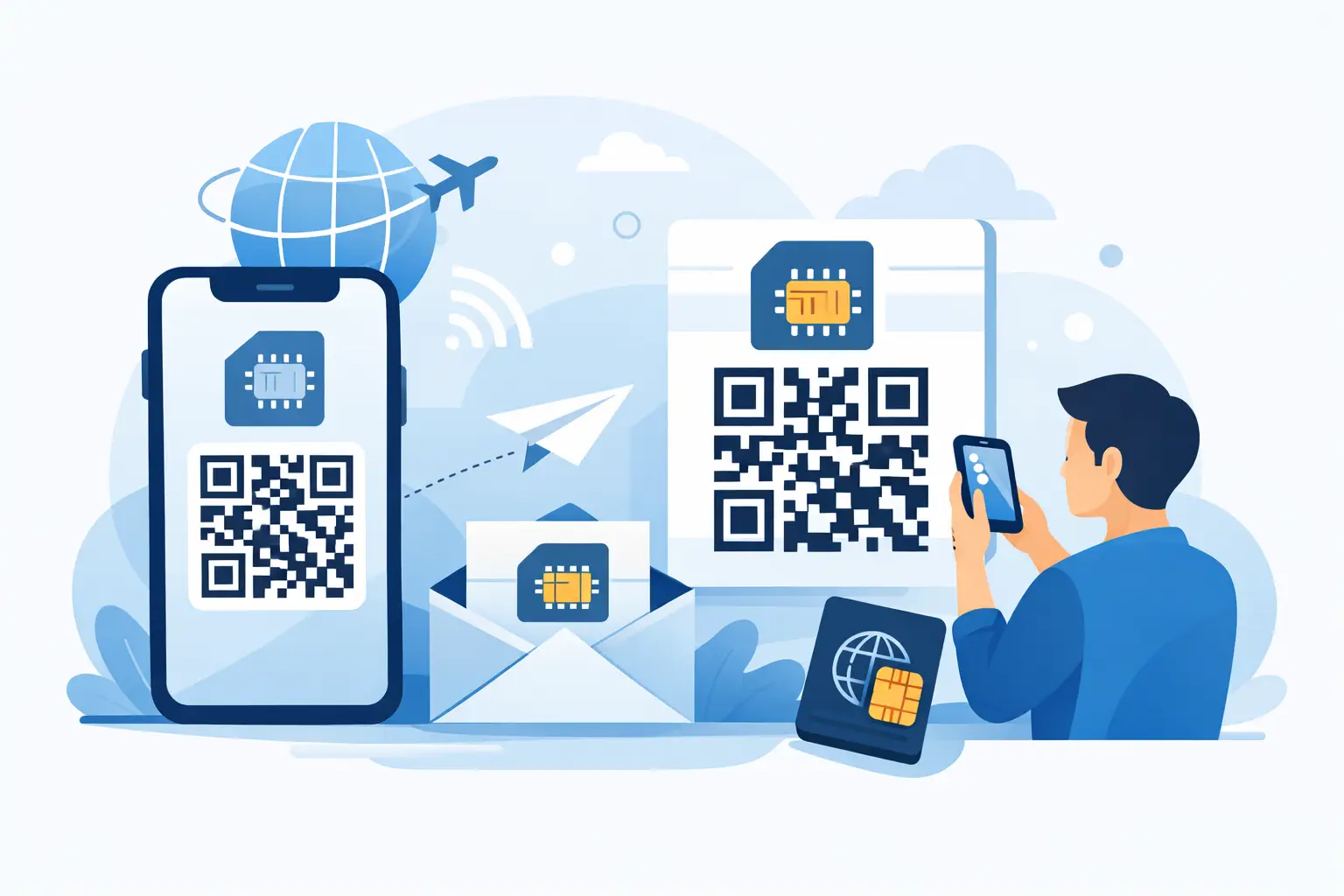
The best eSIM experience feels boring, and that is a compliment. You buy online, receive the QR code right away, install the eSIM in a few minutes, and leave it ready for arrival. Once you land, you switch the line on, enable data roaming for that eSIM if required by the provider, and connect.
That kind of setup is especially useful for travelers moving between meetings. You do not want to explain to a client that you are late because you were trying to decode a local prepaid SIM menu in an airport shop.
For teams, there is another advantage. Repeatable setup means fewer support headaches. If your company sends people abroad regularly, a clear eSIM process is easier to hand off than a vague instruction like “just use your carrier and expense it later.”
There is no perfect option for every trip. It depends on cost, duration, destination, and how much setup friction you can tolerate.
A local SIM can be a good value for long stays, especially if you need local calling or very large data allowances. The trade-off is time and effort. You may need to find a store, show ID, deal with local activation rules, and swap out your regular SIM.
Carrier roaming is the easiest default because it usually requires little setup. The trade-off is cost and clarity. It is fine for some short trips, but not ideal when you want tight control over spend.
An eSIM sits in the middle in the best way. It keeps the digital convenience of roaming without the open-ended billing, and it avoids the in-person hassle of local SIM purchases. For most business travelers, that balance is the point.
Providers that focus on transparency tend to stand out here. TapSim, for example, leans into published limits, straightforward top-ups, hotspot access, and no fake unlimited claims. That is the kind of approach business travelers usually appreciate because it respects time and budget.
Before choosing a plan, ask a few boring questions. Boring questions save money.
How much high-speed data is included? What happens when you hit the limit? Is hotspot allowed? Is the plan country-specific or regional? When does validity start – at purchase, at installation, or at first connection? If activation fails, what kind of support or refund policy exists?
Those details matter more than marketing language. If the answers are hard to find, that tells you something too.
Business travelers do not need perfect connectivity. They need reliable connectivity with clear rules.
That is what makes eSIM such a strong fit. It is fast to set up, easier to budget, and far less annoying than buying connectivity the old way. More importantly, it gives you a chance to choose data on purpose instead of paying for confusion.
Before your next trip, set up your data plan the same way you set up your flight and hotel – ahead of time, with the details checked. A few minutes before departure can save a lot of stress after landing.